AudaTours logoAudaTours

特里尔语音导览:追随马克思、神话与永恒之城的足迹

语音指南15 景点

你知道吗,特里尔的鹅卵石下隐藏着罗马帝国的回响和古老革命的神秘痕迹?在奥古斯塔·特雷维罗鲁姆宏伟的城墙后,潜藏着一个充满伟大胜利和悄然衰落的世界。 这个自助语音导览邀请您探索这座城市,在这里,每一次转角都可能揭示一段不为人知的历史。以导游手册未曾展示的方式了解特里尔。 为什么被盗的圣物盒在西蒙街的阴影下引发了混乱?特里尔西蒙修道院市博物馆的档案中隐藏着什么,它们在夜幕降临后在厚重的墙壁下沉寂?在皇帝时代某个神秘的夜晚,谁在鹅卵石街道上留下了足迹? 让这座充满传奇的城市引领您。每一步,您都将发现其历史的更多层面以及编码在欧洲心脏的秘密。 开始您的旅程。探索特里尔,一个历史永不沉睡的地方。

导览预览

map

关于此导览

  • schedule
    持续时间 40–60 mins按照自己的节奏
  • straighten
    2.0 公里步行路线跟随引导路径
  • location_on
  • wifi_off
    离线工作一次下载,随处使用
  • all_inclusive
    终身访问随时重播,永久有效
  • location_on
    从 特里尔储蓄银行 开始

此导览的景点

  1. You'll recognize the Sparkasse Trier building by its modern, angular facade of light gray panels and the large red flags with the distinctive 'S' logo hanging above the…阅读更多收起

    You'll recognize the Sparkasse Trier building by its modern, angular facade of light gray panels and the large red flags with the distinctive 'S' logo hanging above the street-level entrance. You are standing in front of the main headquarters of Sparkasse Trier - an institution that, while primarily associated with everyday banking matters today, carries a history stretching back to the early 19th century. Imagine how for over a hundred years, three different banks - Stadtsparkasse, Kreissparkasse Trier, and Kreissparkasse Saarburg - competed and coexisted here, managing the savings of both local merchants and ordinary residents. The first municipal savings bank was established here as early as 1825, and in 1856 and 1893, further institutions began serving the surrounding municipalities and districts. One could easily picture a crowd of small artisans, trembling with uncertainty, bringing their first savings and expecting this financial house to protect their assets in those challenging times for Europe. It wasn't until 1995 that the current Sparkasse Trier was born from the merger of these three histories - and despite its technocratic facade, the smell of new concrete, and the sound of computer printers, this place is vibrant: it serves 54 branches and nearly 750 employees. Its influence extends across the entire Trier-Saarburg region, with collaborations with local companies ranging from insurance to investments and leasing. Even if peace reigns around it today, within this institution, a quiet battle for the trust and security of Trier's residents has always been waged - because here, the small details of daily life and dreams for the future were, and still are, entrusted.

    打开独立页面 →
  2. Before you stands a pink townhouse with three distinctive dormer windows on a dark gray roof; to recognize it, look just above the 'EuroShop' - there's a commemorative plaque on…阅读更多收起

    Before you stands a pink townhouse with three distinctive dormer windows on a dark gray roof; to recognize it, look just above the 'EuroShop' - there's a commemorative plaque on the facade. Pause for a moment and imagine the thick air of a 19th-century city. Along this cobblestone Simeonstraße, young Karl Marx walked daily to school, passing shopkeepers, carriages, and crowds of residents. The sounds of conversations and wooden wheels clattering on stone filled the air above this street. It was in front of this house, at number eight, that Karl's life gained long-term family stability - his father, Heinrich Marx, bought a small house here in 1819, which was a significant event for the family. This unassuming place witnessed many personal moments and dramas. Here, Karl lived with his six siblings - Sophia, Hermann, Henriette, Louise, Emilie, and Caroline - and here, in 1824, the entire family was baptized, which caused quite a stir at the time. The laughter of children and the daily hustle of the home could be heard. But fate was not always kind - it was within these walls that his younger brother Eduard died, and a shadow of grief settled on his mother, Henriette's, face. Karl Marx lived here until his graduation in 1835, and the path from school, leading through the commercial street, looks almost the same today as it did then. Interestingly, until the age of twelve, he was educated at home by tutors and his father - imagine young Karl, engrossed in reading, amidst the scent of old books and ink. In later years, as a student and budding publicist, he returned here for longer periods. After defending his doctorate in Berlin, he came back to his family home, visited his fiancée Jenny von Westphalen, engaged in philosophical discussions, and wrote his first articles, often critical of the contemporary authorities. A little later, when he was actively working for the opposition 'Rheinischen Zeitung,' the house once again became a refuge for him. He wrote feverishly here at night, and echoes of the city's hustle and bustle drifted through the open window. The last of the Marx family, Henriette, was still registered at this address around 1850, after which the house passed into other hands. Today, this townhouse stands at the beginning of a lively pedestrian zone, next to cafes and shops, and right nearby you'll find a monumental sculpture of Karl Marx - a gift from the People's Republic of China, symbolizing the global fame of the boy from the house at Simeonstraße 8.

    打开独立页面 →
  3. Before you stretches a wide cobblestone street lined with compact townhouses featuring pastel facades - to spot it, look along the thoroughfare where Sparkasse bank is on the…阅读更多收起

    Before you stretches a wide cobblestone street lined with compact townhouses featuring pastel facades - to spot it, look along the thoroughfare where Sparkasse bank is on the right, and shop windows and numerous cafe gardens are on the left. You are now standing on one of the busiest shopping streets in all of Germany - Simeonstraße. Throughout the day, crowds of people rush by, some hurrying to shop, others sitting at cafe tables. Today it's a pedestrian zone, but as recently as the 1970s, buses traversed the street, and cars and bicycles pushed through scattered groups of pedestrians. Since 1971, Simeonstraße has been officially closed to vehicular traffic. This is where Trier's commercial heart beats - it's home to numerous shops, a bookstore, two large shopping malls, as well as cafes, restaurants, souvenir shops, and designer boutiques. As the air vibrates with conversations and the sound of footsteps, it's easy to miss the extraordinary history of this street. Its patron is Simeon of Trier - a hermit saint who moved into Porta Nigra and transformed it into a place of solitude. For this reason, the mighty gate has survived to this day, instead of meeting the fate of other city fortifications. In the Middle Ages, a Jewish ghetto operated in the western part of this road, between Simeon-, Jakob-, and Stockstraße. Remnants of that world are still visible near the preserved Judenpforte, and also on Judengasse. At Simeonstraße 41A, an old synagogue was located, but after the expulsion of the Jewish community in 1418, its building fell to other residents. Today, two city plaques commemorate this difficult history. Past and present overlap here like colorful layers of paint. The monumental Haus Zum Christophel catches the eye - a Neo-Gothic residence from the late 19th century; its facade facing Porta-Nigra-Platz is full of arcades and turrets, while the one facing Simeonstraße appears more modest and asymmetrical. On the windows of the Bel-Etage, stone figures are visible: a farmer, a worker, and a burgher, symbolizing the three estates of 19th-century society. A step further stands an oversized sculpture of St. Christopher with the Child. A little further on is Karl Marx's former residence - at number 8, with a Baroque mansard roof. It was here, a year after the philosopher's birth, that his family moved from the house on Brückenstraße. Meanwhile, at number 59, you'll find the former hospital and chapel of St. Nicholas; today, this originally preserved monument houses a gastronomic establishment. Opposite, on the site of a former Sparkasse branch, daily urban scenes unfolded for decades - from the entrance of the bank's main headquarters, through the activities of municipal offices, to the latest chapter: in spring 2024, a new owner opened a sports store here. Take a moment to rest and look around - you'll also see fragments of Baroque palace facades that have been preserved from former buildings and are now integrated into the modern structures of galleries and department stores. The sounds of old wine cellars also weave into the colorful history of this street, particularly noticeable beneath the now-defunct Karstadt building, where the cellars have been converted into a restaurant. Although Simeonstraße looks modern today, every building, every window, and every cobblestone hides traces of former residents, owners, merchants, and refugees. It is here, in the very heart of the old city, that Trier's history gained a contemporary pulse, yet never forgot its roots.

    打开独立页面 →
再显示 12 个站点显示更少站点expand_moreexpand_less
  1. Before you, you'll see a white townhouse with distinct, colorful arches above the windows and a triangular gable - look slightly to the left, where the facade stands out with…阅读更多收起

    Before you, you'll see a white townhouse with distinct, colorful arches above the windows and a triangular gable - look slightly to the left, where the facade stands out with colorful lines from the neighboring buildings. Imagine standing here on the cobblestone Simeonstraße, with a powerful, slightly mysterious tower rising before you, concealing the history of many eras. Dreikönigenhaus - or the House of the Three Kings - began construction around 1200, when the sound of tools echoed all around. The early Gothic character of this building brings to mind not so much a harsh fortress, but rather a luxurious residence for a wealthy patrician family who wished to emphasize their prestige in the growing city of Trier. Initially, it wasn't called Dreikönigenhaus at all - formerly, this house was known as 'Zum Säulchen,' a reference to the column crowning the building's gable and the marble pillars in the windows. It wasn't until around 1680, when the inn 'Zu den drei Königen' operated within these walls, that the name was changed to the one known today. It stands here, clearly distinguished by its white and red facade among neighboring houses, and its numerous windows with ornate arches look like eyes watching over city life for centuries. The oldest part of the house, with its high windows and massive walls, once protected the family from the dangers of the medieval city - the entrance was high up, and access was only possible via wooden stairs, which could be quickly moved or replaced with a ladder during a threat. The house was originally divided into two separate buildings: front and back, connected much later by stairs. The decorative windows on the second floor, fashionable at the time, with their characteristic pointed arches, are also impressive. It's interesting to note that only 13 such medieval residential towers have been preserved in Trier; however, Dreikönigenhaus was always a residence for the wealthy and influential. It was rebuilt several times: the tower was renovated in 1466, a new roof appeared in 1696, and in the 20th century, a thorough reconstruction was carried out, striving to restore its medieval appearance as faithfully as possible. Today, this tower is not only an important monument but also a witness to the past ambitions of Trier's residents, for whom safety, prestige, and representation were as important as the comfort of daily life. Stand here for a moment and feel this unique atmosphere, as if generations of former inhabitants are looking out at you from behind the windows.

    打开独立页面 →
  2. You are standing right on Plac Porta Nigra, one of Trier's key communication hubs, in the shadow of the famous ancient gate. Imagine the hustle and bustle of bygone eras, when,…阅读更多收起

    You are standing right on Plac Porta Nigra, one of Trier's key communication hubs, in the shadow of the famous ancient gate. Imagine the hustle and bustle of bygone eras, when, already in Roman times, this area, especially today's Simeonstraße, was vibrant as a bustling market. Today, this spot connects five streets: Nordallee, Theodor-Heuss-Allee, Christophstraße, Simeonstraße, and Paulinstraße. However, the square itself does not include the space directly in front of or behind Porta Nigra - these parts have been transformed into peaceful pedestrian zones and named Porta-Nigra-Vorplatz. Looking around, you can see on one side the historic facades of the Simeonstift museum and the 'Zum Christophel' house. On the other side stands a modern Mercure hotel complex. However, it wasn't always like this. As early as 1898, a majestic historicist-style hotel was erected there, known for its opulence and… running hot water in the bathrooms - quite a luxury in those years! Unfortunately, the building fell into disrepair and was demolished in the 1960s. A new structure was built in 1968 and today houses not only a hotel but also a casino - Spielbank Trier. From the beginning, the casino was surrounded by rumors and controversies, and even prosecutorial investigations, but nothing was ever proven. In the center of all this, there was formerly an underground pedestrian passage, later converted into a bicycle storage facility, and today it is closed and awaiting modernization. It's also worth knowing that during Nazi times, the square was named Adolf-Hitler-Platz, and Hitler himself was an honorary citizen of the city until this title was symbolically revoked due to his crimes. Plac Porta Nigra is more than just a point on the map - it is a witness to the city's turbulent history, changing landscapes, and the triumph and downfall of human ambitions.

    打开独立页面 →
  3. Before you is the entrance to the Stadtmuseum Simeonstift - you'll see the bright facade of the building with the modest inscription 'STADTMUSEUM SIMEONSTIFT' above an arched…阅读更多收起

    Before you is the entrance to the Stadtmuseum Simeonstift - you'll see the bright facade of the building with the modest inscription 'STADTMUSEUM SIMEONSTIFT' above an arched passage right next to the mighty, dark walls of Porta Nigra, and a large banner on the left. Imagine now that you are standing in the middle of a bustling square from many centuries ago. The former monastery, around which the museum was built, was once a refuge and workplace for monks. You can hear the muffled voices of passersby, the sound of footsteps on old cobblestones. Today's museum, however, is not only a witness to bygone times but also an oasis of history, art, and extraordinary stories. It has become a place where the daily lives of ordinary Trier residents and the grand history of the city intertwine. The most valuable treasures of Simeonstift are primarily gifts and collections donated by prominent residents of Trier. As you walk through the halls, paintings, sculptures, intricate handicrafts, and even Egyptian Coptic textiles, furniture, or miniature figurines from East Asia pass before your eyes. Each exhibit tells a different story, from the dramas of everyday life, through traces of grand celebrations, to influences from distant lands. The exhibition is divided into thematic rooms, and each one holds emotions from different eras. Here is the 'Trebetasaal' - a room dedicated to the city's legendary founder, Trebeta, son of the Assyrian king. On the wall, you can see a huge painting depicting his legendary journey and heroic deeds. Nearby is an original 10th-century market cross, figures of burghers, and sculptures from the St. Peter's fountain. In the next room - the 'Red Room' - visitors have the opportunity to view Trier through the eyes of its former inhabitants. A large model allows you to trace the city's appearance around 1800. The artist Johann Anton Ramboux captured majestic ancient buildings in his paintings, which have inspired admiration for centuries. In the 'Yellow Room,' artifacts related to the city's economy, tourism, sports, transport, and multicultural traditions await you. Here, you'll learn how Trier has changed over generations - from a flourishing wine trade center to a modern university hub. The second floor, in turn, is dedicated to the 'Donors' Cabinet.' Here, you can admire not only works of art but also fragments of fashionable attire and exotic gifts that the city's residents have bequeathed for future generations. Their generosity and passion have made the museum a place of unique character - the richness of its collections allows for a better understanding of not only the artistic but also the human dimension of Trier. Modern forms have not been forgotten either - in 'Kino-Trier,' a true cinematic journey awaits visitors: from a blurry, moving image of a car passing through Porta Nigra in 1904, through archival films and recordings documenting revolutionary events, to provocative artistic actions of the 1960s. Here, you can also encounter projections of images and photographs of over a hundred famous citizens of the city. The museum is vibrant not only with permanent exhibitions but also with numerous temporary displays - from stories about Karl Marx, through the colorful history of carnival, to the history of navigation and the fascinating world of local artistic craftsmanship. Each theme not only presents objects but allows you to feel the emotions, understand the transformations, and the dreams of the inhabitants of ancient and modern Trier. Thus, Simeonstift is not just an ordinary museum - it's a place where every room and every exhibit can change your way of looking at the city and its inhabitants. All in the shadow of Porta Nigra, at the crossroads of times, history, and human destinies.

    打开独立页面 →
  4. You are now standing face to face with an extraordinary monument that stirred strong emotions even before its creation - the Karl Marx Monument in Trier. Around you stretches…阅读更多收起

    You are now standing face to face with an extraordinary monument that stirred strong emotions even before its creation - the Karl Marx Monument in Trier. Around you stretches Simeonstift Square; people pass by, some pausing to gaze thoughtfully. You feel the weight of history's gaze, cast here in bronze. The statue was erected here on May 5, 2018, precisely on the 200th anniversary of Marx's birth, a son of this city. It weighs a hefty 2.3 tons and stands 5.5 meters tall, including its polygonal concrete pedestal clad with basalt slabs. This is no coincidence - 5.5 meters is a symbolic nod to May 5, 1818, the philosopher's birth date. The pedestal clearly features five distinct edges, each representing one of the five key cities in Marx's life: Trier, Berlin, Hamburg, Paris, and London. Each of these metropolises held particular significance for his ideas and work. Marx's figure itself is depicted in motion, with a book in his left hand. This is not merely an artistic detail - this gesture symbolizes humanity's continuous education and development. The philosopher's right hand reaches for the lapel of his long coat, and his gaze is fixed on the distance, as if his thoughts extend beyond the boundaries of his time, perhaps into the future he wished to shape. His hair and coat lend him gravity, emphasizing his wisdom, and his furrowed brow speaks of deep concerns. It's worth noting that the sculptor of this statue is the Chinese artist Wu Weishan, a member of the Communist Party of China. The statue itself is a gift from the People's Republic of China - not the first such gesture, as similar monuments have also been sent to other European cities. Wu Weishan chose a style that combines European realism with Chinese impressionism, translating Marx's spirit not only into a faithful physical image but also into a dedication to his thoughts. The very process of creating this monument was fraught with tension and controversy. Long debates ensued - was it appropriate to erect a gift from communist China, crafted by a state-supported artist, in a West German city? Some even called this gift a 'poisoned present.' Heated discussions took place in the city council until, finally, the majority decided to accept the gift. The costs of production and transport to Germany were covered by the Chinese, while the city only bore the expenses related to the foundation, paving, and lighting, which amounted to 39,000 euros out of a total of 92,500. The unveiling ceremony itself was filled with official speeches - attendees included the mayor, representatives of state authorities, the Chinese ambassador, and the sculptor. At the same time, protests, marches, and demonstrations swept through the city. There were also dramatic moments - a few days later, a fire broke out; someone set fire to a banner hung on the monument. The fire department acted swiftly, but the entire situation showed how deeply this monument divided society. The debate surrounding the Marx monument in Trier has not subsided; it cuts across modernity and the past, politics and art. For some, it is a symbol of progress, the struggle against capitalism and exploitation; for others - a painful reminder of repressions created in the name of those same ideas. Walking here now, you can almost feel the electrifying atmosphere from a few years ago and be aware that you are looking at more than just an ordinary statue - it is a continuously living element of a global historical and political debate. Curious about the description, cost, or donation as part of Chinese foreign policy? Don't hesitate to contact us in the chat section for additional information.

    打开独立页面 →
  5. Before you stretches a wide avenue, lined with rows of diverse residential townhouses, some with pastel facades and elegant decorations, while on the left side there are also…阅读更多收起

    Before you stretches a wide avenue, lined with rows of diverse residential townhouses, some with pastel facades and elegant decorations, while on the left side there are also modern and historic buildings - just look ahead along the busy street and at the neighboring houses to recognize this place. You are currently on Nordallee, Trier's northern avenue, an artery that, like a thick blue line, marks the northern boundary of the old city. Here, beneath your feet, runs a history dating back to times when a deep and dark city defensive moat ran through here, only to be eliminated in the second half of the 19th century. Now this place looks peaceful, though it still reminds us that for centuries, a different, louder life unfolded here. The avenue was laid out in 1777 as Nussbaumallee - Walnut Avenue. Back then, rows of trees were planted on both sides, under which former city residents strolled, feeling the soft shade of leaves beneath their feet and hearing birdsong. However, by 1857, the remnants of medieval fortifications with their moat had disappeared, and a new urban plan completely transformed the landscape of this part of Trier. The current street layout essentially dates from 1860, covered with green strips and modern buildings, precisely where city walls once guarded the city. Nordallee gradually gained its significance - it was the most important northern thoroughfare, connecting the former Schießgraben (a promenade on the city's outskirts) with the main railway station and the northern edges of the city walls. Even today, despite intense traffic, nearby fragments of the medieval wall can be found among modern buildings - small brick sections that silently watch over the present. It's easy to notice that many of the townhouses here are true testaments to late 19th and early 20th-century architecture: you'll see Neo-Renaissance style in some buildings, historicism and late-classical details on facades, and elements of reformed architecture visible in window shapes or cast-iron garden fences. On the southern edge of the street, the extensive complex of the Order of the Brothers of Mercy, known as Brüderkrankenhaus, dominates, operating continuously since 1887, and its original, Neo-Gothic chapel - remarkably preserved after heavy bombardments of World War II - reigns over the entire complex with its serene majesty. Walking along Nordallee, you also pass an impressive bus stop, designed to shelter from rain and heat, while also catching the eye with its form. Many routes stop here - for a moment, you can forget all haste and observe the city's rhythms: people move to the hospital, to work in offices, or visit loved ones. The mood of this place is diverse, because while the West has inscribed its Renaissance houses with characteristic gables and ornaments here, the east of the street long ago bid farewell to Baroque figures and eclectic stations - where Adolf-Hitler-Straße once ran, the old name and new times have returned. Surprisingly, in the very middle of Nordallee, everyday life intertwines with architectural curiosities - right next to the stop, at Nordallee 1, rises the complex of the Brothers of Mercy. Formerly, this place buzzed with the murmur of sisters' prayers and hospital sounds. After the war, mainly the Neo-Gothic chapel survived, and new hospital wings only grew here in the 1960s and 70s. Today, it is also the site of a modern helipad for rescue helicopters. The intersection of streets you are passing through is also part of the transformations that show how the very character of the city has changed. Even the street name signs reveal Trier's fluctuating fortunes - once, a part of Nordallee was renamed in honor of successive presidents, only to return to its old order after the war. With so many layers of history before you, it's easy to understand why this place is considered part of the protected conservation zone, Grüngürtel. Every now and then, you can encounter further traces of the old city: from the Baroque figures of Ferdinand Tietz near the Mosel, to the townhouses that residents speak of with pride. Nordallee is a street where history changes with almost every step, and beneath the surface of daily traffic, stories of change, oblivion, and the hope of the city of Trier are hidden.

    打开独立页面 →
  6. Before you stands a bright, massive townhouse with a distinctive, ornate gable above a large entrance gate and a series of tall windows with gray frames - this is Mergener Hof on…阅读更多收起

    Before you stands a bright, massive townhouse with a distinctive, ornate gable above a large entrance gate and a series of tall windows with gray frames - this is Mergener Hof on Rindertanzstraße. Mergener Hof is a place that has witnessed extraordinary stories for centuries. The first mention of this building dates back to 1283, but its current form comes from the early 17th century. Imagine the hustle and bustle of a medieval city; in 1454, monks used this building, specifically as an asylum behind the walls of St. Marien monastery - hence the name 'Mergener' derived from 'Marien.' When Napoleon's era arrived, the entire property passed into private hands - completely changing its character. In the 17th century, the Jesuits began their work here, caring for young people, focusing not only on their spiritual but also their craft development. It was often loud with laughter, but also with challenges - for decades, successive prohibitions and difficulties could not break the community here. When the Jesuits transformed the Hof into a youth home in the 1930s, it was quickly confiscated during the Nazi era. After the war, it slowly regained its function, eventually becoming an open place - not only for young boys, as before, but now also for girls. Today, at Mergener Hof, you can feel an atmosphere of engagement - sports, youth support, education, and cultural events blend here with the ironic continuity of nearly eight centuries. It's a place where tradition meets everyday life, and young people, as they have for decades, continue to learn courage, cooperation, and responsibility for the world around them.

    打开独立页面 →
  7. Before you, you see a monumental stone gate with massive, two-story towers featuring numerous arches and windows - this is Porta Nigra, the characteristic entrance to the former…阅读更多收起

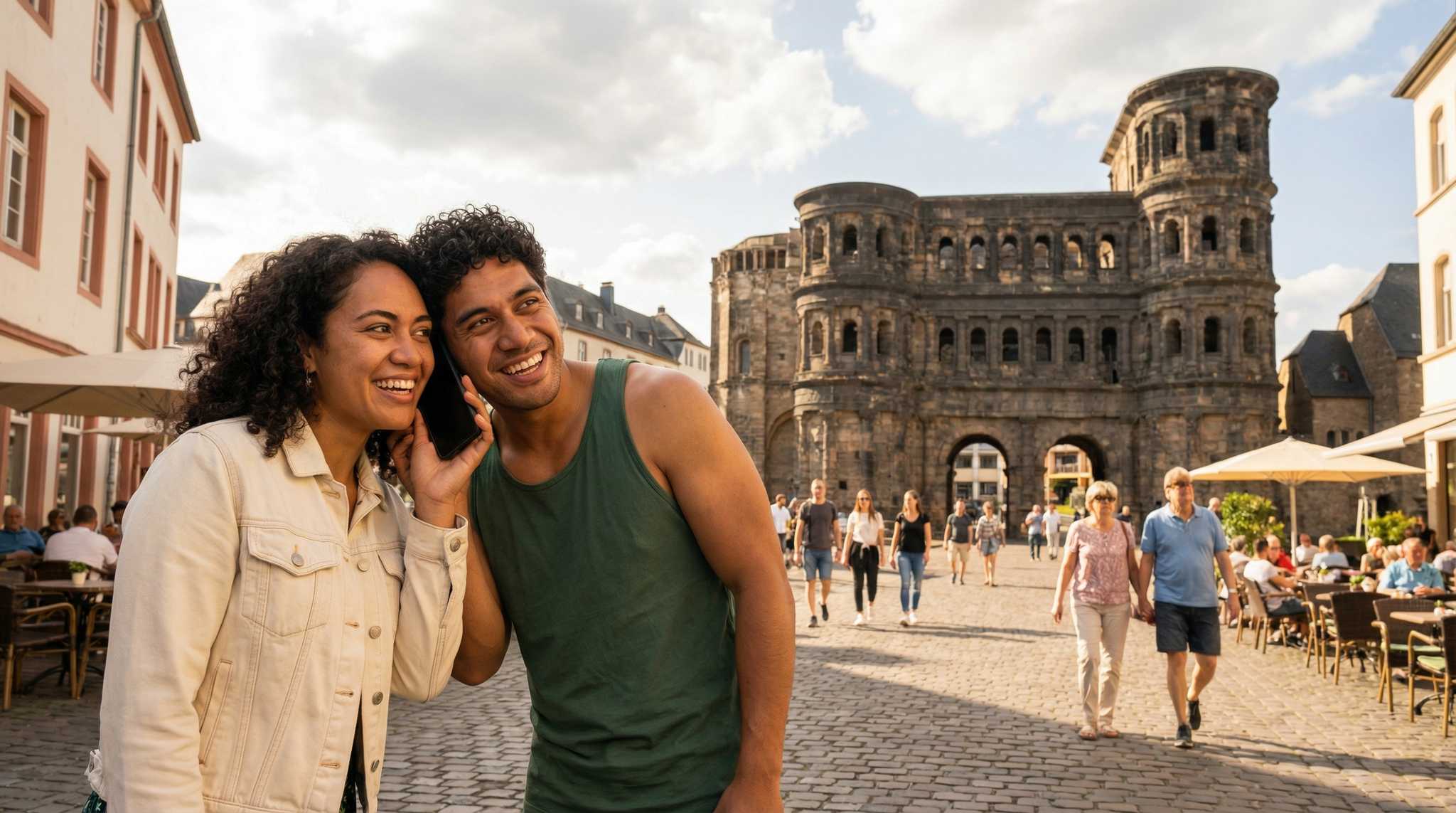
    Before you, you see a monumental stone gate with massive, two-story towers featuring numerous arches and windows - this is Porta Nigra, the characteristic entrance to the former Augusta Treverorum; just look at the dark gray stone amidst modern streets to recognize this symbol of ancient Rome. Imagine that we are now in a place that for over two thousand years has witnessed immense changes, triumphs, and tragedies. The ancient Augusta Treverorum, meaning 'Augustus' city in the land of the Treveri,' was founded here on the Mosel between 18 and 17 BC. It was here that the first Roman legions passed through the valley, building bridges, roads, and encampments, before a great city erupted - in a place where previously there was simply a modest river crossing. The new city quickly gained momentum under Emperor Augustus, and during the empire, it became a vibrant center of the province of Gallia Belgica. Roman administration, officials, and merchants built monumental baths, a forum, an amphitheater, and structures like Porta Nigra here, and the colony of Trier numbered tens of thousands of inhabitants. Porta Nigra itself, which stands before you today, was one of many elements in a system of city walls that stretched for over 6 kilometers - and more than just a defensive point. For residents, it was a gateway to the 'world': legionaries with fresh battle scars, patricians in purple tunics, startled horses, and merchants pushing carts full of wine passed through it. At its peak, around 300 AD, Augusta Treverorum was the largest city in northern Europe - more people lived here then than the amphitheaters of the time could hold. It was then, when great rulers like Constantine the Great reigned in imperial palaces, that powerful palaces and basilicas were built here, and a crowd of courtiers, merchants, and artisans flocked from across the empire. The city's wealth was based on ceramic products, glass production, textiles, and wine trade transported along the Mosel. Even when an age of unrest arrived - civil wars, invasions by Franks and Germans - Trier still lived on, successive generations of inhabitants hid within its walls, and the Great Gate still stood guard. After the fall of the empire, Augusta Treverorum slowly lost its former glory. Poorer inhabitants settled in the abandoned baths and palaces, and the remnants of Roman power were taken over by Frankish rulers and bishops. Today, the stone arches you see are a remnant of an era that shaped the city and almost all of Europe. Passing under these arches, you tread where thousands of years ago, armies, captives, dignitaries, and children awaiting their fathers' return from distant provinces of the Empire once walked. All of this happened here, under this very sky, within the walls of modern-day Trier.

    打开独立页面 →
  8. Before you, you'll see a bright, elongated church building with a distinctive Baroque turret on a steep roof - look along Flanderstraße, on the left side of the street, to easily…阅读更多收起

    Before you, you'll see a bright, elongated church building with a distinctive Baroque turret on a steep roof - look along Flanderstraße, on the left side of the street, to easily spot the facade and the characteristic spire with its lantern. Imagine how in 1714, when it was still quieter and less urban bustle around, the Augustinian sisters, known as 'Welschnonnen,' gathered here to lay the cornerstone for a new church. The reason for this construction was clear: a new place of worship and an educational center for girls, which had long been the mission of the nuns who came to Trier. The church, though unassuming from the outside, was intended from the beginning to be a refuge - both spiritual and practical. The church, dedicated to the Assumption of the Blessed Virgin Mary, became one of the few preserved examples of High Baroque in Trier. When you step inside - though today we remain outside its walls - you can imagine the richly decorated interior: a high cross vault supported by narrow pillars and a colorful gallery almost reaching the middle of the nave. This gallery, once a space for singing nuns, now bears one of Welschnonnenkirche's greatest treasures - the oldest preserved and still functioning Stummorgan in Trier, dating from 1757. This historic organ, faithfully restored to its original design, allows you to experience the atmosphere of past services today. Imagine its sound, echoing off the wooden choirs and gently spreading throughout the interior. In the shadow of this history lies a touch of unease: the nuns who ran the school and monastery here even survived Napoleon's reforms, when other congregations were dissolved. The Prussians, however, were not so lenient - in 1874, during the Kulturkampf, the sisters had to leave the city and go to Belgium. The church remained but came under the care of the Marian Association. After the sisters' departure, the monastery buildings were designated for the needs of a newly established gymnasium, which exists to this day. As you stand here, before the facade with its high window and Baroque portal, consider the roles this church has played over the centuries. It was a refuge for worshippers, a school, a meeting place, and in the difficult post-war times, even an alternative sanctuary for other parishes in the city. Today, Welschnonnenkirche remains a place of living tradition and gatherings, including English-language masses and organ concerts. It's worth looking at the figures of Pierre Fourier and Augustine at the altar inside - these figures recall the constant care for the education and well-being of girls, with which the history of this temple is intertwined. And although this church does not possess famous relics, on December 10, 2010, amidst a grand ceremony, a relic of St. Pierre Fourier was brought here, placed on a statue in honor of the order and the city. Welschnonnenkirche has permanently etched itself into the memory of residents and visitors as a place where the history of faith and learning intertwines with everyday life.

    打开独立页面 →
  9. Before you, you'll see a characteristic relief depicting a large, bronze bell tower with two figures on either side holding hammers, and beneath it, an arch carved with a Latin…阅读更多收起

    Before you, you'll see a characteristic relief depicting a large, bronze bell tower with two figures on either side holding hammers, and beneath it, an arch carved with a Latin inscription - this is what distinguishes Glockenstraße. Before you venture deeper into this street, imagine how everything was different here in medieval times: the scent of metal and ash hung in the air, the sounds of hammers could be heard, and a slight unease was felt, because it was right here that a bell founder's workshop existed. It is from the 'House Under the Bell,' preserved to this day, that the street took its name. The half-timbered building holds a 15th-century history within its walls, and according to discoveries from 1885, vast quantities of metal waste and ash - remnants of bell casting - were found underground. In your imagination, you can hear the echo of a bell that perhaps rang out somewhere in Europe from this very workshop. Walking further, look at the house at number 12 - since the 16th century, the inn 'Zur Glocke' has been located here, and in its cellars, hundreds of years ago, wine was stored, as the house itself is built on Roman foundations from the 12th century. Every guest felt the weight of this history beneath their feet while drinking the local beverages. Formerly, the inn was called 'Zur wilden Gans' and attracted local residents, merchants, and travelers - here, stories were spun, sorrows drowned, and some conversations likely ended in a small brawl. A little further on, you might come across Dasbach-Brunnen - a fountain whose bronze sculpted scenes tell of Father Georg Friedrich Dasbach's fight for the rights of poor farmers and winemakers, and the difficult fates of those threatened by usury. It is places like these that make people wonder how many passersby and merchants these walls have seen over the centuries. Don't forget to glance at Dasbachhaus at number six, the former headquarters of the cooperative bank with which Dasbach was associated. Even the most austere, classical facades attract the eye with their simplicity, and the history of house number 10 shows how much the architecture here has changed over decades - a former printer and mayor of the city transformed two old townhouses into one and gave it the appearance you see today. Every step along Glockenstraße is a connection to stories that intertwine happiness and ruins, play and hard work, the resounding loudness of bells and the silence of abandoned cellars, awaiting the next century.

    打开独立页面 →
  10. Before you stands a massive, rectangular building of raw brick, with symmetrically arranged windows, which strongly stands out among more modern houses - to find it, just look in…阅读更多收起

    Before you stands a massive, rectangular building of raw brick, with symmetrically arranged windows, which strongly stands out among more modern houses - to find it, just look in the center of a small square, where its thick walls and seemingly simple form give the impression that time has stopped. You are now standing opposite the Jerusalem Tower - the oldest element of the medieval 'Palais Walderdorff' and one of the few preserved defensive houses in Trier. When you close your eyes, imagine the rustle of dresses and the clatter of wooden clogs from almost a thousand years ago. This tower was built in the 11th century; originally, it had as many as six stories, but over the years, the two highest floors disappeared from the city's skyline. Among the streets of old Trier, there were once seven or even eight such towers, but today, besides this one, three others still stand: Dreikönigenhaus, Frankenturm, and Konviktsturm. This place was a silent witness to dramatic events - in 1147, during a visit by Pope Eugenius III, the tower needed urgent repairs after earlier damage. Try to imagine the frantic six-week reconstruction that took place here - the hammering, the buzz of workers, the anxiety of residents. The extraordinary charisma of this place also stems from the fact that it may have concealed the drama of the Jewish community in 1096, when their most precious treasures were hidden here during a wave of persecution. Legend has it that the building may have taken its intriguing name, 'Jeruzalem,' from these very events. Observing the simplicity of the brick facade now, you can discern traces of former double arched windows and slit openings on the ground floor - discovered only during the 1999 renovation. Also, think of the spiral staircase winding somewhere within the walls and the former entrance, which was located high up, on the third floor - invisible to casual passersby. Today, this tower no longer guards anyone's property or life - its upper floor has been converted into a wedding hall, and you can, for a moment, feel the weight of history that slumbers in the silent stones of old Trier.

    打开独立页面 →
  11. Before you is a narrow street with a characteristic stone arch and bright, historic buildings with red window frames - look to your left to spot the entrance to Judengasse through…阅读更多收起

    Before you is a narrow street with a characteristic stone arch and bright, historic buildings with red window frames - look to your left to spot the entrance to Judengasse through the stone gate. Imagine standing in this place over 700 years ago. Judengasse was the heart of Trier's Jewish community, full of daily movement, conversations, and the aromas of traditional cuisine. Residents strolled through this alley, and children ran among houses whose foundations date back to the 12th century. About 60 houses clustered in this district formed a vibrant hub - there was a synagogue, prayer houses, and residential buildings with solid cellars dating back to 1235, like the famous house at number 2. This is one of the oldest documented Jewish houses in Germany. It's worth imagining the market bustle when merchants arriving through Judenpforte - this historic gate from 1219 - brought fresh goods to the 'Great Jewish Square.' However, the history of this place also carries the shadow of dramatic events - after the expulsion of Jews in 1349, the district ceased to be the center of their lives. Today, in this alley, you'll find restaurants and feel the traces of those bygone days, and the city strives to pay due respect to this multi-layered history by creating new historical and educational presentations.

    打开独立页面 →
  12. You are standing in front of the Catholic Vereinshaus Treviris, a place whose presence has left a deep mark on Trier's landscape - even if today only fragments of its former glory…阅读更多收起

    You are standing in front of the Catholic Vereinshaus Treviris, a place whose presence has left a deep mark on Trier's landscape - even if today only fragments of its former glory remain: the historic entrance gate to the southeast and a section of the northern wall in Art Nouveau style. Look around - where modern houses, shops, and glass passages now stand, once echoed the lively voices of residents and the sounds of daily community gatherings. The history of this place extends much further than the Vereinshaus building itself. Before its construction, as early as the 13th century, a wealthy judicial family's estate stood at this spot - mentioned as 'platea domini Jakobi.' It was from this local notable that the entire Jakobsstraße took its name. The Vereinshaus itself was only built in 1895 at the initiative of influential Trier residents, and their mission was clear: to provide Catholic associations, especially those engaged in social work, with a safe haven and a place to achieve their goals. From the very beginning, county architect Eberhard Lamberty led the modernizations, and Bishop Michael Felix Korum performed the solemn dedication a year later. The building was not the work of a single designer. When the cornerstone for the monumental concert hall was laid in 1898, architect August Menken sent his plans all the way from Berlin, and local specialists completed the designs. The complex comprised several distinct buildings - with a restaurant, a library, and a huge hall for concerts, balls, and exhibitions. The characteristic Neo-Renaissance facade with a curved gable on one side and a turret on the other reflected its surroundings - each part had its unique style and purpose. Already by the late 19th century, the Vereinshaus could boast its own electrical power supply - and this was before any power plant was opened in Trier. In the basement were huge wine cellars - as many as 1,000 barrels and a quarter of a million bottles were stored here, so that Mosel wines could reach Russia, both Americas, and European courts. However, the ballroom was the heart of the complex. This is where lavish concerts, masquerades, political debates, and intimate gatherings took place. The venue was famous for its excellent acoustics and impressive interiors - two floors featured balcony galleries, large glass panels let light onto Art Nouveau decorated walls, and everything was crowned by an organ whose sound was considered the pride of the city. During World War II, when the municipal theater in Neustraße lay in ruins, Treviris took on the role of the city's cultural heart. It was here that residents experienced the emotions of the first post-war performances and concerts. In the same place where, somewhat later, socialists gathered for a rally in honor of Marx and Christian Democrats for party conventions, the last carnivals of the old world were celebrated in the early 20th century. Sometimes history added bitter notes - like when the NSDAP forbade the use of the word 'Catholic' in the house's name, threatening a boycott. Over time, however, the building ceased to meet expectations - maintenance costs rose, audiences dwindled, and the city was unwilling to take over the property. After 1970, the halls became deserted, concerts fell silent, and despite residents' protests, the decision was made to demolish it. Ironically, the city was celebrating Trier's inclusion on Europe's list as an example of monument protection in 1974, while one of its greatest architectural works disappeared from the map. Today, all that remains of the former Vereinshaus is a modern shopping arcade with apartments, which itself fell into disrepair over the years. In recent years, a chance for a new beginning has emerged - municipal enterprises have repurchased and plan to revitalize this place, aiming to restore its proper standing in Trier's life. Take a moment to consider how our surroundings change - and how many emotions, histories, and dramas can be hidden behind an ordinary facade right next to a busy bus stop.

    打开独立页面 →

常见问题

如何开始导览?

购买后,下载 AudaTours 应用并输入您的兑换码。导览将准备好立即开始--只需点击播放并按照 GPS 引导的路线行驶即可。

导览期间我需要互联网吗?

不需要!开始前下载导览并完全离线享受。只有聊天功能需要互联网。我们建议在 WiFi 下下载以节省移动数据。

这是导游带领的团体游吗?

不是--这是自助语音导览。您按照自己的节奏独立探索,通过手机播放音频解说。没有导游,没有团体,没有时间表。

导览需要多长时间?

大多数导览需要 60-90 分钟才能完成,但您完全控制节奏。随时暂停、跳过站点或休息。

如果我今天无法完成导览怎么办?

没问题!导览具有终身访问权限。随时暂停和恢复--明天、下周或明年。您的进度已保存。

有哪些语言可用?

所有导览均提供 50 多种语言版本。在兑换代码时选择您的首选语言。注意:导览生成后无法更改语言。

购买后我在哪里访问导览?

从 App Store 或 Google Play 下载免费的 AudaTours 应用。输入您的兑换码(通过电子邮件发送),导览将出现在您的资料库中,准备下载并开始。

verified_user
满意保证

如果您不喜欢该导览,我们将退款。请联系我们 [email protected]

安全结账使用

Apple PayGoogle PayVisaMastercardPayPal

AudaTours:语音导览

有趣、经济实惠、自助徒步导览

试用应用 arrow_forward

深受全球旅行者喜爱

format_quote 这次导览是游览这座城市的绝佳方式。故事很有趣,感觉不太照本宣科,我喜欢能够按照自己的节奏探索。
Jess
Jess
starstarstarstarstar
第比利斯导览 arrow_forward
format_quote 这是了解布莱顿的一种可靠方式,感觉不像游客。解说有深度和背景,但并未过度。
Christoph
Christoph
starstarstarstarstar
布莱顿导览 arrow_forward
format_quote 一手拿着羊角面包,零期望地开始了这次导览。这款应用真的很适合你,没有压力,只有你、你的耳机和一些很酷的故事。
John
John
starstarstarstarstar
马赛导览 arrow_forward

无限语音导览

解锁全球每个导览的访问权限

0 导览·0 城市·0 国家
all_inclusive 无限探索