
布宜诺斯艾利斯语音导览:一场文化与历史的奥德赛
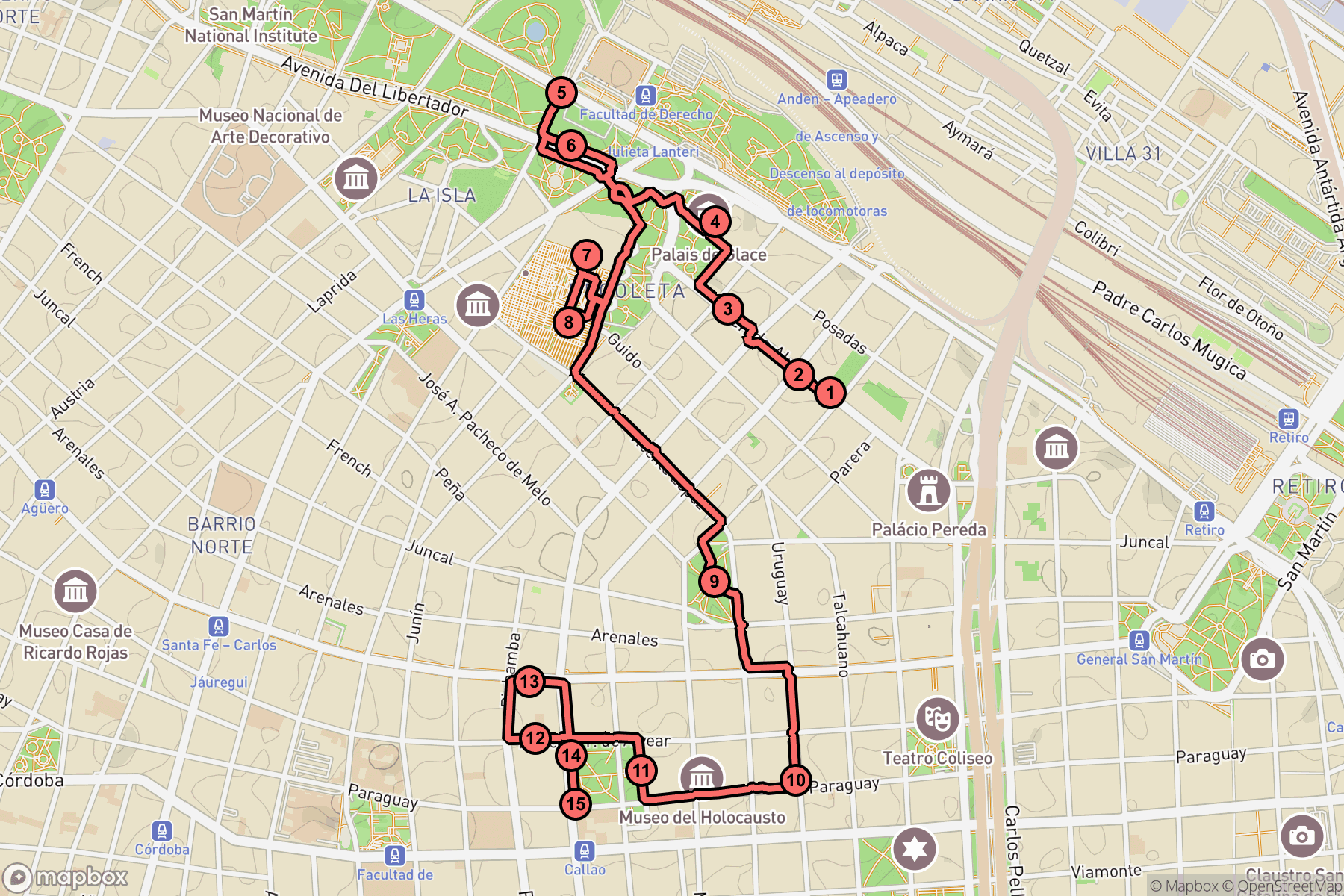
在雷科莱塔宏伟的立面和大理石墓穴之下,几个世纪的权力斗争和秘密仍在林荫大道中回响。 通过这个沉浸式自助语音导览,以前所未有的方式探索布宜诺斯艾利斯。按照自己的节奏探索传奇景点和被遗忘的角落,同时发现塑造这座城市的丑闻、起义和奇闻异事。 为什么一封神秘的信件曾在雷科莱塔公墓的陵墓中引发混乱?阿尔维尔宫酒店的丝绒窗帘背后又上演了哪些秘密交易?1976年一个动荡的午夜,哪位年轻的活动家从卡洛斯·佩列格里尼高等商学院的礼堂中消失了? 从阳光明媚的大道走向寂静的庭院,踏上一条充满戏剧性和发现的道路。感受脚下失落叛乱的脉搏,以及发现隐藏在眼前故事的兴奋。 立即按下播放键,走进雷科莱塔优雅表面之外的阴影。
导览预览
关于此导览
- schedule持续时间 40–60 mins按照自己的节奏
- straighten5.8 公里步行路线跟随引导路径
- location_on
- wifi_off离线工作一次下载,随处使用
- all_inclusive终身访问随时重播,永久有效
- location_on从 教廷驻阿根廷使馆 开始
此导览的景点
To spot the Apostolic Nunciature to Argentina, look for a stately cream-colored palace with tall shuttered windows, elegant ironwork balconies, a rounded corner tower, and a…阅读更多收起
To spot the Apostolic Nunciature to Argentina, look for a stately cream-colored palace with tall shuttered windows, elegant ironwork balconies, a rounded corner tower, and a yellow-and-white flag waving by the entrance. Now, as you stand here in front of the grand Fernández Anchorena Palace, imagine the blend of anticipation and careful diplomacy that has filled these halls for more than a century. This isn’t just a fancy mansion with stunning architecture; it acts as the nerve center for the Vatican’s presence in Argentina. Think of it as the “Holy See’s Headquarters,” where the Apostolic Nuncio-currently Archbishop Mirosław Adamczyk, appointed by none other than Pope Francis in 2020-balances official duties with a bit of spiritual gravity. Being a nuncio is a bit like being a quarterback, shouting plays to both the President of Argentina and the Pope at the same time! Generations of holy diplomats have walked these polished floors, from the days of Lodovico Maria Besi in 1850, who made his rounds in Argentina before indoor plumbing was even a standard luxury, to more recent ambassadors who might sneak a look at Google Maps before a meeting. Over the years, the nunciature’s shifted hands more often than a relay baton, with each representative navigating complex local politics, church drama, and the challenge of always keeping their cassocks wrinkle-free. You’re standing at the crossroads of heavenly ambition and earthly intrigue. Here, behind those grand gates, popes and presidents have connected, and the Catholic hierarchy keeps its direct line to Rome buzzing. Even though the Vatican flag flutters peacefully today, rest assured-if you’re a fan of real-life history mixed with just a sprinkle of divine diplomacy, this place has always been buzzing long before mobile apps could give you a tour.
打开独立页面 →Look straight ahead-you’ll see elegant Parisian-style buildings with decorative balconies lining a wide avenue; on your right, the street stretches out under a canopy of trees and…阅读更多收起
Look straight ahead-you’ll see elegant Parisian-style buildings with decorative balconies lining a wide avenue; on your right, the street stretches out under a canopy of trees and blue awnings mark a classic entrance. Now, let’s imagine you’re standing here in the late 1800s. The land you’re on, once just called Bella Vista, was little more than a path...until 1885, when Don Torcuato María de Alvear-Buenos Aires’ very first mayor-decided to immortalize his father’s name by carving out this grand avenue. You’d probably hear the distant clatter of horse-drawn carriages and the crisp click of well-shined boots along the wide, brand-new sidewalk. This wasn’t just a street; it was a bold statement by a city winning its fight against yellow fever and determined to show off its resilience and style. Suddenly, the wealthiest families in Buenos Aires raced to build their magnificent mansions here, eager to leave behind old neighborhoods and their memories of epidemics. The air was heavy with the perfumes of high society-and maybe, just maybe, the scent of fresh croissants sneaking in from a Parisian fantasy. By the turn of the century, Avenue Alvear became a catwalk of decadence. Imagine walls wrapped in the stately embrace of French Academic architecture, sunlight bouncing off stone and ironwork, and a parade of carriages rolling past the Ortiz Basualdo mansion-now the Embassy of France. Right there was the Pereda Palace, now the embassy of Brazil, and the dazzling Concepción Unzué palace, which today hosts Argentina’s exclusive Jockey Club. The epic elegance continued at every step: you’d spot the famous Duhau Palace, now the Park Hyatt, and grand homes adopted by embassies, clubs, and even the Vatican itself! Across the avenue, luxury was a way of life. No wonder this street was once ranked among the world’s top five boulevards for sheer quality, glamour, and, well, how stylishly it could empty your wallet! But let’s fast-forward to the golden age, when the avenue was splashed with showrooms-Escada, Louis Vuitton, Cartier, and Ralph Lauren. If you wanted to shop for the finest suits, jewels, or even a pair of snappy shoes, Alvear was the place-and, between us, even the mannequins would whisper in French. Over time, times got tough for luxury brands, and many moved on. Now, Hermès and Montblanc are stubbornly holding the fort, surrounded by the same proud palaces that watched fashions come and go. Behind every corner-whether it’s a quiet art gallery, a hint of Chanel in a vintage shop, or a whispered business deal at a fancy club-you’re walking among ghosts and legends of Argentina’s high society, all under these ever-busy trees. Keep your eyes open; on Avenida Alvear, every doorway could lead to a secret ball, a scandal, or perhaps the world’s fanciest cup of coffee!
打开独立页面 →Take a look in front of you - that's not just any hotel. You're facing a true palace with a past as sparkling as its chandeliers: the Alvear Palace Hotel. Can you imagine elegant…阅读更多收起
Take a look in front of you - that's not just any hotel. You're facing a true palace with a past as sparkling as its chandeliers: the Alvear Palace Hotel. Can you imagine elegant ladies in pearls and gentlemen in tuxedos arriving in shiny cars, sweeping up these steps right into the heart of Buenos Aires’ Belle Époque? Well, let's pull back the curtain and take you there. It all started in the roaring 1920s with Rafael De Miero and his cosmopolitan wife, Enriqueta Monsegur. He was so enchanted by the grand hotels and the style of Paris that he decided Buenos Aires needed a little French glamour of its own. So, he snapped up this prime corner-once home to the old British Consulate-already perfect for drama thanks to its sloping ground. Not even a tricky piece of real estate could stop the dream! De Miero hired some of the best architects of the day, Estanislao Pirovano and Valentín Brodsky, and set them loose with one simple instruction: “Make it magnificent.” Maybe a little too simple, because the project kept growing-every day, a new detail was added, like a chef not knowing when to stop with the spices. Construction started in 1922 and took ten whole years, partly because of the slope and partly because perfection isn’t built overnight. September 3, 1932 finally arrived. You can almost hear the music and laughter echoing from the opening night-layers of excitement, silk gowns swishing past gold-trimmed mirrors, all of Buenos Aires’ high society coming for a look at the city’s new jewel. But it wasn’t always smooth sailing. Fast forward to the 1970s, a time of velvet, flares, and, apparently, deep trouble for the hotel. Under Baron Andreas von Wernitz, the glamour faded badly-it was so dire, they sold off nearly all the rooms to keep the place going. By 1978, the hotel was almost down for the count. But then, as in all great hotel stories, new owners arrived! The Sutton Dabbah Group bought it in 1984 and began a resurrection worthy of a movie montage-restoring everything from the grand salons to the tiniest stair-step. They brought the Alvear back to life, polishing its original Parisian stone and restoring the luxurious style somewhere between Louis XIV and Louis XVI-if you’re not sure what that means, think: “fit for a king, but with even fancier doorknobs.” Take a peek at the facade and imagine the layers of paint being stripped away to reveal that historic, creamy limestone, complete with quirky marks from air conditioners long banished. Inside, the places practically designed for drama: there’s a central gallery that’s 85 meters long-so big you might get tired before reaching the end-stunning red lacquered columns, and a staircase that looks straight out of a fairy tale. Initially, the building only reached four stories, but now it stretches up to eleven, with hidden kitchens in the basement, and for a long time, a legendary rooftop restaurant: the Roof Garden. That was sadly replaced by more guest rooms in 2003-a tough trade-off, but a practical one. You want juicy stories? The Alvear is bursting with them. Famous faces? We’ve got Tony Curtis swashbuckling through room 606, Christina Onassis with an entire suite just for her phone calls, and even the Emperor of Japan demanding a custom aquarium in his suite for his rare fish. Sometimes, visitors went a little wild-like the Emir of Kuwait, who wanted only the freshest goat’s milk. The staff chartered a plane deep into the countryside just to deliver his breakfast. And then, there are those unpredictable moments, like the night actor Michael Ironside tripped over a floor polisher and smashed an enormous vase, only to insist on finishing the job with the polisher himself. Now that’s cleaning up after yourself! Even music history happened here: in 1992, the pop band Roxette recorded two songs in room 603-maybe some of their Swedish pop magic is still echoing in the hallways. Horacio Ferrer, the great tango poet, loved the place so much that he called it home for nearly forty years. Standing here, you’re not just looking at a hotel-you’re seeing nearly a century of city legends, dreams, scandals, and elegance, all wrapped up in marble and gold. If these walls could talk, I bet they'd ask for a glass of something bubbly first.
打开独立页面 →
再显示 12 个站点显示更少站点expand_moreexpand_less
Right in front of you, you’ll spot a cream-colored, round-looking building with a glass awning above the entrance and a sign that boldly reads “PALACIO NACIONAL DE LAS ARTES -…阅读更多收起
Right in front of you, you’ll spot a cream-colored, round-looking building with a glass awning above the entrance and a sign that boldly reads “PALACIO NACIONAL DE LAS ARTES - PALAIS DE GLACE”; just look for the elegant black metalwork and those letters above the main doors. Now, let’s dive into the Palais de Glace - I hope you brought your imaginary skates, because this place began as Buenos Aires’ most exclusive ice rink! Picture the year 1910: horse-drawn carriages pass outside as inside, the Argentine upper crust swirl around a circular, 21-meter rink, elegant music filling the air from an organ high above, and natural light pouring through a dramatic dome in the ceiling. The building, designed by José R. Rey and Besadre and perched on land donated by the city, didn’t just offer skating; the first floor boasted stylish balconies, a fancy café, and everywhere-chatter in French and laughter that echoed under the vaulted roof. But trends change faster than a skater on ice! By 1912, this icy playground was snapped up by Baron Antonio Demarchi, the Swiss consul-also conveniently related to a former president. Gone was the rink, and in came polished oak floors for the hottest new craze: dancing! This is where tango, once considered a bit scandalous, found an unlikely champion. Demarchi even organized a legendary event to prove that tango was more art than indecency, hiring a celebrated orchestra and daredevil dancer Enrique Saborino. You could almost sense the tension as crowds gathered, critics poised to be, well, critical, and tango’s fate at stake. When the music started, the room buzzed with excitement... After that, Palais de Glace became tango’s high temple! The city’s most dashing couples twirled here under the sparkling dome, while famous orchestras-from Canaro to Firpo-played for crowds gliding across those shiny floors. All that glamour, all that mischief… including one infamous night in 1915, when the legendary Carlos Gardel showed up for his birthday celebration, only to catch a bullet in his chest amid a love triangle gone wrong! The party screeched to a halt, friends rushed him to the hospital, and as doctors discovered, extracting a bullet near the heart was far riskier than singing a high note. Gardel carried that bullet for the rest of his too-short life-a risky memento of Parisian passions, Buenos Aires drama, and Recoleta intrigue. In 1930, it was time for a plot twist! The city handed the building to the Ministry of Education and Justice, breathing new life into its circular halls as a palace for the arts. Renowned architect Alejandro Bustillo swapped out the skating rink for gleaming exhibition spaces, transformed rotundas into art galleries, and replaced those showy columns and domes with something more modern-a bold move, but a necessary one as the Palais entered its next chapter. Interior murals painted in the 1930s celebrated Argentina’s vibrant artisanal and fine arts scene. As the years spun on, it hosted the prestigious Salón Nacional de Artes Visuales, showing off the country’s finest painters, sculptors, photographers, and dreamers. The Palais de Glace has seen fashion’s fads, roaring dances, gangster disputes, and brushstrokes of genius. These days, it’s closed for restoration-finally taking a well-deserved spa day! But it remains the government’s top showplace for Argentine art, with a collection of a thousand works and a reputation big enough to fill every seat in its long-lost balconies. So while you can’t glide under the dome today, just imagine the swirl of skates turning into tango steps, the secrets whispered in every corner, and the incredible creativity that’s passed through these doors-for over a century, this has been Recoleta’s center stage for a spectacular show called Argentine culture.
打开独立页面 →Wow! Right in front of you rises the extraordinary Floralis Genérica, a monument so big and bold that even Mother Nature might get a bit jealous. Standing in the lush Parque de…阅读更多收起
Wow! Right in front of you rises the extraordinary Floralis Genérica, a monument so big and bold that even Mother Nature might get a bit jealous. Standing in the lush Parque de las Naciones Unidas, this metallic bloom is an 18-ton, 23-meter-high wonder, crafted from stainless steel, aluminum, and concrete by the Argentinian architect Eduardo Catalano. It’s not just a flower; it’s a gift-a true love letter to Buenos Aires from its creator. Catalano imagined a flower that wasn’t any one species, but a tribute to all flowers everywhere. Hence the name: “Floralis” means floral, “Genérica” means generic-she’s the universal flower! Back in 2002, when Floralis Genérica was unveiled, excitement buzzed through the city. With materials supplied by the aircraft company Lockheed Martin Argentina, this flower had some serious hardware behind her elegance. There was only one little hiccup: on opening day, the petals wouldn’t close-maybe it was just stage fright? Thankfully, a few months later, after some technical tweaks, she started her daily dance: opening every morning at 8 a.m., stretching her six silver petals to greet the sun, and then closing gently at sunset. And what a show for the senses! The petals-each 20 meters long-shine in the sun by day and bathe the night in a warm red glow as they fold in for sleep. Don’t think Floralis is shy, though: she stays wide open for remarkable nights, like May 25th, September 21st, New Year’s Eve, and Argentina’s Independence Day. When the moon is full, she celebrates too, staying awake just a little longer. But beware-when strong winds whip through the city, Floralis acts just like a real flower, folding her petals tight, proving that even metal blooms need to seek cover. Yet not every year’s been easy on her. In 2010, after years of use, she fell silent for five years, like a grand opera singer losing her voice. The blueprints vanished, vandals snuck into her machinery, and she sat still-until 2015, when a heroic team, led by engineer Salvador Sorbello, brought her back to life, adding shimmering LED lights and clever sensors. Even last December, when a fierce storm knocked down a giant petal, Floralis proved she’s as dramatic and resilient as any diva. Surrounded by a 44-meter mirrored pool, she’s not just a sculpture; she’s a living part of Buenos Aires-changing with the light, the weather, and the spirit of the city. Now, go ahead and snap your photos-but remember, you’re staring at a flower with a mind (and schedule) of her own!
打开独立页面 →To spot the National Museum of Fine Arts, look for the striking long, salmon-colored building right ahead with four grand columns supporting the entrance, large banners above the…阅读更多收起
To spot the National Museum of Fine Arts, look for the striking long, salmon-colored building right ahead with four grand columns supporting the entrance, large banners above the doors, and a staircase leading up from the street. Welcome to one of the crown jewels of Argentine art - and my personal favorite place to daydream about becoming a world-famous painter! Here’s the story: imagine the busy streets of Buenos Aires back in 1895, when President José Evaristo Uriburu decided it was time for a national home for beauty, creativity, and a staggering amount of paintings. The National Museum of Fine Arts opened its doors with just 163 works. Picture the old Bon Marché building, where you could buy jewelry or attend art shows in its bustling corridors. Honestly, it sounds like the perfect store: “Would you like a nice brooch with your Manet, ma’am?” Within a few years, thanks to passionate souls like Eduardo Schiaffino-artist, critic, museum founder, and a bit of a collector himself-the museum’s collection quickly ballooned. Friends and collectors donated treasures, while Schiaffino himself wasn’t shy about writing “friendly reminders” to anyone with a good painting gathering dust at home. Soon the collection was top class, adding masterpieces from France, Spain, Italy, and beyond, making the museum a true rainbow of art history, stretching all the way from pre-Columbian times up to the modern era. But much like a painting in progress, the museum needed the right canvas. It moved from the Bon Marché to the sparkling iron-and-glass Pabellón Argentino at Plaza San Martín, a building fresh from Paris’s Universal Expo. Here, art found a majestic but very temporary home-and a lot of shuffling of paintings! By 1932, the collection landed in this very building in Recoleta, once a humble pump station and transformed into a museum by visionary architect Alejandro Bustillo. Imagine the scene: the old columns remain, but all the fussy decorations and chimneys are swept away for a modern, serene look - perfect for showing off masterpieces. The museum quickly grew into a living, breathing hub for art lovers, children on school trips, and visitors from Argentina and far-flung lands. Over the decades, its walls have echoed with laughter, quiet contemplation, and maybe even a little art-inspired daydreaming. The halls have welcomed major exhibitions: from Goya to Picasso, Renoir to Rodin, and even a world-class Bauhaus display that shook up the art world here in 1970. The 1980s brought drama when-cue the suspenseful music-twenty-three artworks were stolen in a daring Christmas caper, with only a few returned decades later. Forget Ocean’s Eleven, this was Ocean’s Art Gallery! But the museum always recovered, constantly renovating and rediscovering new ways to display its 12,000 works, from ancient tapestries to the wildest modern art. The library here isn’t just a quiet place with dusty books; it’s Argentina’s biggest art library. It started in 1895 and was opened to the public in 1942-the place where artists, students, and researchers all dig for inspiration, surrounded by legendary donations from critics and collectors. And this place has always loved a celebration. In 1945, on its 50th anniversary, the museum threw an art party no one would forget, sending exhibitions across Argentina and welcoming masterpieces from Europe. Modern directors brought in video art, wild installations, and more than a few up-and-coming young geniuses. In 2004, the museum even helped start a new branch way out in Neuquén, so Patagonia could get a little taste of the magic. And you, my art-seeking friend, are standing at the very heart of it all. Imagine the painters, sculptors, collectors, and dreamers who walked these steps before you. Maybe-just maybe-the next masterpiece on these walls will be inspired by someone on this tour! Now, ready to step inside and see a few wonders yourself?
打开独立页面 →To spot the Recoleta Cultural Center, look for a grand salmon-pink building with elegant white trim, lots of windows, a glass canopy over the main entrance, and banners splashed…阅读更多收起
To spot the Recoleta Cultural Center, look for a grand salmon-pink building with elegant white trim, lots of windows, a glass canopy over the main entrance, and banners splashed with bold colors right ahead of you. Now that you’re facing the Recoleta Cultural Center, get ready to meet one of Buenos Aires’ true survivors-it’s had more transformations than a soap opera character, and nearly as much drama. The warm façade you see has watched centuries of locals walk by, each bringing their own stories, laughter, and dreams. Believe it or not, three hundred years ago, this was a peaceful spot belonging to Franciscan monks. Imagine the air filled with the scent of orange blossoms and murmurs of prayer echoing through ancient cloisters-it must have been tranquil... until the city’s history started stirring things up. In just a few lifetimes, this site became a convent, then a hot spot for revolutionary intrigue, a school, a prison, a military barracks, and-by the 1800s-a hospital and an asylum both for the desperate and the forgotten. There was even a bakery, a botanic garden, and some rather opinionated nuns insisting on good ventilation-fresh air has always been trendy here. By the late 19th century, the building was fancied up by architect Juan Antonio Buschiazzo, who added the neogothic and Italianate touches you see today-thank him for those swanky corner spires and majestic columns. With new money and new ideas flowing into Buenos Aires, Recoleta became the place to be, as society’s top hats paraded by what was then known as the Asylum of the Elderly. Gossip has it, even the most fashionable folks of the city would take a turn around the newly beautified plazas nearby, eager to be seen. But don’t let the fancy façade fool you-fast forward to the wild 1960s, and outside these walls, young hippies filled neighboring plazas with music, crafts, and debates about rock and freedom while the old asylums slowly faded inside. There’s a bittersweet flavor in knowing this place sheltered some of Argentina’s poorest, while just over the wall, bohemians and rock legends gathered to spark a new cultural fire. And then, just as the 1980s arrived-and with them, winds of democracy-this place was ready for its most radical reinvention yet. Out went the last remnants of the asylums and in came a dream: the city’s most daring cultural center, proudly designed by Clorindo Testa, Jacques Bedel, and Luis Benedit. They blended ancient walls with bold modern touches-metal staircases, open galleries, and colorful murals-creating a patchwork you can see and feel today. From this moment, the Recoleta Cultural Center pulsed with the energy of artists pushing boundaries, dancers stomping rhythms, and musicians tuning up for legendary performances. It was the venue for wild art installations-like Yoko Ono’s garden of coffins and trees, or concerts by David Bowie and Gustavo Cerati. It was a cradle for rebellious ideas too, as women’s rights and LGBTQ+ voices found early platforms here, and the Abuelas de Plaza de Mayo made their vital searches visible. During difficult times, this place became a safe space for the young and bold-where underground culture leapt into the light. That revolutionary feeling has never gone away. The building buzzes with workshops, exhibitions, hip hop sessions, drawing classes, laughter from the bar, and the constant movement of Argentina’s-and the world’s-most creative souls. The maze of patios and arcades, with sunbeams flickering through ancient and modern windows, is a living reminder that art, youth, and a little chaos can give new purpose to any space. Step right up into the Recoleta Cultural Center-you’re part of its next chapter now.
打开独立页面 →Right in front of you is one of the world’s most breathtaking cemeteries-La Recoleta Cemetery, where Buenos Aires’ most famous and infamous find their eternal rest. Picture its 14…阅读更多收起
Right in front of you is one of the world’s most breathtaking cemeteries-La Recoleta Cemetery, where Buenos Aires’ most famous and infamous find their eternal rest. Picture its 14 acres filled with grand vaults, haunting sculptures, wandering cats, and more drama than a soap opera! Behind those mighty Neoclassical gates and Doric columns, nearly 5,000 above-ground mausoleums are arranged in “city blocks,” like a city for the dearly departed. It all started in the early 18th century when Franciscan Recollect monks built a quiet convent and a beautiful white church nearby. Flash forward to 1822-Argentina booted out the monks, turning the gardens into Buenos Aires’ very first public cemetery. And get this-the people in charge, like Governor Martín Rodríguez and Bernardino Rivadavia, are actually buried right here. The original French engineer, Próspero Catelin, who also designed the fancy façade of the Metropolitan Cathedral, dreamed up the layout. Then came the Italians! In 1881, mayor Torcuato de Alvear had Juan Antonio Buschiazzo, a top Italian architect, give this place its last big glow-up. But why is this cemetery world-famous? The answer lies in the residents: Nobel Prize winners, military commanders, presidents, the founder of the navy, even Eva Perón-her glamorous tomb attracts as many fans today as she did in life. As you wander, you’ll spy every style imaginable, from Art Deco to Neo-Gothic, with marble shipped straight from Paris and Milan-because even in death, style is everything in Argentina! The place dazzles with dazzlingly kept monuments but also tells stories of neglect, with broken glass and crumbling angels here and there. Oh, and those cats! In the 1960s, the feline count hit 60, prowling among the tombs like furry sentinels. Today, just a dozen remain, thanks to adoption drives-though if you hear a mysterious "meow," don’t be startled. It is a city of stories, mystery, and a little bit of glamour-so don’t forget to tip your hat politely as you pass by; after all, the neighbors here are forever!
打开独立页面 →To spot Plaza Vicente López y Planes, just look for a sunlit plaza filled with winding old trees, a grand streetlamp, and a backdrop of tall apartment buildings-it feels like a…阅读更多收起
To spot Plaza Vicente López y Planes, just look for a sunlit plaza filled with winding old trees, a grand streetlamp, and a backdrop of tall apartment buildings-it feels like a green triangle right in the middle of the city bustle. Now, as you’re standing here, take a deep breath and imagine this spot two hundred years ago-it wasn’t always a peaceful plaza! Back then, it was called the “Hueco de las Cabecitas,” and yes, that means “the hollow of the little heads”… not exactly a picnic spot, since it was a sheep slaughterhouse and you would’ve seen piles of heads lying around. If you wanted a brick for your house, you might even find them being cooked right here over smoking pits, while a little lagoon sat in the middle, reflecting the city’s early growth. There’s even a wild tale of a dramatic duel fought between two servants from rival rich families, adding a touch of old Buenos Aires gossip to the air! Today, you’re surrounded by towering tipas and jacarandas that bloom in purple and gold, and the giant fig tree you see-often mistaken for an ombú-is straight out of landscape designer Carlos Thays’ dream of a local, leafy paradise. If you ask me, this place is both drama and peace, history and spring-all at once!
打开独立页面 →In front of you is a sleek, modern building with blue-tinted windows stretching upwards, and the bold silver letters “UCES” catch the sunlight right above the main entrance-just…阅读更多收起
In front of you is a sleek, modern building with blue-tinted windows stretching upwards, and the bold silver letters “UCES” catch the sunlight right above the main entrance-just look up at the corner for that unmistakable sign! Let me tell you the story of the University of Business and Social Sciences-UCES, as everyone calls it. Imagine the city back in 1942-not a laptop in sight, Argentina mid-century, and a small group of passionate sales leaders gathering on street corners, all fired up about bringing big ideas to life. They created the Asociación de Dirigentes de Venta, a club for clever folks who wanted to sell, manage, and change the world. They didn’t have a fancy building back then, probably more coffee cups than diplomas-lots of brainstorming, not so many PowerPoint slides! Fast-forward to the 1950s. Picture the city bustling with new hopes: black-and-white taxis buzzing by, the distant ring of a tram, and here comes the foundation for a business school. By 1957, they opened their own advanced school. Years rolled on-names changed faster than a student switching majors: by the 1980s, they were known as ADE, and soon after, the famous FAECC. Still, the real deal was coming: even if their courses were loved by businesspeople, official recognition was the missing magic ingredient. The big change came in the 1980s. Students could finally wave around their diplomas and say, “Look, it’s official!”-imagine the sighs of parents everywhere. But the true turning point arrived in 1988, when a team of graduates and thinkers gathered under Dr. Horacio O’Donnell. They were on a quest, asking experts from over a hundred and fifty universities around the globe for advice-sort of like planning the biggest, boldest group project in history. From stacks of papers and meetings emerged a vision: a university that would blend serious study, real-world case solving, and sharp research, all under one roof. And in 1991, with a dash of excitement and maybe a little nervousness, UCES was officially born! They kept the name as a tribute to everything they’d built up to that point-not just “a university,” but something deeper, rooted in expertise and open to the vibrant energy of Buenos Aires. Now, as you look up, picture all the dreams and borrowed textbooks that have passed through these doors. This spot is the heart of the “Distrito UCES,” right at the intersection of Paraguay and Uruguay streets. But the adventure doesn’t stop here. UCES has popped up campuses all around Buenos Aires province, and even in places as far south as Ushuaia-now that’s what I call a university with travel goals. Inside these modern halls, students zip through programs in business, economics, law, psychology, communication, health sciences, and even agronomy and veterinary studies. There’s something for everyone-from marketing whiz kids who can’t resist tracking the latest digital trends, to future doctors, public accountants, or the next great Argentine philosopher. Some students train to become the country’s next best music therapist-imagine jam sessions in those lecture halls-while others learn everything from project management to working as professional nurses. Feeling a little overwhelmed by possibilities? You’re not alone. UCES also offers mountains of postgraduate programs: doctorates for those who want to spend even more years in libraries, plus diplomas in everything from neuropsychology to e-commerce, from coaching with horses (really!) to advanced endovascular techniques. Whatever your passion, this buzzing hub might just have a course for it. So, as you stand on this very corner among rushing city feet and the hum of hopeful voices, remember: this is more than a university building-it’s an ongoing story of ambition, innovation, and a few really well-earned coffee breaks. Keep looking up-you never know what the next chapter here will bring!
打开独立页面 →To spot the Sarmiento Palace, look for a grand, white stone building with ornate details and a tall, dark slate roof-right in front of you, glowing beautifully with nighttime…阅读更多收起
To spot the Sarmiento Palace, look for a grand, white stone building with ornate details and a tall, dark slate roof-right in front of you, glowing beautifully with nighttime lights. Now, let’s imagine ourselves in the heart of Buenos Aires in the late 19th century. The year is 1886 and the city is buzzing with the excitement of new ideas, all swirling around the construction of this magnificent palace. If you’d been here back then, you would’ve seen architects Carlos and Hans Altgelt arguing over the blueprints, one with a French accent in his pencil lines, the other with a German twist-they ended up mixing both, creating this splendid palace with its fancy mansard roofs and so many decorative touches you might start counting and lose track! Picture this: the facade was originally covered in a special “Paris stone,” now hidden beneath paint, but once shimmering under the Buenos Aires sun. Even today, take a peek at the mezzanine windows. You might make out sculptures representing Arts, Sciences, and the Power of Peace, watching everyone who enters. Don’t forget to look up at the balconies-those figures aren’t just decoration, they’re symbols of the mighty Río de la Plata and the Andes Mountains, standing watch over the city. Now, the land you’re standing on was once part of the enormous estate of Petronila Rodríguez. She wasn’t just any old heiress-her will required the city to use this spot for a temple, an asylum, and a school for 700 girls, with a museum and library inside. Talk about ambitious! I hope the city officials had plenty of coffee when they read that will. Her dream school did move around town a bit before eventually disappearing, but she certainly left her mark. The palace opened its doors in 1893 (with grand fanfare, no doubt), first serving as the city’s court building. But Buenos Aires had a musical-chair moment with its public offices-for a while, the school was elsewhere, and the courts were right here. By the early 20th century, school bells gave way to government phone calls, and in 1934, a new school elsewhere in the city was named after Petronila. The place became the headquarters for the powerful National Education Council between 1903 and 1978, while the rest of the Ministry of Education’s staff had to squeeze into nearby buildings like clowns in a circus car. By the late 20th century, the palace needed a bit of modernizing-think more electrical outlets and less echo for those phone calls. Architect Félix Ruiz Martínez came in, determined to reorganize the place, even rebuilding parts of the plaza and underground spaces. Through every change, it’s managed to hold onto its sense of grandeur-so much that in 2006, it was declared a National Historic Monument.
打开独立页面 →To spot the Carlos Pellegrini School of Commerce, just look to your left for a long, elegant cream-colored building with ornate, classical details and large windows stretching…阅读更多收起
To spot the Carlos Pellegrini School of Commerce, just look to your left for a long, elegant cream-colored building with ornate, classical details and large windows stretching along the street-it's hard to miss on Marcelo T. de Alvear! Alright, take a deep breath of Recoleta air-maybe you can almost smell the history! Imagine you’re standing here in 1909. The year is young, but the neighborhood is already buzzing, and this grand building in front of you, designed by architect Gino Aloisi, stands proud and new. The stone façade, noble and bright, hints at the serious studies and big dreams brewing inside. If you listen closely, you might almost hear the shuffle of shoes on the marble floor and faint echoes of classroom chatter. Now, let’s rewind to 1890, when Argentina was sprinting into economic modernity-think bustling markets, telegrams whirring, businessmen in top hats! Carlos Pellegrini, who was (quite conveniently) both Vice President and acting President, saw a need: where would Argentina’s future accountants, translators, and commercial whizzes come from? He solved it with swift political penmanship, decreeing the creation of the very first School of Commerce in the country. The classrooms, at first, taught math and book-keeping side by side with French and English, because when international trade was booming, you wanted to be able to haggle-in style! By 1892, the curriculum evolved, and by 1894, it split into preparatory and commercial courses. You needed to be at least 14, and ready to face a tough entrance exam-so, better practice your handwriting! Over the years, this school was the entryway for countless ambitious teens, eager to leave their mark on the bustling world outside. By the time the 20th century really got rolling, Pellegrini’s school was already revered as the nation’s top site for commercial studies. In 1908, in honor of its founder, it became the Carlos Pellegrini School. It grew and grew, and in 1913, it became part of the University of Buenos Aires, providing a direct academic pipeline to higher learning. Rumor has it, some students secretly relished entering through the “front door to adulthood”-with a big chunky ledger under one arm! Fast forward to the mid-20th century, and you’ll find the biggest change: this was the place where, slowly and bravely, the rules shifted and women walked through the doors as students for the first time. And if you listen for a second, you can picture applause-and maybe a few skeptical whispers-in the classroom. But it’s not just about study, sweat, and chalk dust. Pellegrini has witnessed its share of drama too-imagine student protests echoing down these halls, the tension of academic reforms, and the wild years when rumors and threats shook the building to its core in 2007. During that stormy time, the school faced bomb threats and sit-ins, its future seemed uncertain. But, in true Argentine fashion, it bounced back! Smart leadership, a dash of new technology, and those famously passionate students brought the “Pelle” spirit roaring back, even sending an alumna to work with NASA. What makes this place legendary is not only its tough academic rules-trust me, getting in is like winning the lottery for about half the hopefuls each year-or the fact that if you don’t keep up, you’re off to take more exams in February, March, or even July. It’s also the camaraderie, the debates, and the sense of belonging to something bigger than yourself. The students here tackle business, social sciences, foreign languages, and even “Solidarity in Action” classes that challenge them to look beyond ledgers and spreadsheets. So, as you stand outside gazing at this living monument of learning, know that inside these walls, future tycoons, thinkers, and history makers have spent countless hours hoping desperately for a passing grade-and maybe also for a break at the school café. Don’t worry, the only exam you have today is to see if you can spot every detail of Recoleta as we continue on our journey! Yearning to grasp further insights on the location, entrance course or the curriculum? Dive into the chat section below and ask away.
打开独立页面 →Look for a grand, cream-colored building with ornate balconies and sculpted figures on either side of a golden sign that says "GRAND SPLENDID"-the entrance to El Ateneo is just…阅读更多收起
Look for a grand, cream-colored building with ornate balconies and sculpted figures on either side of a golden sign that says "GRAND SPLENDID"-the entrance to El Ateneo is just below, glowing warmly with people coming and going. Alright, you’re at the famous El Ateneo Grand Splendid! You’re standing in front of what might look like the world’s fanciest library, but this spot has as much drama as a Shakespearean play and as many stories as, well… a giant bookstore. Let’s peel back the curtain. Picture Buenos Aires in 1919-rows of elegant cars outside, ladies in feathered hats, and gentlemen eager for an evening out. The smell of fresh paint still lingers and the city buzzes with excitement: a brand new theater is opening right here, thanks to Max Glücksmann, a visionary businessman with a soft spot for entertainment. He wanted more than just a building-he wanted a palace of culture. The architects, Peró and Torres Armengol, didn’t disappoint. Four rows of opulent balconies, a stage wide enough for grand performances, and an audience enthralled by the magic of the theater: all of it, right before you. The first shows dazzled with famous tango artists-imagine the legendary Carlos Gardel walking through these doors, ready to record in a hidden studio tucked inside the building. There’s even a legend that Glücksmann taught Gardel to project his voice by grabbing the back of a chair and singing with all his might. Who knew vocal power-ups could be so practical? This wasn’t just a stage for actors and singers-it was also a hub for radio. In 1923, from somewhere above your head, Radio Splendid crackled to life, with a rooftop antenna poking into the Buenos Aires sky. Crowds passing by would spot the odd structure and wonder what mysteries were being broadcast from this very building. On October 1, 1929, Carlos Gardel made his radio debut upstairs-if only you could eavesdrop on that echo from the past. The Grand Splendid was the place to be between 1919 and 1982 for unforgettable performances, then rolled right into the future by transforming into a cinema. For nearly two decades, movie-goers gasped at international blockbusters, making it one of the city's most beloved cinemas. When the lights finally went down for the last time in 1999, it seemed like the magic had ended. But Buenos Aires doesn’t give up on its legends! In 2000, a dramatic plot twist arrived: El Ateneo, one of Argentina’s oldest bookstore brands, took over. Workers bustled for months, restoring every detail-the velvet stage curtain, the dazzling dome high above, the golden trim, each balcony-and gave the building a new life. Instead of crowds clapping for actors, you now have thousands of book lovers every single day, wandering among the 120,000 titles, sniffing that glorious smell of paper and ink. Walk in and you’ll spot armchairs where audiences once sat, balconies where you’re free to read, and a restaurant on the old stage, complete with a piano. And if you get lost, just follow the sound of book pages turning like a gentle river inside. Up above, the stage is set for peace quite literally. Gaze at the dome: painted by Nazareno Orlandi in 1919, it glows with flowers, angels, and a triumphant figure of peace-with doves soaring as if the war clouds have parted for good. And just for you film buffs, there’s a mysterious woman on the left side of the dome holding an old-school movie projector, using her reel to spread a ribbon of peace across the whole painting. No wonder El Ateneo keeps winning global awards-The Guardian named it the second most beautiful bookstore in the world in 2008, and by 2019, National Geographic put it at number one. Even presidents and celebrities make detours to see this one-of-a-kind landmark. So when you step inside, imagine you’re strolling through history’s own playbook, where every balcony, every whisper, and every book holds a tiny bit of the magic that’s unfolded here for over a century.
打开独立页面 →Look straight ahead for a marble sculpture at the center of a fountain - it’s a figure of a young man crouched low, stretching forward to drink from water flowing right out of a…阅读更多收起
Look straight ahead for a marble sculpture at the center of a fountain - it’s a figure of a young man crouched low, stretching forward to drink from water flowing right out of a rock. Now, let’s soak up the story of “El sediento” - or “The Thirsty.” Imagine Buenos Aires back in 1914: the city is evolving, and tucked near busy Callao Avenue, this very spot gets treated to a new artistic treasure. Crafted by Luisa Isabel Isella de Motteau, one of Argentina’s earliest and most talented women sculptors, the marble boy before you quenching his thirst is not just thirsty for water, but thirsty for life! Isella started her adventure in far-off Monza, Italy, sharpened her skills in Chile where she won gold for her talents, and then headed to Paris thanks to a government scholarship and a little help from Carlos Pellegrini (yes, the same name you’ll spot at our next stop). She rocked the art world in Paris, winning a gold medal in 1909, but back home, her sculpture’s debut in the Plaza Rodríguez Peña was bittersweet-war was breaking out in Europe, and she was stuck in Paris, missing her own big day! There was no party, just quiet admiration from afar. And, thanks to some serious budget cuts caused by the war, seashells and seaweed details meant for that original Art Nouveau flair got left out. Even the fountain basin was lowered-so if the young guy seems a tad close to the ground, now you know why! Isella finally came home in 1919, dedicating her life to teaching art. Over the decades, vandals, time, and dry spells took their toll. The fountain dried up, the marble gathered grime-but don’t worry, in 2001, it was lovingly restored, letting our thirsty friend drink-and charm passersby-once again.
打开独立页面 →You’re now facing Callao Avenue: just look straight ahead for a wide street stretching into the distance, flanked by tall, classic and modern apartment buildings decorated with…阅读更多收起
You’re now facing Callao Avenue: just look straight ahead for a wide street stretching into the distance, flanked by tall, classic and modern apartment buildings decorated with wrought-iron balconies, little shops at street level, and a bustle of city life weaving through tree-dotted sidewalks. Alright, time to step into the grand story of Callao Avenue! Picture yourself standing here centuries ago-no roaring buses or honking taxis-just a scruffy muddy path winding through a wild land of cacti and swamps, known playfully by the locals as the Lane of the Prickly Pears. Back in the late 18th century, this was the city’s rural edge, grazed by cows and surrounded by silence, so you might have had more luck meeting an adventurous cow than a banker or a bookshop owner. It all started to change in the early 1800s when Bernardino Rivadavia decided Buenos Aires didn’t just need some more cows, but a bold new boulevard. With engineer Felipe Senillosa at his side, Rivadavia gave this dusty shortcut a serious makeover: out went the miry puddles, in came order and ambition-thirty vast varas (an old Spanish measurement) wide, no less! It was named after the port of Callao in Peru, giving a little nod to South America’s then-bustling trade routes. Back then, some folks thought it looked like a broad, empty marsh, and even as late as the 1880s, it was more guesswork than glamour. Then came the late 19th century, and with it, a wave of wealth and grand ambition. High society moved in, bringing with them not just fine boots, but architects crafting elegant mansions, stately banks, ornate hotels, and palatial schools. The avenue blossomed into a corridor of classic French-inspired facades, like the legendary Confitería del Molino with its dramatic tower, and the gleaming Savoy Hotel-where dignitaries and dreamers have raised a toast or two. Even the Jesuits, ever the urban pioneers, snapped up land for their Church of the Salvador, signaling the city was finally taking root here. In the first half of the 20th century, Callao Avenue was known far and wide as Boulevard Callao. Couples would stroll under the lamp-lit trees (once small, never quite forming that New York-style canopy), while carriages and, later, stylish cars zipped between office towers and stately residences. Yet the city, ever hungry for change, watched modern buildings rise ever taller as the mid-century approached, each one striving to touch the sky. But not all stories are of endless glory. As fashions changed-some say as quickly as Buenos Aires weather-the splendid palaces fell to the bulldozers, and glass-and-concrete towers rose. Fabled hotels like the Savoy turned into nightclubs, the glamorous Confitería del Molino sat abandoned, and even the pavement seemed to sigh with memories of tango melodies from the past. Still, the avenue’s heartbeat never faded. In recent years, new laws have saved many historic gems from demolition, preserving the soul of Callao for wandering poets, curious tourists, and everyday porteños alike. All along this avenue, politics thrived close to the Congress, students hurried between elegant schools and universities, banks buzzed with life, and families found sanctuary in leafy residential stretches. It’s a place where history’s layers are baked right into the stone: from Jesuit bells to rallies for change, whispered tales of high society, and even the odd passionate debate over coffee about what belongs to the city’s future, and what should linger from the past. So as you gaze down Callao Avenue, you’re seeing more than storefronts and balconies-you’re peering down a living timeline, where the past and present meet at every step, and where Buenos Aires never, ever stands still. Seeking more information about the description, characteristics or the route? Ask away in the chat section and I'll fill you in.
打开独立页面 →
常见问题
如何开始导览?
购买后,下载 AudaTours 应用并输入您的兑换码。导览将准备好立即开始--只需点击播放并按照 GPS 引导的路线行驶即可。
导览期间我需要互联网吗?
不需要!开始前下载导览并完全离线享受。只有聊天功能需要互联网。我们建议在 WiFi 下下载以节省移动数据。
这是导游带领的团体游吗?
不是--这是自助语音导览。您按照自己的节奏独立探索,通过手机播放音频解说。没有导游,没有团体,没有时间表。
导览需要多长时间?
大多数导览需要 60-90 分钟才能完成,但您完全控制节奏。随时暂停、跳过站点或休息。
如果我今天无法完成导览怎么办?
没问题!导览具有终身访问权限。随时暂停和恢复--明天、下周或明年。您的进度已保存。
有哪些语言可用?
所有导览均提供 50 多种语言版本。在兑换代码时选择您的首选语言。注意:导览生成后无法更改语言。
购买后我在哪里访问导览?
从 App Store 或 Google Play 下载免费的 AudaTours 应用。输入您的兑换码(通过电子邮件发送),导览将出现在您的资料库中,准备下载并开始。
如果您不喜欢该导览,我们将退款。请联系我们 [email protected]
安全结账使用 


