
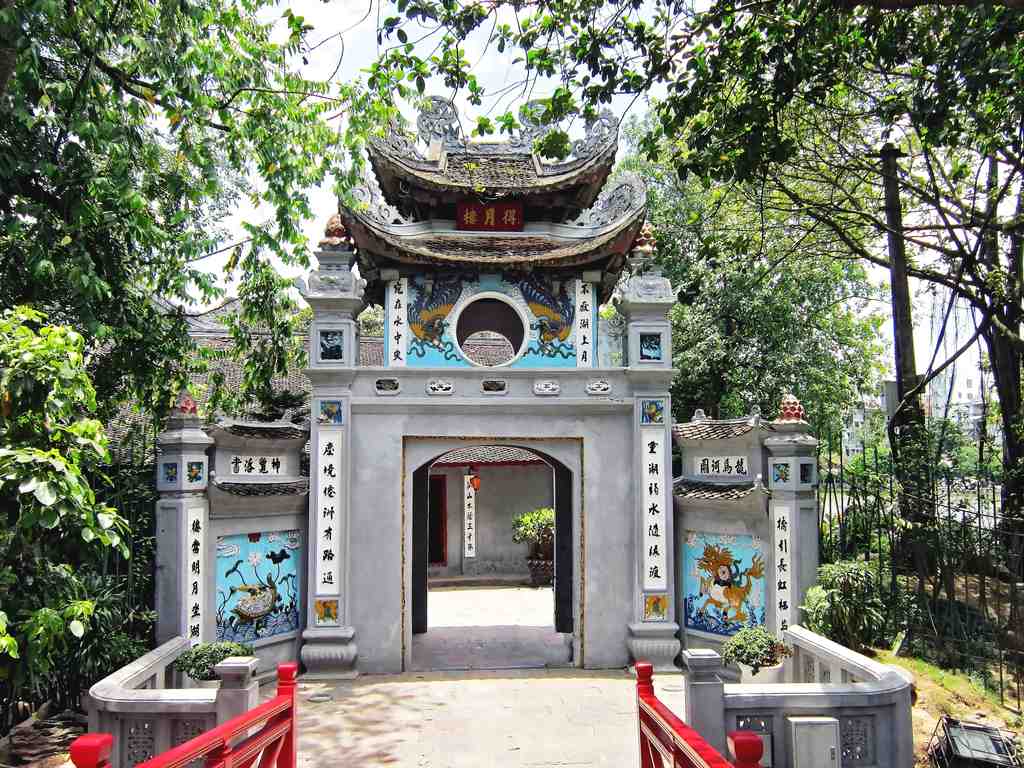
Just ahead of you, look for a gray stone gate topped with dragons, vivid painted creatures, and bold Chinese calligraphy, nestled beneath swaying tree branches, right where the bright red bridge ends.
Alright, traveler, as you stand here by the entrance to Ngoc Son Temple, let’s invite your imagination back through the centuries-don’t worry, I promise there are no pop quizzes at the end, only stories! Now, close your eyes for a moment and picture the gentle lap of lake water and the rustle of old banyan leaves that have watched over this temple for generations. Ngoc Son Temple sits on a jewel of an island in Hoan Kiem Lake, and its story is one that has evolved with every ruling dynasty, every legendary hero, and, yes, even a few turtles.
The tale begins long ago, when King Ly Thai To moved the capital to Thang Long-today’s Hanoi. Back then, there was already a shrine here, known as Ngoc Tuong, later renamed Ngoc Son in the era of the Tran dynasty. This spot became hallowed ground for those who sacrificed themselves resisting Mongol invasions. Imagine solemn ceremonies, incense drifting in the cool air, and the glow of lanterns reflecting off the dark lake.
But nothing lasts forever! Over the years, the ancient temple crumbled, only to be revived and rebuilt again and again. Fast forward to the 18th century-during the Le dynasty-Trinh Giang, a powerful lord, constructed a pleasure palace called Khanh Thuy nearby and even sculpted hills of earth to enhance its beauty. When the winds of politics shifted and the Trinh family fell, the palace didn’t survive, but local villagers rebuilt a new shrine on the old ground. Even a charitable soul named Tin Trai chipped in, building the original Ngoc Son pagoda that became the core of today’s temple.
Before long, it wasn’t a pagoda for Buddhist worship anymore, but a proper temple honoring both Tran Hung Dao-the iron-hearted general who booted the Mongols in the 13th century-and Van Xuong, the star-deity of scholars and exams. Imagine generations of students pausing here, hopes high and hands trembling, leaving prayers for luck before the imperial test.
And trust me, if ancient shrines are a bit hard to keep track of, you’re not alone-I once tried mapping out all the renovations and nearly lost my sense of direction! Newspaper headline: “Tour guide disappears under pile of old blueprints.”
In the 19th century, the temple got a polish thanks to Nguyen Van Sieu, a wise scholar and real-life multitasker. He built not only the temple’s main hall, but also the surrounding walls, and installed stone embankments. Right here, the two buildings-the main shrine and covered bridge-create that magical connection between land, water, and sky that Hanoi locals cherish. The stone square pavilion you see to the lake’s south? That’s Tran Ba Pavilion, its eight sturdy columns symbolizing a steadfast guard, like a guardian watching over the waves of both water and culture.
Now, as you look up above the entrance, you’ll spot the fanciful “Moon Embracing Pavilion” and painted scenes of dragons and phoenixes dancing across panels. Stroll across the brilliant red The Huc Bridge-the name means “where sunlight lingers.” The bridge itself is famous; the first version eventually collapsed during the French colonial period, and the version you see today was rebuilt under the watchful eye of Trương Văn Đa, who was part architect, part philosopher-because in Vietnam, even your architect might write you poetry!
Beyond the gate lies the main sanctuary: two shrines, one honoring Tran Hung Dao and Van Xuong, where statues rise on high stone pedestals. Here, the scent of burning incense seems to float through walls and centuries all at once. There are more deities worshipped inside, including Laozi, Guan Yu, Buddha Amitabha, and more-a celebration of Vietnam’s spirit of religious harmony, with Confucian, Taoist, and Buddhist ideas living together under one roof. Nifty, right?
And don’t miss the oddest treasure: in the rear hall you’ll see the preserved body of a legendary Hoan Kiem turtle-yes, a giant turtle, who once swam these waters and now shares the temple with the gods and heroes.
So as you stand here, listen to the wind in the trees and try to imagine the centuries of voices, prayers, schoolchildren, and victorious generals whose spirits mingle in the air. Ngoc Son Temple doesn’t just tell a story; it sings it, rippling out across the lake in waves of history, myth, and hope. Ready for your next adventure at Hoan Kiem Lake?


