
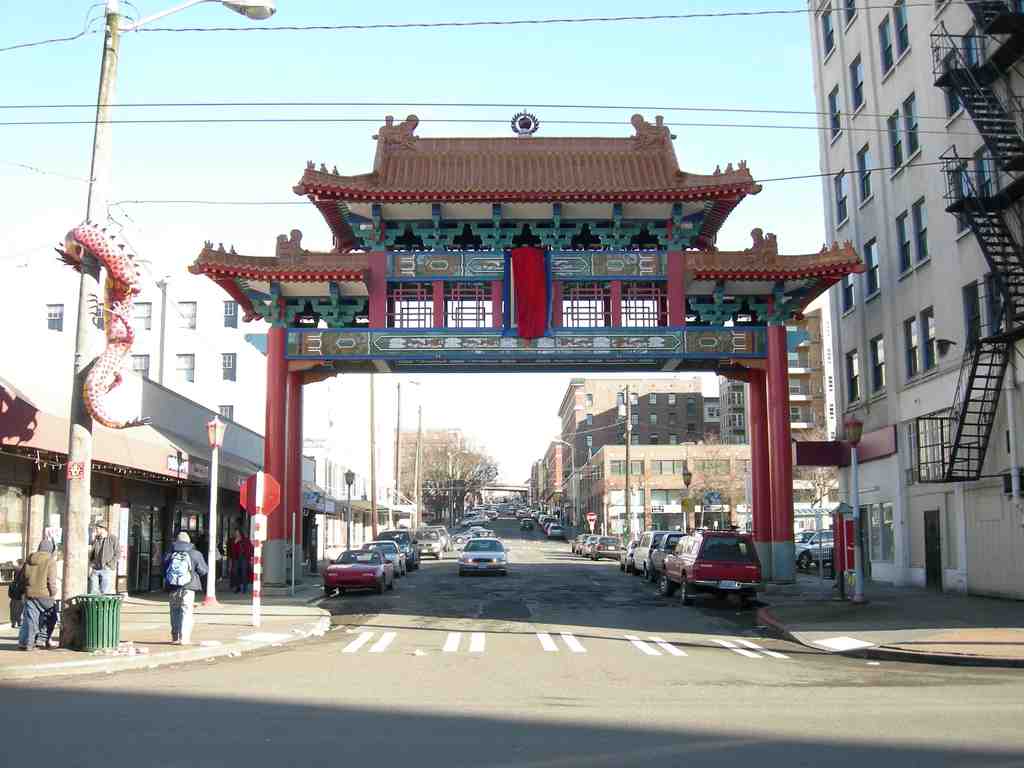
To spot the Chinatown-International District, just look ahead for a grand, colorful gate with traditional Chinese architectural details and a red-tiled roof stretching above King Street-a magnificent archway that stands out among the low-rise buildings and nearby dragon sculpture winding up a lamppost.
Welcome to the beating heart of Seattle’s Chinatown-International District, or as locals like to call it, the CID! If you listen closely, you might even hear the faint clatter of mahjong tiles, the sizzle of hot woks, or laughter from families gathering for a holiday celebration-because this isn’t just a neighborhood, it’s the living storybook of Seattle’s Asian American community.
Close your eyes for a second-or, well, maybe don’t if you’re crossing the street-but just imagine: Over 150 years ago, Chinese immigrants first arrived in Seattle, drawn by dreams of opportunity out West. It was the gold rush, timber, and railroads that called to them, and soon these newcomers set up their first homes near the old Yesler Mill on the city’s rough-and-tumble waterfront. But this early "Chinatown" would not be their last. As the city grew, the community was pushed from place to place-a rough journey shaped by prejudice, the Exclusion Act, and even the aftermath of the Great Seattle Fire. Still, with every move-from the muddy hills to the busy blocks here near King Street-they rebuilt, reconnecting, and creating something even stronger.
By the time you’re standing beneath the colorful gate, you’re actually at the entrance to what became the third Chinatown-what a third time! They say the third time’s the charm, after all. Here’s where history, resilience, and flavor all meet. The neighborhood soon became a patchwork, a home not just for Chinese immigrants, but also Japanese families, Filipino workers, and later, Vietnamese newcomers, each adding a new spice to the CID’s simmering pot. Imagine late nights in the 1920s, when Japantown bustled with restaurants, shops, and even jazz music, played by African American musicians who’d come north in search of brighter days.
But life was never easy here. During World War II, the CID’s Japantown was nearly emptied as its residents were suddenly taken away to internment camps. Shops closed, apartments emptied, and the music faded, only for new voices to arrive in their place-Vietnamese immigrants after the Vietnam War, Filipino workers, and new waves of Chinese families. Every wave left something behind; every struggle wove another thread in the fabric of this place.
Yet the battles weren't only those of the past. When the hulking Interstate 5 was built through the neighborhood in the 1960s, many historic businesses were bulldozed, and the community faced-and survived-one disruption after another, including the construction of the Kingdome stadium just next door a decade later. If you hear a distant echo, maybe it’s the shouts from one of the many protests that sprang up along these streets: residents demanding a voice in their own future, business owners rallying to keep their doors open, or neighbors united to preserve Lane Street from private development.
Despite challenges, the CID’s spirit never faded. The 45-foot-tall gate right in front of you-a glorious splash of red, teal, and gold-was unveiled in 2008. It wasn’t just built for looks; it’s a symbol of pride, a welcome mat not just for tourists, but for everyone whose story has ever begun here.
Today, walk these streets and you’ll see Vietnamese markets bursting with bright vegetables and fragrant herbs, Japanese bakeries with rainbow-colored sweets in the windows, and murals and dragon sculptures that make you feel like you just wandered into another world. On festival days, the air is alive with the crackle of firecrackers and the swirl of dragon dancers. At Lunar New Year, the whole district comes alive; in summer, Dragon Fest draws crowds from across Seattle for music, food, and martial arts.
Behind all this fun, though, there are scars. The neighborhood has wrestled with gentrification, homelessness, and loss-the threat of old businesses closing, families moving away, and the relentless pace of change. In fact, the Chinatown-International District was recently named one of America’s 11 Most Endangered Historic Places, a sobering honor reminding us all to treasure every cobblestone, every storefront, and every story that’s still unfolding here.
So whether you’re here for dim sum, heritage, or a bit of both, let your senses soak it in, and remember: this isn’t just a neighborhood. It’s a living record of struggle, celebration, and the rich diversity that keeps the city’s heart beating strong. Soaking up all these stories? You, my friend, are officially part of the CID’s living history!
Yearning to grasp further insights on the location, culture or the transportation? Dive into the chat section below and ask away.




