
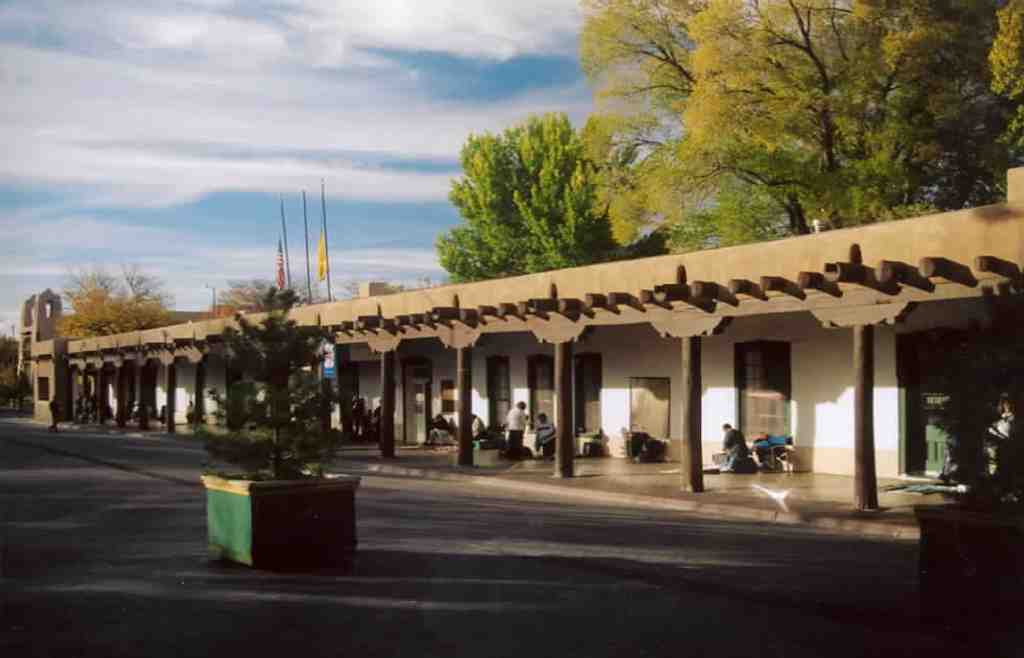
On your right, look for the long, low adobe building with a deep wooden porch lined by chunky posts and dark beams, stretching almost the whole block like it’s calmly claiming the Plaza.
This is the Palace of the Governors, and if these mud-plastered walls could talk… they’d probably ask for a lozenge first. The Palace has been running Santa Fe’s “front desk” since the earliest days of Spanish rule-officially set up as the capital building in 1610, when Governor Pedro de Peralta got construction moving (some historians argue it really took shape closer to 1618). Either way, it’s old enough to make most American history feel like a new hobby.
Stand here a moment and take in the Territorial Style-thick adobe, that long portal, the way the whole building sits low and wide, built for sun, wind, and the kind of high-desert weather that changes its mind before lunch. Archaeologist Jesse Nusbaum, brought in during a 1909 restoration, loved that the Palace didn’t fight the landscape. He wrote that it was shaped by the climate, matched to the “earth and sky.” In Santa Fe, blending in is kind of the flex.
But the real drama is what this place has witnessed: the Pueblo Revolt in 1680, the Spanish return in 1693-1694, Mexican independence in 1821, the U.S. taking New Mexico as a territory in 1848, and finally statehood in 1912. For centuries, whoever held power tended to do it from right here-because nothing says “authority” like an adobe headquarters on the Plaza.
And then there’s the moment that feels almost cinematic. In the late 1870s, Governor Lew Wallace-yes, the guy who wrote Ben-Hur-worked here. One night in spring 1879, after a tense meeting with Billy the Kid out in Lincoln County, a thunderstorm rolled in. Picture it: shutters closed, lamp shaded, Wallace writing the Crucifixion scenes… while worrying someone might put a bullet through the window. Productivity, Santa Fe style.
From 1909 until 2009, this building served as the state history museum, and it’s been a National Historic Landmark since 1960-so beloved it even got its own turquoise postage stamp that same year.
When you’re set, Soldiers’ Monument is a 1-minute walk heading west.


