
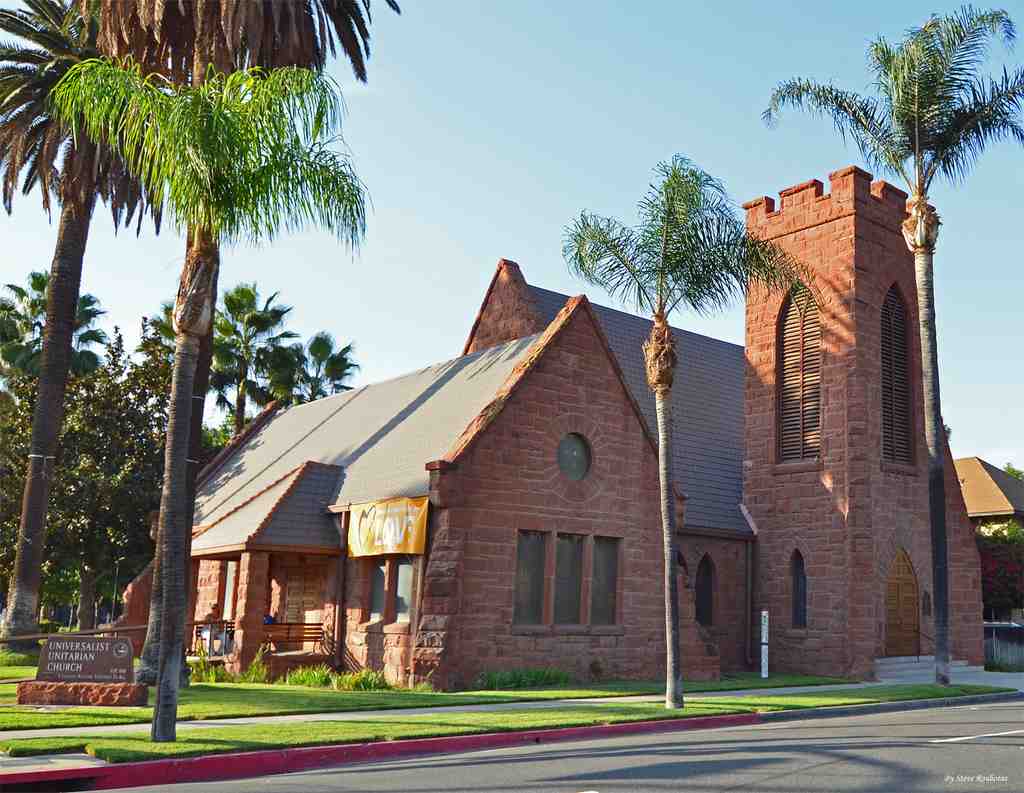

Look to your left for a striking building constructed of rough-hewn red sandstone, featuring a steeply pitched roof and a prominent square tower topped with castle-like battlements. The app has a cool historic photo showing what this place looked like back in 1899.
What you are looking at is the Universalist Unitarian Church of Riverside, and its story is one of sheer determination and constant evolution. You see, before they had this elegant structure, the congregation's first home was entirely recycled. Back in 1882, they purchased Riverside's original wooden schoolhouse for a mere 300 dollars, which is roughly 9000 dollars today. They hauled that wooden building to a donated lot and remodeled it into a chapel. This ability to take something old, move it, and completely repurpose it for a growing community perfectly captures Riverside's early spirit. When resources were scarce, the people here did not just give up... they adapted and rebuilt with whatever they had at hand. That rugged resourcefulness laid the groundwork for the ambitious city we see today.
By 1891, local builders faced the new church walls with imported Supai sandstone. That is the exact same ancient red stone that forms the spectacular slopes of the Grand Canyon. It was an extraordinary logistical feat for the era to bring that massive rock all the way from Arizona.

As the decades passed, the congregation proved just as adaptable as their architecture. In 1938, they officially bridged the gap between two liberal faiths by joining the American Unitarian Association. Interestingly, when the church reincorporated in 1957, they made a highly unusual choice. They deliberately placed the word Universalist before Unitarian. It was a defiant nod to their origins as the first Universalist parish in the American Southwest, completely reversing the standard national naming convention.
Their protective spirit eventually extended to the building itself. When experts realized this historic unreinforced masonry building, meaning heavy stone construction lacking internal steel supports, was incredibly vulnerable to California's earthquakes, the congregation rallied. They undertook a massive seismic retrofitting project, successfully saving the structure from disaster in 1988.
If you want to peek inside, they are open Sundays from 10 AM to noon, and Tuesday through Friday from noon to 2 PM. Next, we are going to explore how Riverside protected its mind as well as its soul, as we take a quick one-minute walk to uncover the story of the city's rescued literary treasures at the Riverside Public Library.


