
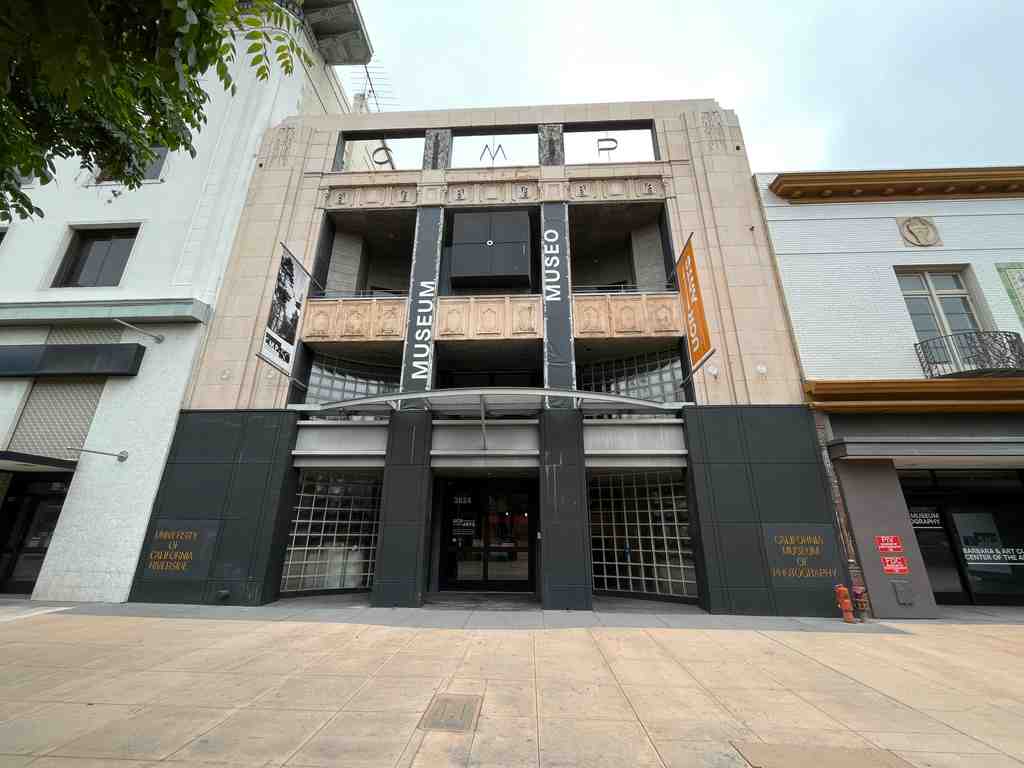
On your left, you will spot the museum by its pale upper facade contrasting with heavy dark entrance pillars, and a very distinct, protruding black box sitting right on the upper balcony.
It takes a fierce, almost radical kind of imagination to look at an abandoned retail shop and decide it should be transformed into a giant, inhabitable machine. This push for unconventional, modern ideas is exactly what defines the California Museum of Photography.
You are looking at a renovated 1930s dime store... a classic early twentieth century shop where everyday goods were sold for just five or ten cents. Back in 1986, the university bought this building from the city for exactly one dollar. Architect Stanley Saitowitz gutted the inside, redesigning the entire space as a literal metaphor for a camera, working on the philosophy that the people walking through it are the film.
And that strange black box up on the balcony? That is a walk-in camera obscura. A camera obscura is an ancient optical device, essentially a completely pitch-black room with a tiny hole that naturally projects a live, upside-down image of the outside world onto an interior wall. You can actually step inside it and stand physically within the mechanics of early photography.
The museum itself actually began as a grassroots effort in 1969, when an orthopedic surgeon named Dr. Robert Bingham teamed up with an art professor in the basement of a university library. He donated two thousand vintage cameras... a collection that has now swelled to ten thousand pieces of photographic apparatus.
But the true power of this museum lies in what it protects. With the largest photographic holdings in the Western United States, this institution has been shaped by individuals who refused to let history be erased. Consider the legendary photographer Ansel Adams. In 1964, he was hired to photograph the university system for a massive project. He spent three years traveling, trying to capture the invisible product of knowledge. But in a sharp twist of political conflict, his celebratory book was published the exact same month the new state governor abruptly fired the university president. Adams watched the institution he just spent years documenting get politically dismantled, leaving his seven thousand negatives as a poignant record of a fractured era.
Then there is the Keystone-Mast Collection, an archive of over two hundred and fifty thousand stereoscopic negatives. Stereoscopy was an early craze where two slightly offset photos were viewed together to create a three-dimensional illusion. Because they were meant to look perfectly natural, photographers captured an immense amount of hidden detail. Decades later, a contemporary artist examining these glass plates discovered something bizarre... the original photographers had secretly staged dead birds and rabbits hidden deep in the foliage of the landscapes.
The museum is closed Monday through Wednesday, but opens its doors Thursday through Sunday from midday to late afternoon. Now, let us walk toward the pedestrian area just ahead, as we make our way to the Main Street Pedestrian Mall.


