
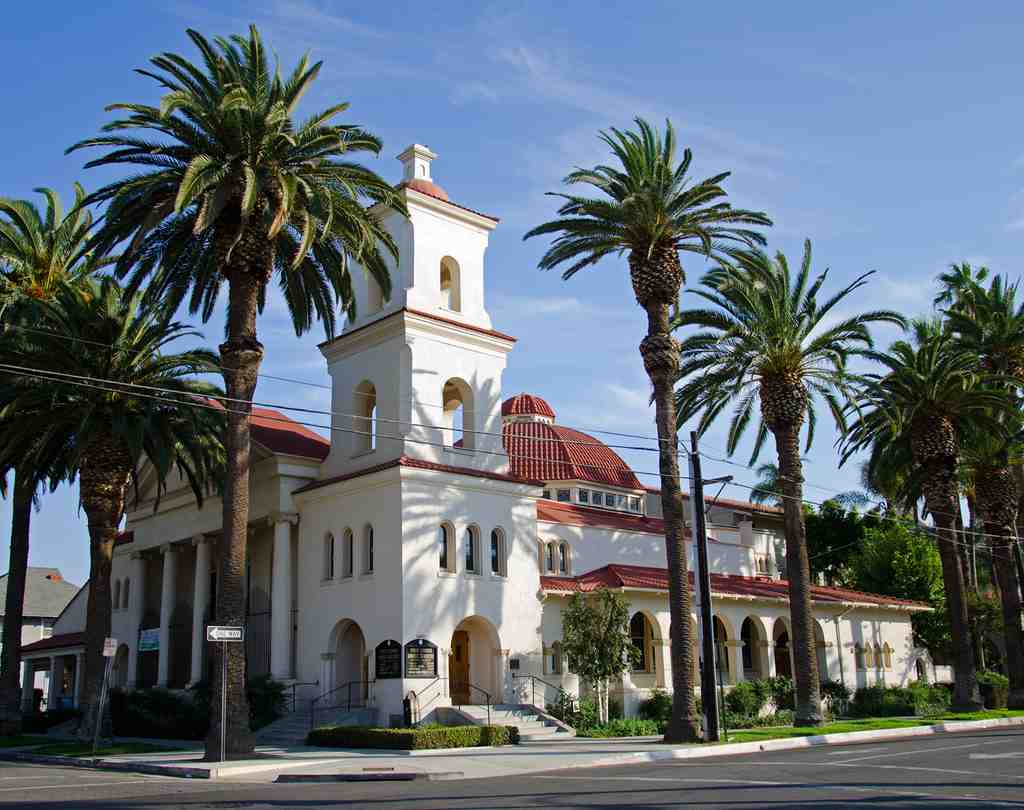

On your right, look for the striking white stucco building featuring a red-tiled dome and a prominent, three-tiered bell tower. This is the First Church of Christ, Scientist, completed in 1901, and it is a masterpiece of design.
The architect behind this beauty was a man named Arthur Benton. Benton was not just a hired hand for this project, he was actually one of the founding members of the congregation and served as its secretary. His deep personal investment shines through every detail of this building, which was his very first design in Riverside and a pioneering example of Mission Revival architecture, a style that draws heavily on the smooth walls, rounded arches, and clay roof tiles of historic Spanish missions.

But the story of this building really starts with the fierce determination of one woman, Emma Stanton Davis. She moved to Riverside in 1887 and began practicing Christian Science, which had been founded by Mary Baker Eddy just a couple of decades earlier. Davis was the very first class-taught student of the religion in all of California. Her healing work quickly attracted a devoted following of prominent citizens, including wealthy citrus growers who helped legitimize and fund this exact building.
The church actually built a permanent tribute to her relentless drive. Look at the two bell towers flanking the main entrance portico. The one on the left has two segments, but the larger one on the right has three. That right tower is not just decorative. The functional second floor of that larger tower was originally built specifically to serve as the personal room of Davis herself.

Over the years, the interior of the church had its own evolution. In 1913, the congregation purchased a massive pipe organ. To fit the enormous instrument, they had to entirely repurpose the original choir loft into a chamber for the organ pipes. Later on, original stained glass windows located near the rostrum, which is the raised platform where speakers stand, were moved and eventually relocated to a neighboring Sunday school building.
But the true legacy of this church extends far beyond its walls. When it was dedicated, the local paper declared it the prettiest in the city. A man named Frank Augustus Miller, who ran a modest adobe tourist hotel nearby, walked over and was absolutely captivated by the work Benton did here. Miller saw this building and instantly realized Benton was the exact visionary needed to transform his simple adobe into a grand, palatial destination.
That spark of inspiration changed the identity of this city forever. Let us take a short walk to see what Benton and Miller built next, the internationally famous Mission Inn Hotel and Spa is just a three minute walk away.


