
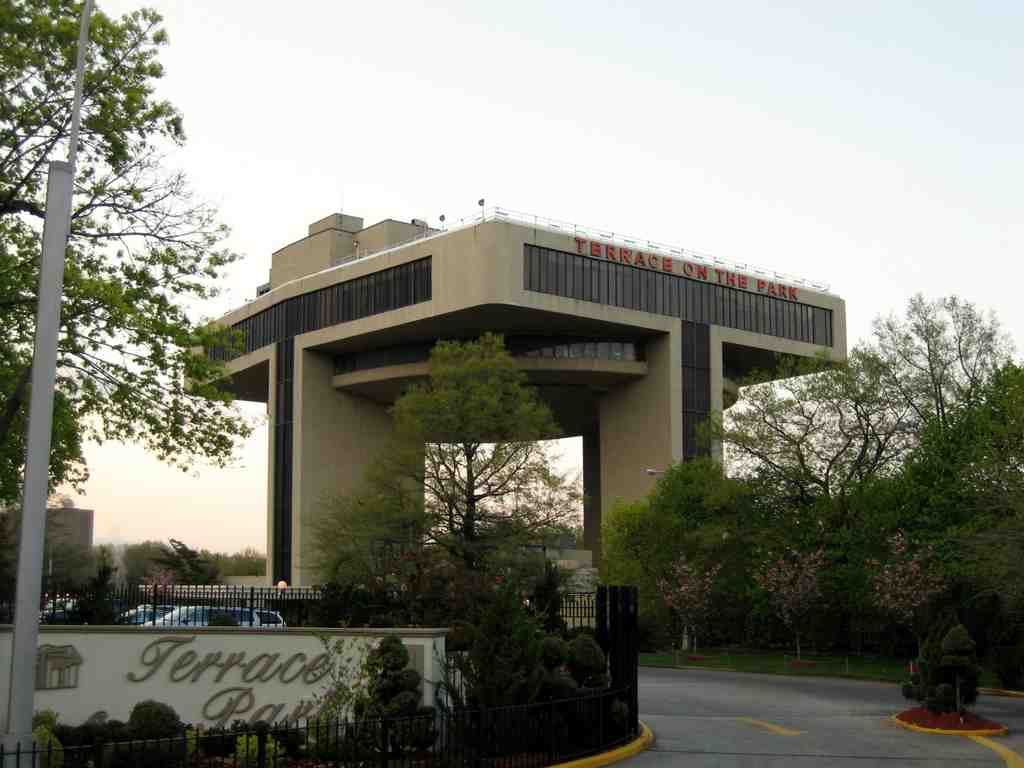
Look to your right and you will see a massive, flat topped concrete structure suspended midair on four giant pillar legs, proudly displaying the red letters Terrace on the Park across its upper rim.
We just left the quiet domestic dream of the Underground World Home, but up there, floating one hundred and twenty feet above the ground, is Robert Moses's ultimate space age fantasy. Moses, the president of the nineteen sixty-four World's Fair Corporation, wanted an aerial gateway. He imagined a futuristic transportation hub where VIPs would bypass the messy streets below and hopscotch across city rooftops in high speed helicopters.
The Port Authority spent two point four million dollars to build it, about twenty-four million today. They designed it in the Brutalist style. Those four giant legs create a T shape on each side, standing for transportation. The plan was thrilling. Businessmen would land on the roof, ride an elevator down into an opulent restaurant called Top of the Fair, and dine on crab ravigote while looking down at the crowds.
Inside, the artwork perfectly captured the grand ambitions of the fair. The famous cartoonist Rube Goldberg even painted a mural called How to Cure World's Fair Tired Feet, depicting a wacky, overly complex contraption of gadgets to soothe aching soles.
But grand master plans rarely survive contact with reality. Helicopter travel was simply too expensive and impractical for the average fairgoer, who was already paying a steep admission fee just to access the restaurant. Diners complained about poor service, and by August of the fair's very first year, Top of the Fair filed for bankruptcy. Ultimately, the broader city vision of a sprawling network of rooftop helipads died after a tragic helicopter accident on a Manhattan skyscraper in nineteen seventy-seven.
Yet, when the top down utopian dream failed, the local community claimed this floating concrete box and made it completely their own. In nineteen sixty-nine, it reopened as a catering venue named Terrace on the Park, entirely shifting its focus from exclusive sky high VIPs to neighborhood celebrations. Queens residents transformed it into a legendary party palace. The sheer scale of those enormous ballrooms meant people threw impossibly extravagant celebrations. One groom actually rode a live horse right into the building, and a boy celebrating his bar mitzvah was famously paraded into the ballroom on a real baby elephant.
The building became deeply woven into Queens pop culture. In nineteen sixty-five, The Beatles landed a helicopter on that roof, then rushed to their concert in an armored truck to escape screaming teenagers. Years later, Fran Drescher, the future star of the sitcom The Nanny, married her high school sweetheart here. Around that same time, a young, unknown dancer named Madonna got a job running the venue's elevators. She was famously fired after just two weeks because she was caught having sex with a waiter inside the elevator car. You really cannot script that kind of local history.
From a failed playground for airborne elites to a beloved stage for neighborhood weddings and wild teenage escapades, this hovering banquet hall proves that the best urban spaces are the ones the people adapt for themselves. Now, from luxury dining in the sky, we are going to look toward the final frontier of space. Let's walk about six minutes to our next stop, the New York Hall of Science.




