
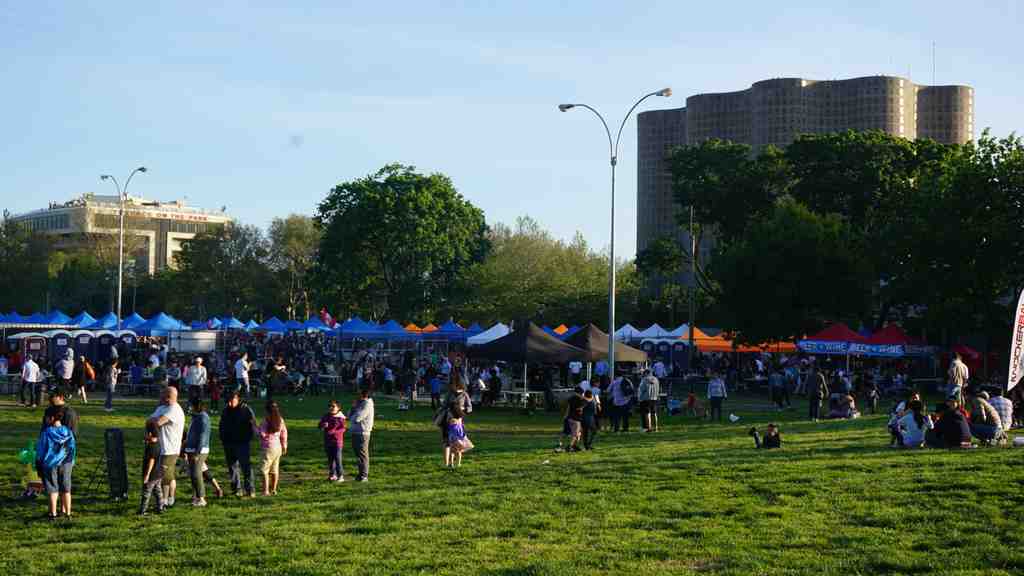
Look to your right at that wide flat expanse of paved asphalt, marked by rows of white canopy tents standing just behind a low metal barrier. This space might look incredibly simple compared to the massive concrete rockets of the Hall of Science we just saw, but this is the Queens Night Market. What happens here is a spectacular victory for the people of this borough. Instead of some billion dollar master plan handed down by politicians, this market is a triumph of pure grassroots energy, transforming an everyday patch of park into a chaotic celebration of Queens' incredible diversity. It proves that the most powerful things in a city are not built by committees, but by neighbors sharing their culture plate by plate.
It all started with a guy named John Wang. He was a university trained corporate lawyer who was utterly burnt out and just two weeks away from leaving New York for good. But he had a wild idea. He remembered the buzzing, community focused night markets of his childhood in Taiwan, and decided to recreate that magic right here. He had zero background in event planning. He just poured his life savings into the project and gave himself exactly one year to succeed or fail.
Opening night in April 2015 was an absolute, glorious disaster in the best way possible. Wang and his tiny crew were completely unprepared. Massive, crushing crowds flooded the park, completely overwhelming the forty vendors. It was so instantly popular they eventually had to start ticketing the early preview nights just to keep the sheer volume of people from breaking the event.
Wang instituted a strict five dollar price cap on all food, which is now six dollars. He actually called it his personal rebellion against how insanely unaffordable New York City had become. But keeping it that cheap required brutal personal sacrifice. Wang did not take a single day off for five years. He ran it with no staff for eight years and did not even break even until year three. Today, they rely on corporate sponsors to subsidize the vendors so the food stays cheap.
The true heart of this market is the vendors, who represent over eighty countries. Wang's wife, oral historian Storm Garner, preserved their incredible stories in a university thesis that became a published cookbook. You learn about people like Maeda Qureshi, who ran a stall called The Pakistand to raise money for charities. When the pandemic hit in 2020 and the market paused, the community was devastated. Qureshi actually paused her stall to work full time as an intensive care unit nurse in Elmhurst. Meanwhile, immigrants like Danny Atehortua from Colombia used the massive crowds here to launch Arepalicious, which is now a permanent physical restaurant.
Now, let us walk toward a building that has seen almost every single era of this park's sprawling history. We are heading over to the Queens Museum, just a six minute stroll away.




