
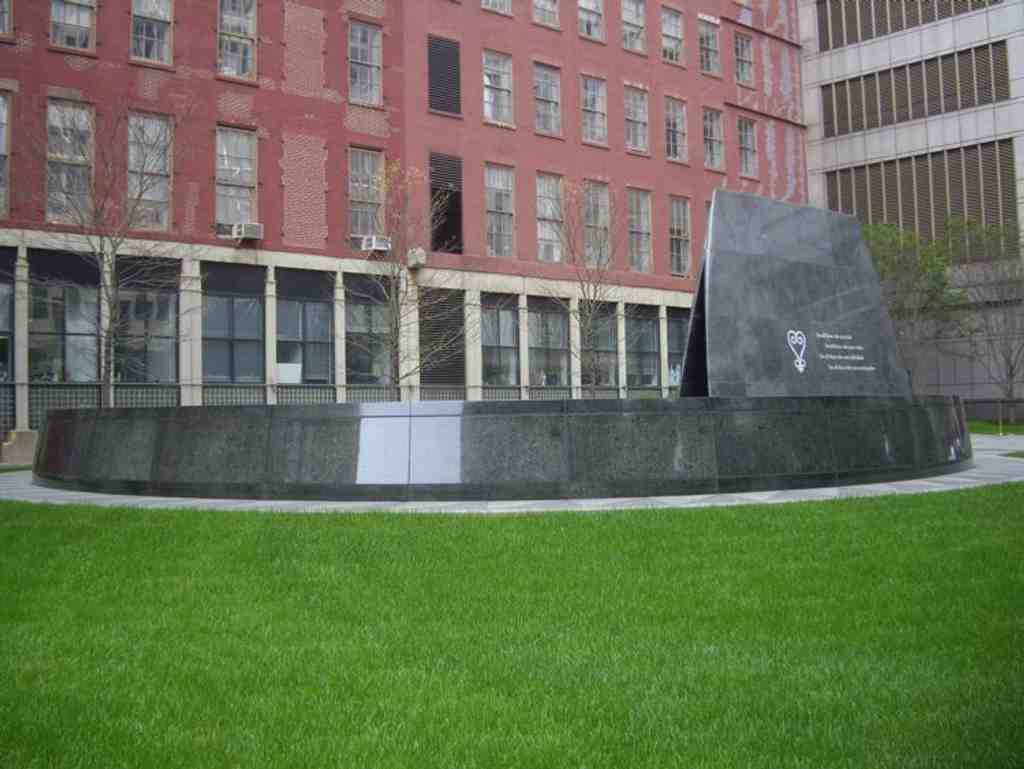
To spot the African Burial Ground National Monument, look for a striking black granite structure shaped like a circle and a tall, angled chamber sitting on a patch of bright green lawn, right outside the Ted Weiss Federal Building at the corner of Duane Street and African Burial Ground Way.
Alright, you’ve made it! You’re standing beside what at first glance looks like an impressive piece of modern art, but in reality, this is New York’s most moving historical secret-one that refused to stay buried. Picture the late 1600s: the city was much smaller, with farmland and muddy roads. Europeans called it New Amsterdam until the English swapped in “New York.” Right here, a future metropolis built up over what became the largest colonial-era cemetery for people of African descent in the country-today’s Civic Center. Thousands of New Yorkers, many enslaved, some free, were laid to rest under this very ground.
This spot is marked by the 24-foot tall Ancestral Chamber, made of green African granite and engraved with a West African Sankofa heart: its message, “Learn from the past to prepare for the future.” The circle you see isn’t just stone-it’s a “Circle of the Diaspora,” a map of the Atlantic slave trade, with stones brought here from both Africa and North America. Some people call it a powerful symbol of worlds brought together, though I think of it more as a petrified reunion!
But let’s rewind to the days when the city’s population was only a few thousand, and nearly half the city’s households had slaves. Harlem was wilderness, Trinity Church refused to let Black people be buried on its grounds, and so began the “Negro’s Burial Ground” on what was then just the outskirts. In those days, the British had their own rules-a little less freedom, a lot more work. Africans worked all over early New York: building houses, roads, even helping shape the city’s shipping and trade.
By the American Revolution, enslaved Africans made up almost a quarter of New York’s population. Even George Washington’s slaves tried to escape here following the British promise of freedom. The city became a magnet for people hoping for a new life. The war upended everything: loyalty, freedom, and even who got to stay in the city. After the British left, and long after July 4th became “New York’s Emancipation Day,” the story of the burial ground faded under streets and skyscrapers.
Except, luck-or maybe fate-had other plans. When a new federal building was rising in 1991, workers found bones. At first, people thought it was an old potter’s field. But more digging uncovered hundreds of burials-over 419 intact remains. It was a shock. The noise of city traffic was suddenly replaced by protests and public outcry. People demanded respect for those buried here, and Congress hit pause on construction. It took years, a lot of passionate voices, and some tense moments in Washington, but this place finally got the honor it deserved.
Picture the Ancestral Reinterment Grove here: 419 hand-carved coffins from Ghana, lined with Kente cloth, placed with care in seven burial mounds, heads facing west. The ceremony was emotional enough to make even a tour guide need a tissue. Thousands joined a procession that traveled from Washington D.C. to Manhattan, letting the world know this wasn’t just New York’s history, but America’s, too.
Inside the memorial’s visitor center, you can see artifacts, stories, and a life-sized tableau of a funeral. Amazingly, some skeletons had filed teeth from African rituals, pendants as keepsakes, even signs of tough lives-disease, malnutrition-yet they also left us clues about their culture, resistance, and dreams.
Today, this monument is a place of memory, education, and justice-proof that history can be forgotten only until someone decides to remember, even if it takes a construction accident to get our attention! So as you stand here, the city’s buzz fades and you’re part of a centuries-old story-a story still being told and, thankfully, never truly buried.
When you’re ready, let’s wander over to our next stop-the grand Surrogate’s Courthouse. Onward!
Interested in a deeper dive into the africans and african americans in new york city, memorial or the legacy? Join me in the chat section for an insightful conversation.


