
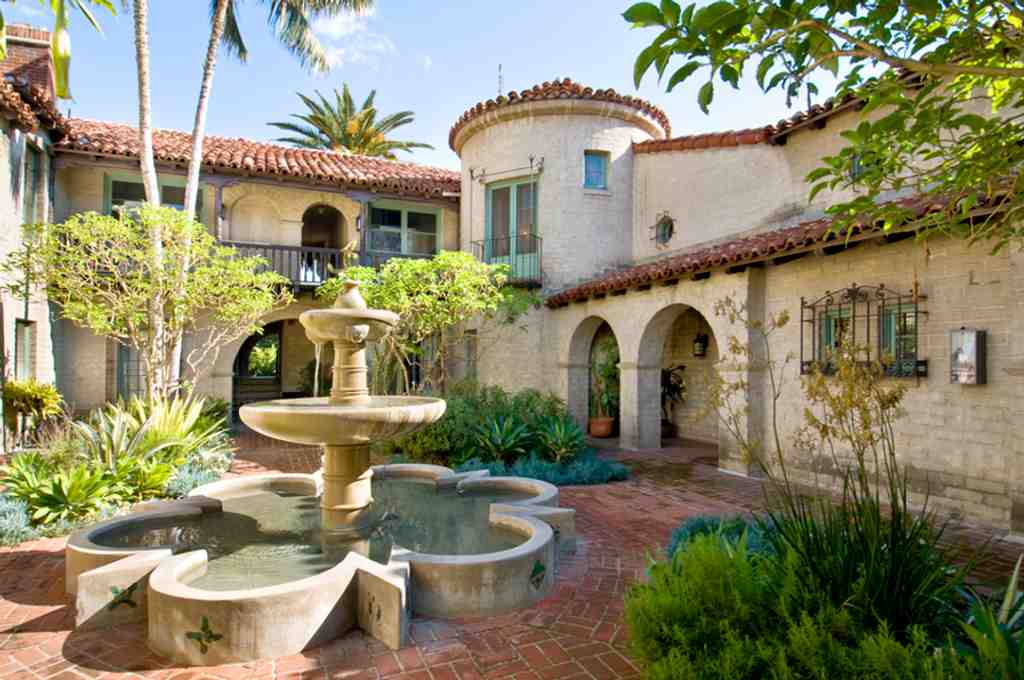
Right in front of you is El Cabrillo-just look for the two-story Spanish-style courtyard, where old brickwork, arched walkways, a rounded turret, and a classic tiled fountain in the center practically transport you to golden-age Hollywood.
Alright, welcome to El Cabrillo, where history, mystery, and a pinch of Hollywood magic meet right under these shady palms! Can you hear that gentle trickle from the stone fountain? That sound has echoed off these walls since 1928, when legendary movie mogul Cecil B. DeMille decided to create something truly spectacular. He brought in the dynamic architect duo Arthur and Nina Zwebell-think of them as the Spielberg and Lucas of courtyard design. But here, they did something special: unlike their other work, El Cabrillo was built from sturdy brick, not just stucco and wood, immediately giving it more gravitas and a permanent, grand feel.
As you gaze around, soak in the Spanish Colonial Revival details-the hand-made tiles, the swirling wrought-iron, and those magnificent timbered ceilings peeking through the windows. If you imagine candlelight and a parade of stars in elegant 1920s garb, you’re not far off. El Cabrillo quickly became one of Hollywood’s most fashionable addresses, where celebrities and up-and-coming actors wanted to be seen. In fact, actress Ann Harding paid an eye-watering $500 a month to live in one of the snazzy front apartments-try charging that for rent to your houseplants today!
Stories swirl around this place. Some say DeMille built it to house his favorite New York stage actors when “talkies”-movies with sound-first arrived. Others believe it was a lavish present for his daughter Frances. Either way, only in Hollywood could the truth be less dramatic than the legends! And true to form, the complex became a backdrop for old and new Hollywood alike. Rudolph Valentino may have filmed a silent scene here in the courtyard, while, decades later, drag legend Divine and costume collector Kent Warner both called it home. There’s even a Hollywood-style heist twist: after Warner died, the basement was cleaned out, tossing priceless treasures like James Dean’s “Rebel Without a Cause” boots and Marlon Brando’s “Wild One” jacket straight into the trash-ouch!
But not all the drama happened on screen. In the 1930s, a scandal erupted when a judge’s daughter and son-in-law were discovered living here rent-free, sparking a grand jury investigation. Then, during tougher times in the ‘70s and ‘80s, residents would sometimes have to duck inside to avoid stray bullets zipping through the night -Hollywood can be as wild as any movie plot, can’t it?
Yet, El Cabrillo has always been a scene-stealer. It shone as the home base for TV’s “Chuck” (though, in true Hollywood fashion, the magical courtyard you saw in the show was eventually recreated on a soundstage), and it’s popped up in “Perry Mason,” “Hollywood,” “911,” and even in “Stalker,” where actor Dylan McDermott strolled through, wondering aloud how much it would cost to live here. Well, today, units go for sums that would make even a mogul blush-$800,000 or more!
Restored to its original glory, El Cabrillo stands not just as a home but as a living, breathing set. Designated both a Los Angeles Historic-Cultural Monument and on the National Register of Historic Places, it invites you to step into a world where the past is present, every tile has a tale, and every evening, you can almost imagine the ghostly laughter of Hollywood legends echoing through the courtyard. So take a moment to savor it-and maybe compose your own Hollywood ending right here.
Intrigued by the ties to hollywood film business, architecture or the later years? Make your way to the chat section and I'll be happy to provide further details.


