
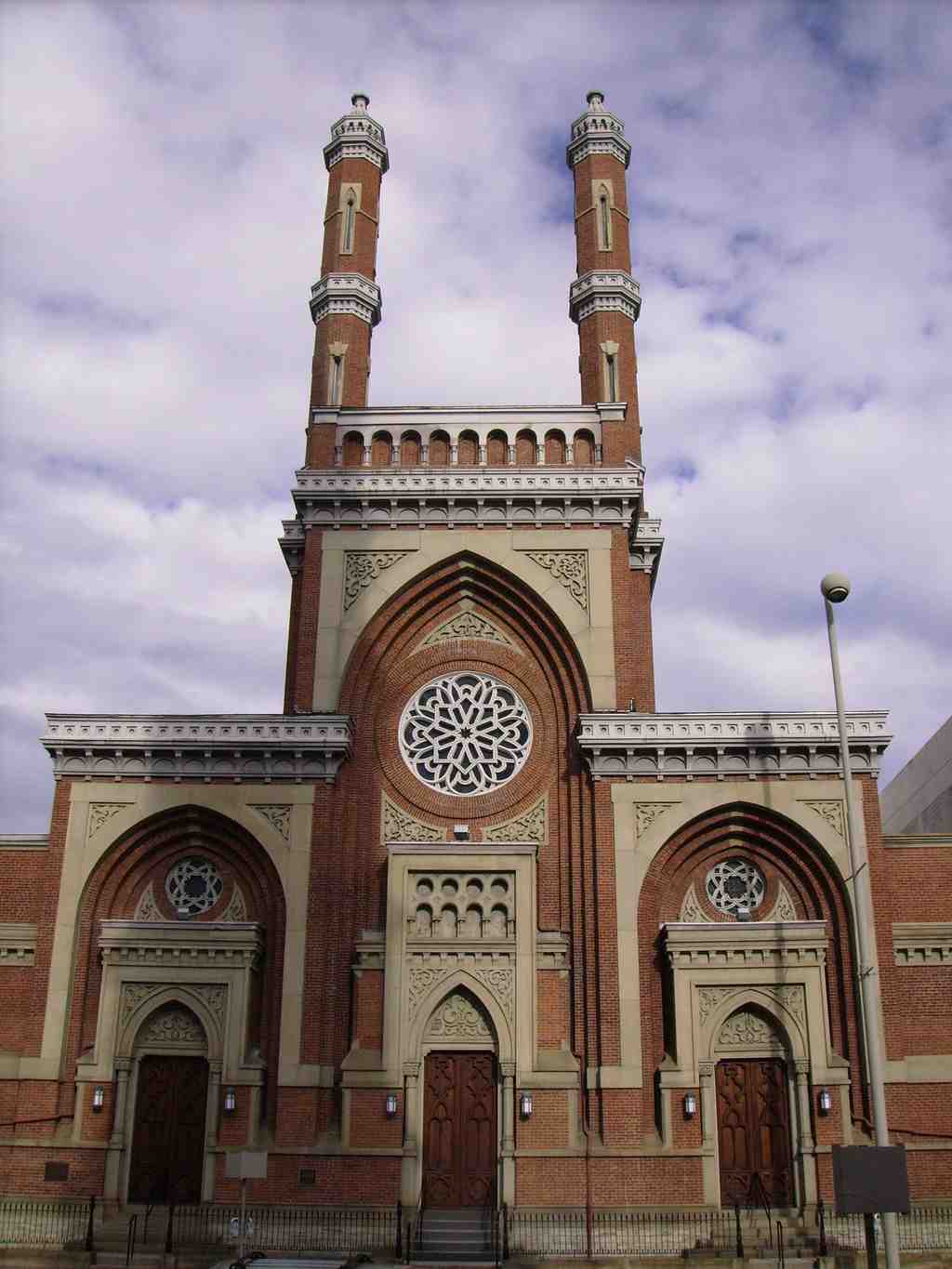
To spot the Isaac M. Wise Temple, look for an extraordinary brick building with two tall, ornate towers and a big round decorative window above its main entrance, right across the street from the Saint Peter in Chains Cathedral.
Welcome to the beautiful Isaac M. Wise Temple, one of Cincinnati’s true architectural showstoppers! If you feel a breeze swirling around those twin towers, just imagine it’s carrying whispers of nearly two centuries of history. Step a little closer and picture this: it’s the mid-1800s. The Civil War is rumbling around the country, and here in Cincinnati, a determined congregation-families of German-Jewish immigrants-are dreaming big. Their old synagogue on Lodge Street just isn’t grand enough. So what do they do? They build this magnificent temple, inspired by the magical Alhambra in Spain. It took a small fortune-$275,000 back then, which could buy you enough bagels to cover Plum Street and then some!
When the Plum Street Temple finally opened on August 24, 1866, Cincinnati’s streets filled with excitement. The air buzzed with pride for a temple dedicated to the legendary Rabbi Isaac Mayer Wise-the founding father of Reform Judaism in America. Wise wasn’t just Cincinnati’s rabbi: he was a rabbi with a reputation that spanned the country! He gave sermons, started newspapers, and led debates that shaped the very future of Judaism in the U.S. In fact, the only thing more impressive than Wise’s legacy might be the temple’s decor-look up at those beautiful arches and the rose window above you. That intricate pattern? Imagine sunlight streaming through it, making colors dance across the pews inside.
Over the years, this temple hasn’t just stood still. It’s been at the heart of many milestones. In 1972, a Bostonian named Sally Priesand was ordained here-the first female rabbi ever ordained by a rabbinical seminary in the United States. Not bad for a building whose neighbor, St. Paul’s Episcopal Cathedral, vanished into history long ago.
Today, the Wise Temple stands as a reminder of vision, endurance, and hope, echoing the footsteps of every member who’s ever walked through its doors. And just think-without that original group of dreamers from 1840, this corner of Plum Street would be missing a little magic…and a lot of history.


