
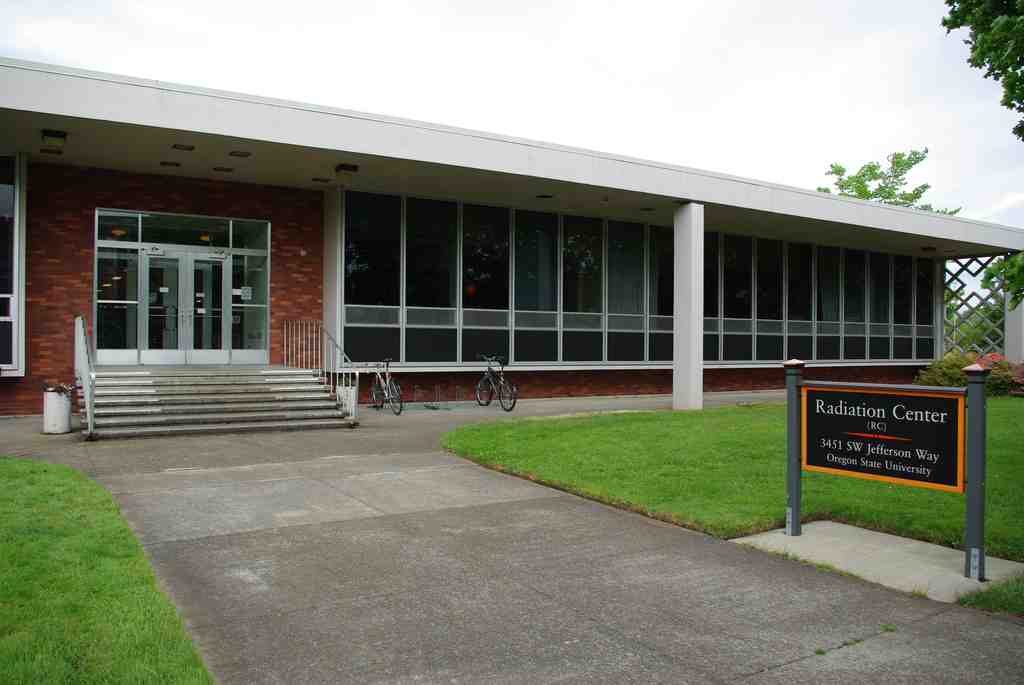
To spot the Oregon State University Radiation Center, look ahead for a low, brick building with a long row of tall silver-trimmed windows and a sign on the lawn by the entrance that reads “Radiation Center, 3451 SW Jefferson Way.”
Alright, time to add a little excitement to your campus walk-welcome to the Oregon State University Radiation Center, where science gets so intense, it literally glows! This seemingly quiet building might look like your average campus hall, but step a little closer, and you might imagine hearing a faint hum from all the buzzing research inside.
Now, let’s turn back the clock to the late 1960s. The year is 1967, and tucked over here on the west side of campus, OSU is preparing to flip the switch on something big-a TRIGA Mk. II nuclear reactor, which sounds like a robot from the future, but is really a peaceful powerhouse for science. This reactor isn’t just humming away on its own; surrounded by thick concrete and graphite, it’s quietly supporting all kinds of experiments, from chemistry and civil engineering to geology and even ocean sciences. If you imagine the sounds of excited chatter and clinking glassware-well, you’re not far off.
The mission here is simple but powerful: to support the entire university with research, teaching, and service projects that need access to radiation or radioactive materials. It’s not a mad scientist’s lair-though it has just the right number of secret-sounding labs and mystery-but a place where bright minds come together for good.
The beating heart of the center is the Oregon State TRIGA Reactor, which can chug steadily along at a thermal output of 1.1 megawatts-or pulse up to an electrifying 3000 megawatts for a split second. That’s a flash of energy strong enough to make your hair stand on end-if you were allowed near it, of course! Thankfully, only trained professionals get that close, and most of what happens here takes place behind sealed doors and layers of protection.
This reactor isn’t a one-trick pony: it features six in-core irradiation facilities with names straight out of a sci-fi script. Some of these are the Central Thimble, the CLICIT, and the “Lazy Susan”-yes, a Lazy Susan, only instead of serving up snacks, it hands out neutron flux in neat circles! Can you picture samples spinning slowly, bathed evenly in invisible rays? You won’t see or feel a thing out here, but through these clever devices, researchers test minerals for age, create medical isotopes for hospitals, and even help forensic experts solve crimes.
Speaking of crime-busting: the reactor here once helped analyze evidence in the case of the infamous I-5 Bandit-a serial killer. A beam of neutrons, a bit of radioactive wizardry, and suddenly clues that were once invisible became clear as day. It’s a reminder that what happens in this quiet building can have real-world impacts, sometimes in the most dramatic ways.
But don’t worry, safety isn’t just an afterthought. For over a decade, this center has hosted HAZMAT radiological training-teams learning how to handle emergencies, overseen by the Oregon Department of Energy. If anything ever goes wrong (which, knock on wood, it doesn’t), there’s a rapid-response security force ready in moments. And now, OSU’s own campus Public Safety guards the facility-no need for capes, but maybe a cool utility belt or two.
The reactor also boasts some impressive neutron beam ports-think tunnels that channel intense streams of neutrons and gamma rays out for experiments. Beam port #3 is especially popular, used in neutron radiography, which is basically an X-ray vision for scientists. Behind those panes of glass and layers of shielding are controls that would look at home in a sci-fi movie, with safety features galore-like automatic shutdowns if anyone gets too curious with the doors and shutters.
But not everything here is old school! You’ll find projects studying how to sterilize medical equipment, develop new treatments for cancer, track fission in tiny minerals, and even figure out how old a rock is just by peering at particle tracks. In all, around 70% of the projects here depend on the reactor, drawing students and experts from all over the world.
So the next time you pass by, know that within these calm, brick walls beats the pulse of cutting-edge science, flashing brilliantly-albeit invisibly-through all corners of campus and, sometimes, the world. And remember, while it might not have a glowing green core like in the movies, the real magic is happening just out of sight-carefully, quietly, and with a spark of Beavers science!


