
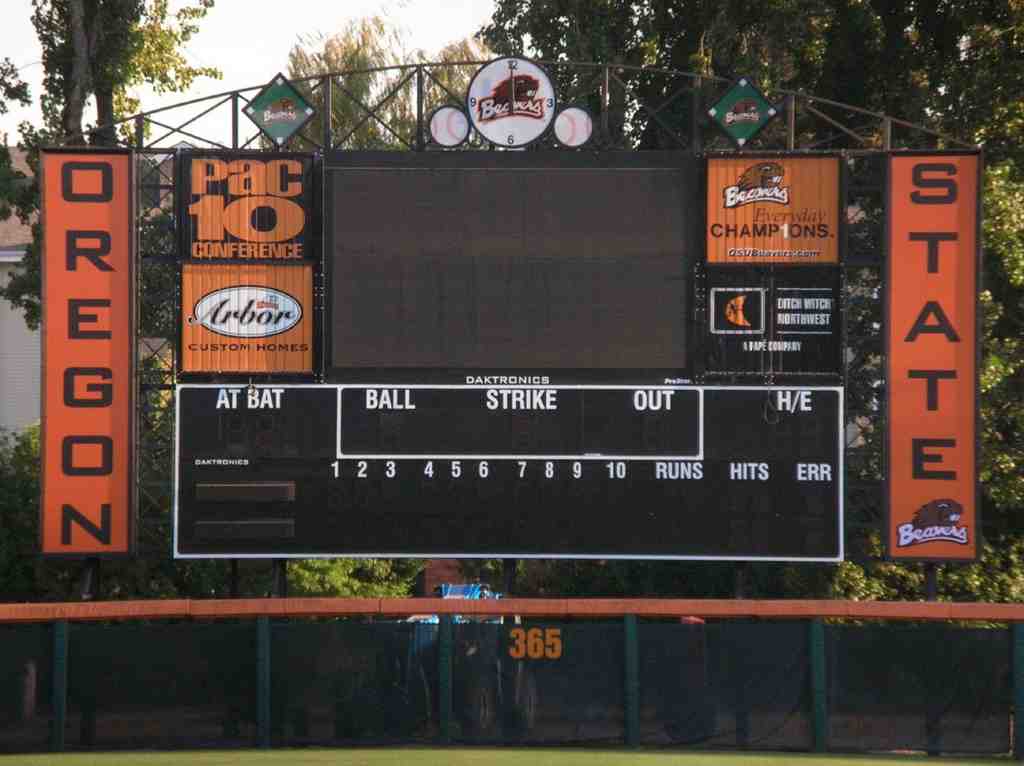
If you’re looking for Goss Stadium at Coleman Field, just find the large scoreboard flanked by tall orange signs that spell out OREGON STATE, standing above a stretch of green field and framed by trees in the background.
Alright, you’re standing in front of a real piece of Oregon State University’s heart and history-Goss Stadium at Coleman Field. Just take a deep breath; you’re about to step into the oldest continuous ballpark in the nation, with over a century’s worth of echoes still trapped between these seats and fences! Imagine it’s April 1907, and the very first game is about to begin right here. The grass is so new you can almost smell the fresh cut, and the cheers of the crowd bounce off the nearby academic halls. Back then, the field wasn’t even officially named yet, but year after year, as the local traditions grew-like the annual alumni bonfire-everyone just started calling it Coleman Field after beloved coach Ralph Coleman.
Now, Coach Coleman left such a mark here, it’s as if his spirit does laps around the bases every game. Thirty-five years as head coach will do that. By the late 1930s, local newspapers were already calling it Coleman Field, and by the ’40s, it was a legendary stop for baseball enthusiasts across the region. Of course, things weren’t always smooth sailing. In the 1960s, there were whispers that the field might be moved out by the west side of Parker Stadium, now Reser Stadium. The tension must have been thick as a mitt full of pine tar-imagine the Beavers having to leave their home right in the middle of campus!
But tradition held on tighter than a catcher’s glove. In 1981, the field got a bit of a facelift after some much-needed improvements. Then came 1986, when tragedy and memory melded together. The Scott Halbrook Memorial Scoreboard was added, honoring a freshman outfielder lost too soon. That scoreboard stood tall until 2006, watching over thousands of fans until a new era of big screens and video replays began.
A real turning point arrived in the late ‘90s, when generous donors John and Eline Goss stepped up with a remarkable $2.3 million gift. This was the remodel that took the creaking bleachers and the old concession stands and transformed them into what you see today-Goss Stadium at Coleman Field. The Beavers could finally stop worrying about being evicted by the academic side of campus. March 12, 1999, the stadium reopened with all its new bells and whistles, and you can bet the fans cheered even louder than before.
Ever played baseball under the stars? The Beavers hadn’t, until lights were added in 2002. Their first-ever home night game was a 4-1 win over top-ranked Stanford. Not bad for a debut! From there, the upgrades kept coming. In 2006-after the Beavers clinched their first national championship-a state-of-the-art scoreboard complete with video replays replaced the old memorial scoreboard. And let’s talk about turf-the field switched to FieldTurf, except for a smudge of dirt on the mound, turning the infield a flashy dark orange, a real treat for the eyes.
But it wasn’t just about looks! In 2008, the stadium grew down the baselines, adding seats and topping out at a whopping 3,587 fans. The expansion included the now-famous Omaha Room, a suite with killer views, hosting everything from anxious parents to gleeful alumni. There’s an academic center too, and don’t miss the Oregon State Baseball Hall of Fame-both tucked right under the Omaha Room.
Oh, and it’s not just Beavers who have fun here-since 2007, the Corvallis Knights of the West Coast League have called this place home for summer games. If you wander by near sunset, you’ll notice something quirky: the diamond faces southeast, which means left-side fielders have to squint into the setting sun. Not your textbook design, but hey, it keeps things interesting!
Crowds roar, bats crack, and memories stack up. In some seasons, the Beavers have averaged over 2,600 fans per game, finishing with record-breaking home records and hosting NCAA regional and super-regional tournaments-13 regionals and 8 super-regionals to be exact! Each echo of excitement is layered with stories-close games, championship dreams, hard-fought losses, and the lasting footprints of star players like Jacoby Ellsbury, who dropped a $1 million donation to fund new renovations, clubhouse, and even a beer garden because, let’s face it, every stadium needs one good place to celebrate victory or, on the rare occasion, a rain delay.
So, as you look at Goss Stadium today, know that it’s more than bleachers and turf. It’s the very pulse of OSU baseball, where every home run, every sunset, and every wild cheer adds to a story over 100 years in the making. Can you feel the anticipation in the air? That’s the sound of history, still being written one pitch at a time.


