
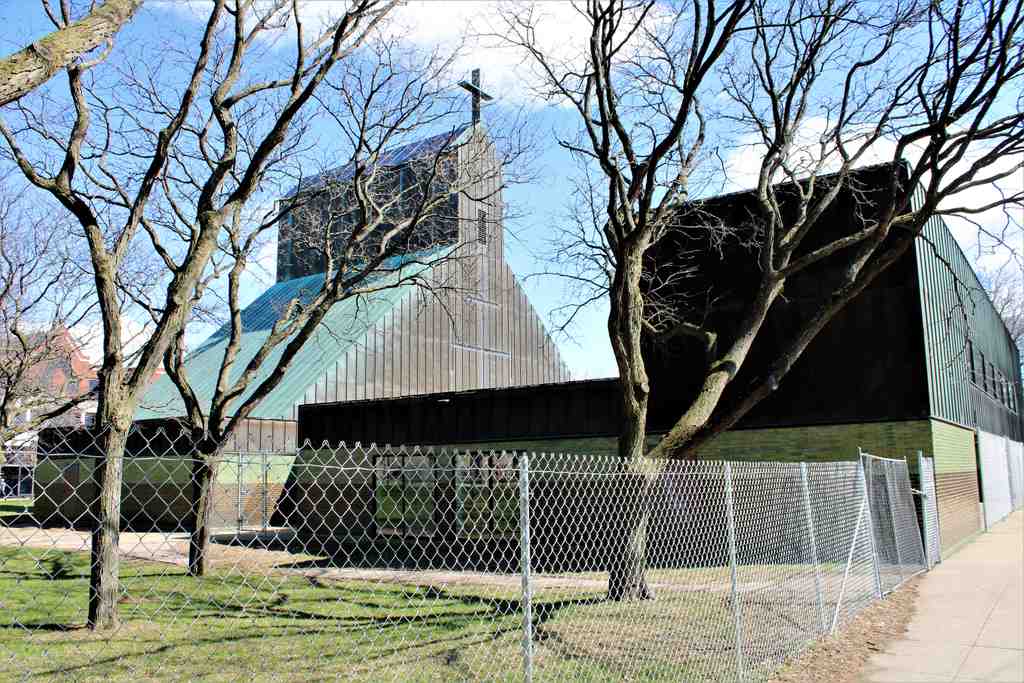
On your left stands a striking modern structure defined by its sharply angled, green standing-seam copper roof resting on bands of brown brick, capped with a prominent simple cross. This geometric sanctuary, completed in 1977, represents just one layer of a location deeply defined by destruction, ambition, and rebirth.
The story begins with the original parish built here in 1832. It was led by Father Jeremiah O'Callaghan, an Irish immigrant known as the Apostle of Vermont, a fearless priest who practically laughed in the face of mob threats. Around midnight in May 1838, an anti-Catholic nativist mob-members of a political faction fiercely hostile to immigrants-set the original wooden church ablaze, burning it entirely to the ground. The conspirators had plotted to carry Father O'Callaghan out of town on a rail and banish every Irish resident from Burlington. The flames consumed everything, leaving behind nothing but a single silver chalice that had been stored safely in the priest's home.
The mob intended to drive the congregation away, but they severely misjudged the priest. Father O'Callaghan publicly declared that he was absolutely not afraid of their intimidation. Following the devastating fire, Burlington witnessed a profound display of community resilience. Sympathetic Protestants, appalled by the midnight bigotry, crossed deep religious and social divides to offer substantial financial support. Their united contributions ensured the Catholic congregation could rapidly rebuild a much stronger church.
This cycle of devastation and reinvention became a defining characteristic of this land. That rebuilt church was eventually replaced by a magnificent Gothic Revival cathedral in 1867, a towering building constructed from local redstone and marble. It stood as a monumental landmark until March 1972, when a young man named Timothy Austin deliberately set a fire inside. As firefighters battled the blaze, the heavy bell tower collapsed into the nave, the soaring central hall of the church. Austin was arrested nearby, confessed to the police, and ultimately pleaded innocent by reason of insanity, which led to his confinement at a state psychiatric hospital.
Determined to endure, the diocese hired prominent architect Edward Larrabee Barnes to design the modernist building you see today, purposefully using dark brick and copper to blend with the surrounding locust trees. Though declining attendance eventually forced its closure in 2018, the site remains a testament to a community that continually rebuilds itself from the ashes.
Our journey through the city's transformation continues. We now leave behind these historic crimes of violent intolerance, walking toward a place that untangles modern tales of deception and conflict. We will head next to the United States District Court for the District of Vermont, just a three-minute walk from here. For those curious about the site's administration, the grounds maintain operating hours from 9 AM to 3 PM Monday through Thursday, remaining closed Friday through Sunday.


