
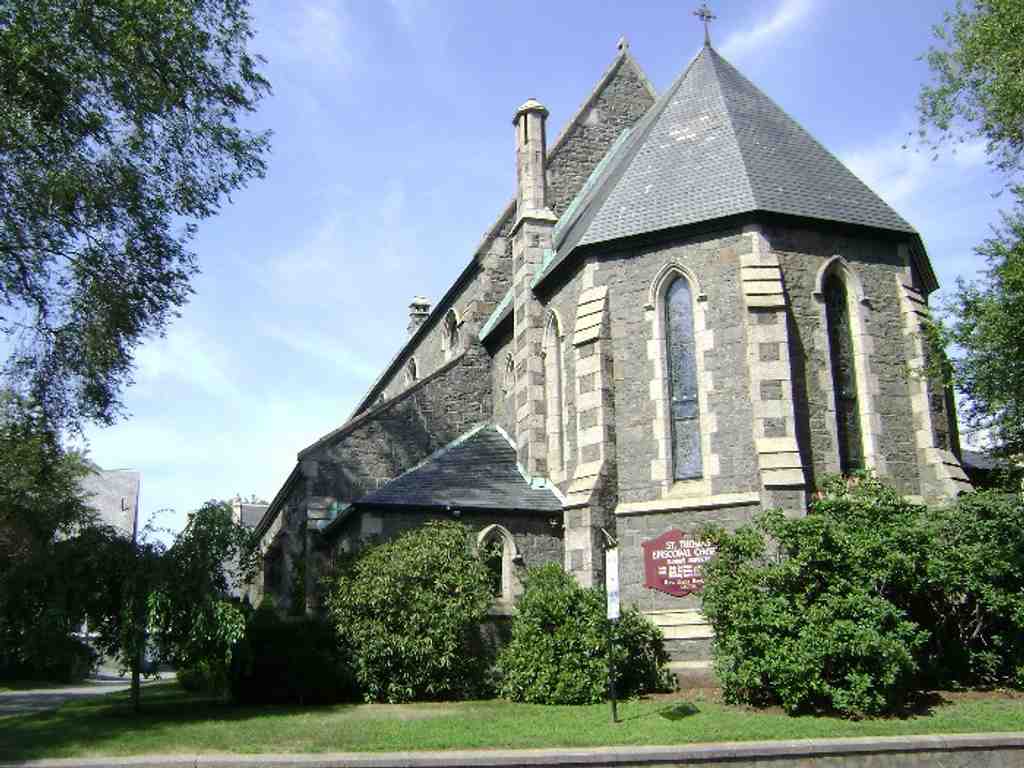
Right in front of you, you’ll see a dramatic, gray stone church, with striking pointed arches and a roof that looks like it’s determined to touch the sky-just look past the leafy trees to spot its Gothic spires and that big maroon sign surrounded by lush greenery!
Let’s imagine we’re stepping back in time-way, way back, before this grand stone structure was even a dream. The roots of St. Thomas Episcopal Church stretch all the way to 1728, when Taunton was still wild and rough around the edges. Picture noisy wooden carts clattering down muddy paths, and a group of determined townsfolk gathering near the Three Mile River, full of hope and grit but maybe a little nervous about starting something new-and not entirely welcomed by the local Puritans, who frowned at anything connected to the Church of England.
Our story gets a little salty-literally!-with Captain Thomas Coram, an English sea captain who showed up in 1698, hoping to establish a parish. He faced all kinds of skepticism and resistance from the townspeople, but he left a quirky parting gift: If, someday, Taunton became “more civilized,” and at least forty upstanding gents wanted a church, they’d get a chunk of his land for it. This sounds like setting up a treasure hunt-but with fewer pirates and more prayer books!
Fast forward a few decades, and the first actual church is built near the Three Mile River. Resources are slim, but the community spirit is strong-they even send a local, John Lyon, all the way to England to be officially ordained as their first resident minister. His first baptism took place on a chilly February day in 1765, with candles flickering and the sound of shuffling hymnals filling the air.
Revolutions and storms can be tough on both buildings and spirits. During the Revolutionary War, just like many other Episcopal churches, St. Thomas had to close its doors for a while. Afterward, a new problem: a minister whose political views were a bit too controversial for the parish, leading to a dramatic dismissal meeting-library, prayer books, and glebe land demanded back!
And then, in 1815, disaster struck. Imagine lightning flashing and furious winds howling, because during a wicked gale, the church came tumbling down. But Taunton’s Episcopal community was persistent. In 1829, they built a new church on High Street-one much nearer to where you’re standing now. Their community kept growing, pews were added, and the sound of hammers and saws echoed as walls rose higher.
Now, the building before you is a testament to perseverance-and some pretty impressive architecture! Designed by Richard Upjohn, the nation’s great Gothic Revival architect, and finished in 1858, this stone masterpiece was consecrated in 1859. The pointed arches, steep slate roof, and tall, narrow windows create that unmistakable Gothic Revival style-meant to inspire awe, maybe even give you goosebumps if you look up at just the right angle!
But through all the years and all the changes, one thing never disappeared: the congregation’s knack for working together, overcoming obstacles, and filling these hallowed walls with the sound of community, from hopeful whispers to joyful hymns. Even now, you can practically hear echoes of laughter from annual meetings and the hum of history swirling around every corner.
So, as you stand here, you’re not just looking at old stones and stained glass-you’re witnessing the stubborn, loving heart of a community that’s weathered centuries. And if you listen closely, you might just catch the sound of a ship’s bell ringing far down the Taunton River, calling you back to the age of Captain Coram and the dream that started it all.


