
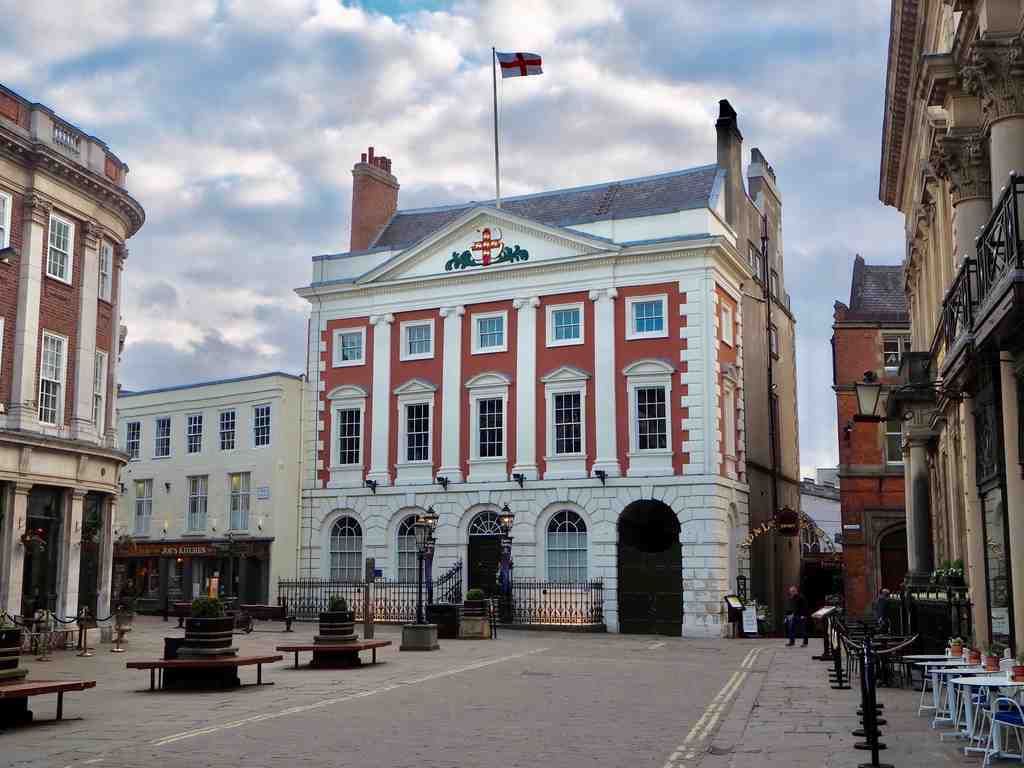
Right in front of you, you’ll spot the Mansion House by looking for a grand, early Georgian building with a bright, eye-catching red and white facade, tall elegant windows, and a flag waving proudly from its rooftop as it stands at the heart of St Helen’s Square.
Now, let’s step back through the mists of time and imagine yourself standing right where lords, ladies, and city officials once trod in buckled shoes and powdered wigs-well, I hope you haven’t brought a wig, or the wind might run off with it! The Mansion House is more than just a posh pad for the Lord Mayors of York-this place is the oldest house specifically built for a Lord Mayor anywhere in England still in use today. In fact, London’s Mansion House only came along twenty years later, so York beat the capital to it. Take that, London!
Picture the bustle of St Helen’s Square in the 1700s: horses clattering, traders haggling, and the sight of masons laying the very first stone here in 1725. After seven years of careful building, this grand home rose up by 1732-so if you sense a whiff of ancient glory, it’s because these walls have seen both feasts and fiascos! The architect remains a mysterious figure, shrouded in the mists of history, though some think the stately front may be the work of William Etty.
Where you stand was once the gateway to the old Common Hall Gates, opening into the medieval world of the Guildhall just behind us. There used to be a public house-imagine a rowdy tavern, laughter spilling into the square-and a chapel here, all of it swept away in 1724 to make way for the Mansion House. Still, some stories linger: today, just as in centuries gone by, every May, the proud Mayor Making ceremony is held in the old Guildhall, with the new Lord Mayor processing right into this building behind me to take up their new post. Imagine the nervous excitement-perhaps even a dropped ceremonial hat or two!
The Mansion House isn’t just grand on the outside; it holds a sparkling secret within. If you could peek inside, you’d see one of the largest civic silver collections in England, now handsomely arranged in a Silver Gallery created in 2017. And no, not everything is neat goblets and pretty platters. Among the oldest treasures is a strikingly elegant gold cup and-wait for it-a silver chamber pot! That’s right, York’s high society had to answer nature’s call just like the rest of us, though theirs was probably a much more glamorous affair. These gifts arrived by the will of Marmaduke Rawdon, who likely wanted the city’s Lord Mayors to enjoy the joys of both fine dining and… more personal comforts, generation after generation.
But the sparkle doesn’t end there. Civic regalia, including swords fit for an epic fantasy, rest within these walls. The Bowes Sword, wrapped once in crimson velvet adorned with pearls and precious stones, was a lavish thank-you from Sir Martin Bowes, a Lord Mayor of London with roots here in York. He was so grateful to the city for saving his childhood church, St Cuthbert’s, that he sent this glittering blade. When it took an unexpected detour to London with King James VI’s entourage in 1603, it came back missing a few jewels-proof that even in royal circles, things mysteriously go "missing" when you lend them out!
There’s also the legendary Sigismund sword, which once belonged to the Holy Roman Emperor himself and came to York via a twisty route through Windsor Castle and the hands of Henry Hanslap. The sword glows with royal arms and rests in a velvet scabbard fit for a knight’s dream.
As you linger here, let your imagination fill with images of oil portraits of past Lord Mayors, velvet-and-silver ceremonies, and the echoes of centuries of power and pomp. The Mansion House stands as a testament, not just to York’s authority, but its love of tradition, pageantry, and the occasional shiny chamber pot. If these walls could talk, I suspect they’d ask for another polish-and perhaps recount a story or two where silver, swords, and ceremony meet the spirited heart of York’s history.


