
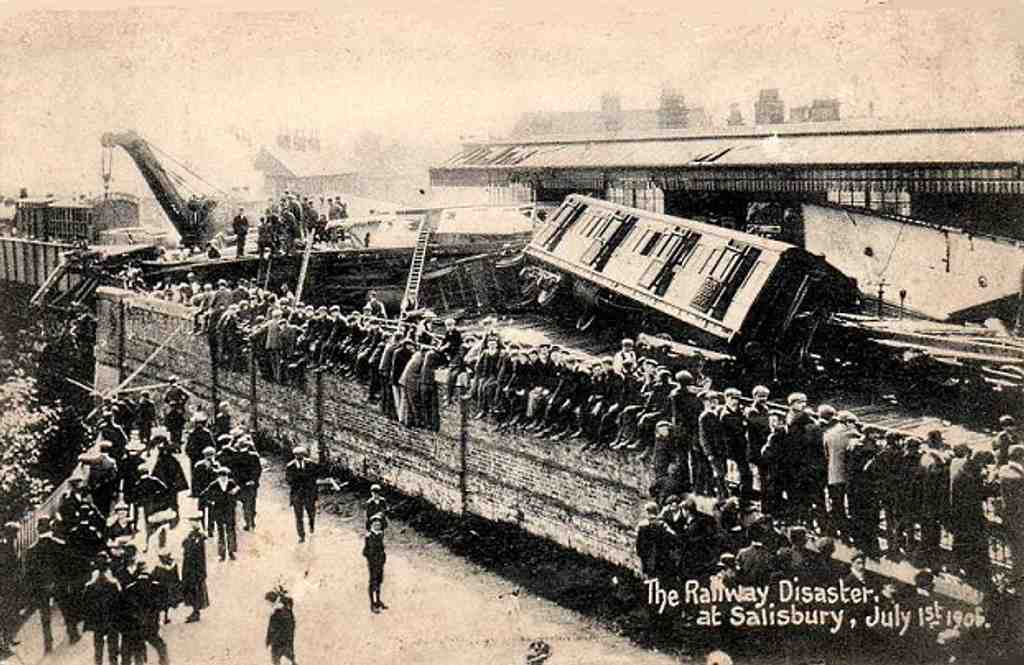
Directly in front of you, you'll see the site where one of Salisbury’s most dramatic and talked-about railway events happened. To spot it, look for the area just alongside the railway lines, marked today by a modern station setting. Picture a crowd, like in the old photo you’ve just seen, right by the tracks-rows of people peering at the wreckage and carriages awkwardly tipped at strange angles.
Now, imagine it: It’s the night of July 1st, 1906. The air smells of coal and steam as a mighty express train from Plymouth thunders toward Salisbury station, going much, much too fast. If you listen closely, you might just hear the heavy chugging of the train’s engine straining. Suddenly, there’s a screech of metal on metal as the train tries-but fails-to make the sharp bend ahead. The whole thing derails, in a shower of debris, smashing into two other trains. A crowd gathers, whispering nervously, their faces ghostly pale in the dim light.
Can you imagine the panic? People saying, “How could this have happened?” - especially with the driver going at more than twice the safe speed. Some say he wanted to show off, racing the rival Great Western line that had just opened a faster route. Others muttered wild rumors about rich passengers bribing for speed-now, wouldn’t that make quite the tale for a mystery novel? Yet, in truth, the real answer remains a bit of a mystery-no one truly knows what was going through the driver’s mind.
After this disaster, all trains were forced to slow down and stop at Salisbury, and the speed limit was nearly cut in half. And next time you’re strolling around the Cathedral, peek inside-there’s a memorial tablet to those lost that somber night.
Now, let's keep moving along your tour-hopefully at a sensible walking pace!


