AudaTours logoAudaTours

Peterhead Audio Tour: Peterhead's Historical Heartbeat Tour

Audio guide8 stops

Beneath the fierce North Sea winds, Peterhead hides secrets behind its stone walls and storm-battered shore. This city has endured shipwrecks, scandals, and sudden calls for heroism. Unlock Peterhead’s lesser-known tales with this immersive self-guided audio tour. Let each stop reveal local legends, hidden tragedies, and moments of quiet rebellion—stories even lifelong residents often overlook. Did terrified townsfolk crowd into the hospital on one infamous winter night? What unresolved disappearance still haunts the edges of Peterhead Town House? Who once slipped past midnight shadows at the Lifeboat Station with a secret cargo? Stride through lanes shaped by ambition and adversity. Hear whispers of political rivalries, lifeboat rescues, royal visits gone wrong, and surprising acts of defiance. Experience Peterhead not as a map but as a living stage for drama both epic and everyday. The winds of history are waiting. Step out and listen close before their echoes fade.

Tour preview

map

About this tour

  • schedule
    Duration 30–50 minsGo at your own pace
  • straighten
    2.4 km walking routeFollow the guided path
  • location_on
  • wifi_off
    Works offlineDownload once, use anywhere
  • all_inclusive
    Lifetime accessReplay anytime, forever
  • location_on
    Starts at Peterhead Community Hospital

Stops on this tour

  1. The talented architect John Alexander William Grant took on the challenge, transforming that old villa into a place of healing. In 1939, just as the world was changing fast, the…Read moreShow less

    The talented architect John Alexander William Grant took on the challenge, transforming that old villa into a place of healing. In 1939, just as the world was changing fast, the new hospital opened its doors-probably with a nervous excitement in the air, and maybe the odd “mind your step” as people rushed in to see what was new. The hospital has kept growing and changing ever since. Princess Anne herself showed up in 1994 to officially open new facilities, and who doesn’t want a royal seal of approval? If you listen carefully, you might even imagine the clink of scissors cutting a bright ribbon. Today, Peterhead Community Hospital isn’t just a building; it’s a hub for the whole area, with a small but mighty maternity unit and a minor injuries center. Walk through its halls, and you can almost sense the generations who have come here for comfort and care-a place where history and healing meet on every floor.

    Open dedicated page →
  2. To spot Old St Peter's Church ahead, look for the tall, simple stone tower with its distinctive pyramid-shaped roof rising up from the midst of an old graveyard-it's the only…Read moreShow less

    To spot Old St Peter's Church ahead, look for the tall, simple stone tower with its distinctive pyramid-shaped roof rising up from the midst of an old graveyard-it's the only large structure like it in the area. Welcome to the mysterious Old St Peter’s Church-Peterhead’s very own stone time machine! Imagine you’re standing here hundreds of years ago, with seabirds wheeling overhead and the salty North Sea breeze on your face. The tower before you is medieval, a silent witness since the days knights clanked by in armor and monks hurried about on whispered errands. This church, once called St Peter’s on the Links, is mostly ruins now, but just picture it echoing with hymns in the 12th century. If these walls could talk, oh, the tales they’d tell! Once, this was the heart of Peterugie, belonging to the Bishop of Dunkeld. But in 1218, it all changed hands like a particularly holy game of pass-the-parcel, landing with the monks of Deer Abbey. Things didn’t stay peaceful forever-just over 300 years later, William Keith, the Earl Marischal, swept in, and the church’s story turned a page full of power, politics, and the glint of opportunity. Every owner left a mark: the Crown took charge, then it became part of a new burgh-imagine the streets buzzing with merchants and townsfolk, all under the church’s watchful stone gaze. But there were misadventures, too! At one point, the church was sold to the York Buildings Company, who went spectacularly bankrupt-imagine a tumbleweed rolling down a cobbled street and someone muttering, “Well… that could’ve gone better.” By 1771, this church was abandoned for a newer one, but its stories stayed put-right alongside the gravestones from the 17th to 19th centuries. Wander around, and you’re tracing the footsteps of Peterhead’s earliest souls, storytellers, mischief-makers and saints alike. And just think: in 2016, it finally became a scheduled monument, recognized for its ancient, slightly battered grandeur. Now, you get to stand where history lingers with every gust of wind. Just don’t let the spirits catch you daydreaming!

    Open dedicated page →
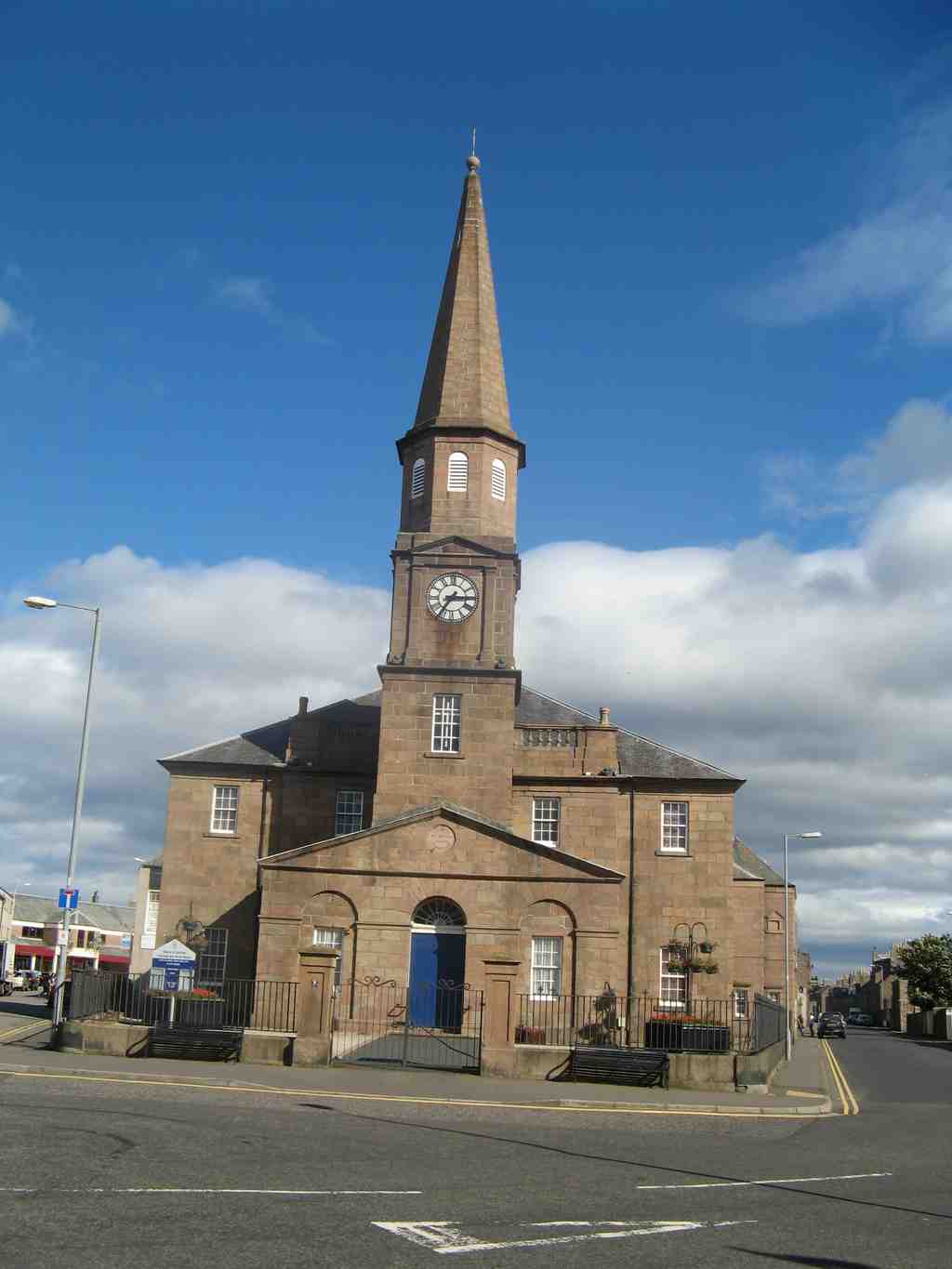
  3. To spot the Old Parish Church, just look straight ahead for a grand stone building with a tall pointed spire and a big clock face right above its bright blue door-it's standing…Read moreShow less

    To spot the Old Parish Church, just look straight ahead for a grand stone building with a tall pointed spire and a big clock face right above its bright blue door-it's standing proudly on the corner of the street. Now, as you stand in front of this magnificent old building, imagine the year is 1806, and Maiden Street is bustling with local folks in bonnets and breeches, all staring up in awe at this brand new church rising above the rooftops. Built by two local brothers, Robert and John Mitchell, you can almost hear the clatter of hammers and the shouts of workers echoing through the fresh Aberdeenshire air. Designed by Alexander Laing-a fella from Edinburgh who probably wore a very serious hat-this church wasn't just any church; it was the “Muckle Kirk,” which means “big church” in Scots. And big it was, fitting for a town with dreams as tall as its steeple. But the star of the show here? Listen closely-if you could hear through time, you'd catch the deep, echoing ring of its ancient Burgerhuys bell, cast all the way back in 1647! That bell chimed for weddings, warnings, and maybe even the odd time someone was late for Sunday service (you can almost picture the minister tapping his foot, can't you?). Though the church closed its doors in 2016 and joined with Trinity Church, its stones still hold laughter, prayers, and more than a few echoes of fiery sermons. Don’t worry-it’s not haunted, but the spirits of Peterhead’s history linger, ready to whisper their stories to anyone willing to listen!

    Open dedicated page →
Show 5 more stopsShow fewer stopsexpand_moreexpand_less
  1. location_on
    4

    Peterhead Sheriff Court

    Buy tour to unlock all 12 tracks
    Look to your left and spot the tall, stone-faced building with steep, pointy gables and a small ornate balcony perched above the main doorway; next to it you'll see a newer,…Read moreShow less

    Look to your left and spot the tall, stone-faced building with steep, pointy gables and a small ornate balcony perched above the main doorway; next to it you'll see a newer, silvery extension that looks much more modern than its neighbour. Now, picture the year 1869 here in Peterhead. The air is thick with the smell of cut stone and the excitement of a new era about to dawn. In front of you, right on Queen Street, the townsfolk gather, their best hats on, as a foundation stone is laid with full masonic honours-the start of what would become Peterhead Sheriff Court. Designed by William Smith, who must have had quite the flair for drama, the building rises with grand, jagged gables reaching for the sky, almost as if the roof is having a competition with the seagulls. Built with sturdy ashlar stone, every block seems to tell a tale-and let’s not forget the cost: £2,600! Back then, that could buy you quite a few barrels of herring and a new suit to boot. By 1871, the courthouse opens with its doors wide and its windows surveying Queen Street with a dignified gaze. Those segment-headed windows and tall pediments with finials above made sure everyone knew this house means business. Pass through the grand doorway and you’d find two courtrooms bustling with stern judges, nervous defendants, and whispers bouncing off the stone walls. Three prison cells lurked within-not the place to find yourself after a big night out! Fast forward to the late 1990s, and local officials realized this courthouse needed a new wing-sort of like a middle-aged man buying a shiny new car. The extension, gleaming with granite from Blackhill Quarry, was the talk of the town until the North Sea’s fierce weather started nibbling away at the stone. Granite turned crumbly, mysteries of weather and time colliding! Thanks to a £1.5 million makeover in 2019, now with smart new aluminium cladding, the courthouse stands ready for the next chapter of trials, tales, and maybe even a bit of drama on stormy nights. So, as you stand here, imagine the echoes of history and the sound of justice through the ages-you never know who’s peering out those old windows even today!

    Open dedicated page →
  2. The Peterhead Trail
    5

    The Peterhead Trail

    Buy tour to unlock all 12 tracks
    Straight ahead, you’ll spot a grand, stone building with perfectly balanced windows, a clock perched high in a tall, spire-topped tower, and a statue standing proudly on the…Read moreShow less

    Straight ahead, you’ll spot a grand, stone building with perfectly balanced windows, a clock perched high in a tall, spire-topped tower, and a statue standing proudly on the steps-the unmistakable Peterhead Town House watching over Broad Street. Now that you’re here, take a breath and let’s travel back in time, where every stone of this Town House has a wild tale to tell. Imagine Broad Street in the late 1700s-horses clopping over cobbles, merchants shouting, and the smell of fresh-market fish in the air. It was here, in 1788, that the Peterhead Town House sprang up in all its neoclassical glory, looking not so different from what you see today. The building’s perfectly symmetrical face and sharp stone edges were meant to announce: Peterhead is thriving! But our story stretches back even further. The very first town building stood not here, but at the corner of Longate and Brook Lane, built around 1600 thanks to the generous George Keith, 5th Earl Marischal. That old tolbooth held many secrets, but in 1645, in the grip of the great plague, it doubled as a hospital. Imagine-sick townsfolk, flickering candlelight and panicked footsteps. Sadly, that building burned soon after. Did Peterhead give up? Not a chance! Another tolbooth rose on Tolbooth Wynd, built under orders of William Keith, fresh from the Tower of London, no less. With a belfry and a bell from 1725, it rang out every hour, echoing across the windy streets. Each chime probably made unruly prisoners and market sellers perk up their ears! But the townsfolk wanted more-a grand, modern home for their council. So, the Community of Feuars (imagine today’s neighborhood association, but in fancy hats) commissioned John Baxter the younger to design this ashlar stone masterpiece. Five airy bays lined the front, and, before the grand entrance porch you see today, there were grand steps leading up, making all arrivals feel very important. Atop the building, that famous clock was crafted here in town by James Argo, and the bell came from the legendary Whitechapel Bell Foundry, the same foundry that made Big Ben in London. It rang out news, celebrations, and-surely more than a few times-startled townsfolk awake! The Town House wasn’t just for show: schoolrooms, markets, and even justice was served within these walls. Downstairs, local markets bustled, while upstairs, council and courtroom business ticked on. And in 1832, a new stretch was added out toward Marischal Street-including a lock-up for “pretty prisoners”-though I suppose that just means “petty,” unless someone was judging beauty contests behind bars! In 1861, the fire brigade rolled out their fancy new horse-drawn engine, ready to tackle any blaze. Not to be outdone, in 1868, King William I of Prussia gifted the statue of Field Marshal James Keith-there he stands, forever keeping Broad Street in check. But time took its toll. By 2019, the Town House was worn and weary, slipping onto the Buildings at Risk Register. Thankfully, the town banded together and with a sprinkle of grants and elbow grease, gave it the grand spruce-up you see today. Now the clock tower still keeps watch, the market floors have found new purpose, and the whole structure stands as a proud testament to Peterhead’s adventurous past, grit, and community spirit. Now, as the sea breeze rattles the spire and the statue of James Keith eyes the horizon, can you feel the pulse of centuries past swirling all around you?

    Open dedicated page →
  3. location_on
    6

    St. Peter's Episkopalkirche, Peterhead

    Buy tour to unlock all 12 tracks
    To spot St. Peter’s Episcopal Church, look for a light grey stone building with tall pointed windows bordered in red, and red double doors right on Merchant Street, just ahead of…Read moreShow less

    To spot St. Peter’s Episcopal Church, look for a light grey stone building with tall pointed windows bordered in red, and red double doors right on Merchant Street, just ahead of you. Now, let’s step back in time for a moment-imagine it’s a chilly December day in 1814. The streets are bustling, and townsfolk are gathering at this very spot, excited for their new church to finally open its doors for worship. But this isn’t just any church-this is the seventh home for the Episcopalians of Peterhead, a congregation that’s had to pack up and move more times than a travelling circus! The story begins in 1699, when the parish was ejected from their kirk, and the brave Alexander Barclay hosted secret services in his own house on Port Henry Road. Over the years, crafty ministers and determined worshippers popped up in secret rooms, borrowed houses, and even a short-lived chapel that got dramatically destroyed by Lord Ancrum in 1746-talk about explosive church politics! By 1814, they finally settled here. Architect Robert Mitchell gave this church its elegant edges and those big, eye-catching windows. Over time, they added more beauty: an apse and a stained glass window in memory of Torry, plus a booming organ in 1867 to fill the air with music. Next time you’re out in the wind or rain, just remember these folks kept moving and rebuilding-nothing could stop them from finding their home on Merchant Street. If these walls could talk, I’m sure they’d sing.

    Open dedicated page →
  4. location_on
    7

    Arbuthnot-Haus

    Buy tour to unlock all 12 tracks
    Look for a grand, grey stone building right in front of you, with five large windows across its perfectly symmetrical front, a little gable up top with a rounded attic window, and…Read moreShow less

    Look for a grand, grey stone building right in front of you, with five large windows across its perfectly symmetrical front, a little gable up top with a rounded attic window, and a spiked iron fence guarding the entrance you’ll see just ahead. Alright, pause for a moment and take it in-this is Arbuthnot House, though if buildings could talk, it might still whisper its old nickname, the Municipal Chambers. Imagine yourself standing on this very street in the late 1700s: the salty air of Peterhead swirling around, carriage wheels rattling along Broad Street, and the sound of Robert Arbuthnot (the original owner, and let’s just say, not short of a penny or two) pacing out the plot for a fine private house. Back then, the building was only half as deep as what you see now, more of an elegant townhouse than the imposing block before you, and it faced straight down to the bustling Town House at the other end. Flash forward a few decades-the house is snapped up by James Arbuthnot, a merchant with an eye for style. Here’s where things start getting interesting: in the early 1800s, the house is given a makeover fit for a neoclassical romance novel, with smooth ashlar stone, those stately sash windows, and a doorway so grand you almost expect a gentleman with a top hat to come strolling out. Now, step inside in your mind’s eye-past the rusticated doorway, you’d find a soaring reception hall stretching up two stories, perfect for gossiping aristocrats or, later, council debates that might’ve gotten just a bit heated! Long after the laughter and music faded, Arbuthnot House took on a serious role: shortly after the Second World War, the leaders of Peterhead ran the show from these very walls. But the years rolled on, councils and councils came and went, and eventually the hustle faded, leaving the building empty and boarded up, its windows looking out as if waiting for the next chapter. And here’s the twist-Aberdeenshire Council has big plans. Soon, the quiet of Arbuthnot House might be broken by the sound of readers and museum-goers, as new life is set to move in. So go on, give a wave. Who knows, maybe one day you’ll walk by and see the lights back on, stories old and new echoing through the hall once again!

    Open dedicated page →
  5. location_on
    8

    Peterhead Rettungsbootstation

    Buy tour to unlock all 12 tracks
    Right in front of you, you’ll spot a low, sandy-coloured building with a slate roof, lined with small windows and a flag flying high-just look to the West Pier, at the edge of the…Read moreShow less

    Right in front of you, you’ll spot a low, sandy-coloured building with a slate roof, lined with small windows and a flag flying high-just look to the West Pier, at the edge of the harbour, where the blue “Lifeboats” signs mark the spot. Now, welcome to the last stop of our journey-Peterhead Lifeboat Station, the heroic heart of this rugged harbour town. Let’s imagine the air-salty, cold, and brisk-where this humble station has guarded the North Sea since 1865. Here, stories of courage ride the choppy tides, and some of the bravest souls in Scotland have raced from this very spot, as if the sea itself had dialled 999. Picture the first lifeboat, a bold 33-foot beast called People’s Journal No. 1, rumbling its way here in 1865 after a free train ride-and honestly, when was the last time you saw a lifeboat carpooling by train? Back then, she was powered by nothing but the wind in her sails and ten stout men at their oars. The lifeboat’s arrival was a local spectacle, displayed in Aberdeen before rolling into Peterhead, paid for entirely by enthusiastic readers of a Dundee newspaper. Imagine the bustling crowd, the cheers, the pride-because their very pennies funded this floating lifeline. The building you see isn’t just bricks and mortar. It’s been rebuilt, expanded, and moved, always evolving with the times. In 1900, the station grew, and by 1912, there was a brand new boathouse and slipway-just think of the sound as those lifeboats slid into the frigid harbour, ready for action. But the sea demands respect, and disaster is never far. On a raging December night in 1914, the lifeboat Alexander Tulloch launched into a gale to rescue the HMS Tom Tit. The wind howled, the waves towered, and, bravely pushing on, the crew were capsized and their boat wrecked. Three lifeboatmen gave their lives. But, even then, hope wasn’t lost-on the cliff above, men of the Rocket Brigade fired lines through the sleet and spray, pulling the Tom Tit’s crew to safety. Of course, Peterhead’s heroics weren’t a one-night-wonder. In 1916, when the Russian steamship Kiev ran aground near Rattray Head, the town’s lifeboat John Ryburn braved icy waters. The rescuers couldn’t come alongside, so ropes were tossed, and one by one, sixty souls were pulled through the freezing surf, hauled aboard. The gratitude crossed continents-a Russian fleet gifted £550, and medals sparkled around the necks of local heroes, like James and William Cameron. By 1928, the trusty George Pickard completed lengthy service and was retired-though she didn’t retire quietly, becoming a yacht before finally being broken up. The No.2 station became the main hub, a sort of nautical “promotion.” And during World War II, Peterhead’s lifeboats became legendary. Picture the blizzard of January 1942-wind screaming at over 100 miles per hour, ships running aground as fast as the crew could blink. The Julia Park Barry of Glasgow lifeboat launched four times, rescuing over 100 people, standing by day and night, the men barely catching a wink of sleep. Their bravery earned a treasure chest of medals, including a rare RNLI Gold Medal for their coxswain, John Buchan McLean. Even in modern times, the tradition of heroics is strong. In 1986, thanks to the generosity of the Robertson Trust-founded by three philanthropic sisters-the station got a gleaming new Tyne-class lifeboat, named Babs and Agnes Robertson. The Robertson sisters must be the only people who could fund a lifeboat with whisky money-they owned shares in Edrington, makers of some of Scotland’s finest drams! Fast forward to 2006, and Peterhead becomes one of the first places to receive the cutting-edge Tamar-class lifeboat, The Misses Robertson of Kintail. She rides at her berth just inside the South Harbour-a 16-metre modern marvel, funded again by those same philanthropic roots. The lifeboat station itself, rebuilt in 1999, is packed with comforts and technology, all to support the volunteers who leap from their beds at the sound of the pager, ready to face the wildest seas. Here, where the wind can still cut to the bone and seagulls circle hungrily overhead, the Peterhead Lifeboat Station stands as a monument to over 150 years of gallantry, sacrifice, and the unbreakable spirit of a community that never, ever lets go of hope-even when the storms roll in. So, as you stand here, remember: this isn’t just a building. It’s a living, breathing story-a silent promise that, on the darkest nights, someone will always set sail to bring you home. And that, my friend, is something truly worth saluting. Intrigued by the notable rescues, 1980s onward or the station honours? Make your way to the chat section and I'll be happy to provide further details.

    Open dedicated page →

Frequently asked questions

How do I start the tour?

After purchase, download the AudaTours app and enter your redemption code. The tour will be ready to start immediately - just tap play and follow the GPS-guided route.

Do I need internet during the tour?

No! Download the tour before you start and enjoy it fully offline. Only the chat feature requires internet. We recommend downloading on WiFi to save mobile data.

Is this a guided group tour?

No - this is a self-guided audio tour. You explore independently at your own pace, with audio narration playing through your phone. No tour guide, no group, no schedule.

How long does the tour take?

Most tours take 60–90 minutes to complete, but you control the pace entirely. Pause, skip stops, or take breaks whenever you want.

What if I can't finish the tour today?

No problem! Tours have lifetime access. Pause and resume whenever you like - tomorrow, next week, or next year. Your progress is saved.

What languages are available?

All tours are available in 50+ languages. Select your preferred language when redeeming your code. Note: language cannot be changed after tour generation.

Where do I access the tour after purchase?

Download the free AudaTours app from the App Store or Google Play. Enter your redemption code (sent via email) and the tour will appear in your library, ready to download and start.

verified_user
Satisfaction guaranteed

If you don't enjoy the tour, we'll refund your purchase. Contact us at [email protected]

Checkout securely with

Apple PayGoogle PayVisaMastercardPayPal

AudaTours: Audio Tours

Entertaining, budget-friendly, self-guided walking tours

Try the app arrow_forward

Loved by travelers worldwide

format_quote This tour was such a great way to see the city. The stories were interesting without feeling too scripted, and I loved being able to explore at my own pace.
Jess
Jess
starstarstarstarstar
Tbilisi Tour arrow_forward
format_quote This was a solid way to get to know Brighton without feeling like a tourist. The narration had depth and context, but didn't overdo it.
Christoph
Christoph
starstarstarstarstar
Brighton Tour arrow_forward
format_quote Started this tour with a croissant in one hand and zero expectations. The app just vibes with you, no pressure, just you, your headphones, and some cool stories.
John
John
starstarstarstarstar
Marseille Tour arrow_forward

Unlimited Audio Tours

Unlock access to EVERY tour worldwide

0 tours·0 cities·0 countries
all_inclusive Explore Unlimited

