
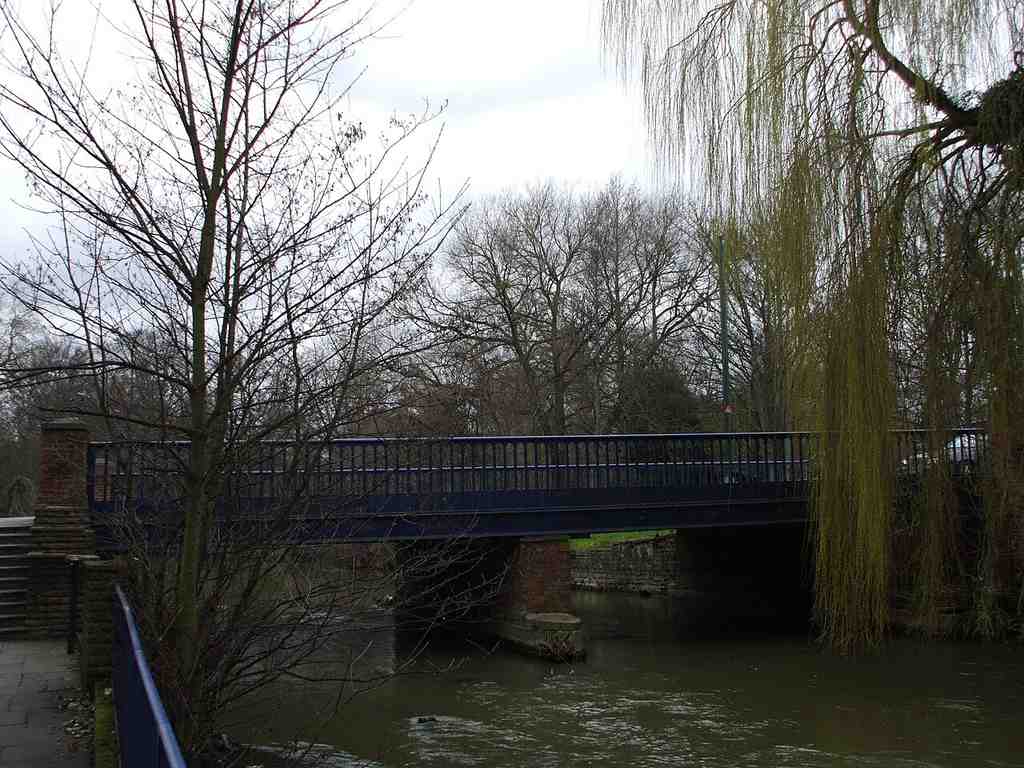
Look for the low, flat cast-iron bridge with straight beams crossing the narrow Castle Mill Stream, a plain Victorian span whose very lack of fuss is its signature.
Hythe sounds tidy enough, but it comes from the Old English word hithe, meaning a wharf or landing place. So this street is really named for its old job. People were unloading cargo here by at least twelve eighty-two, and Oseney Abbey put up the first known bridge between twelve hundred and twelve ten, probably in wood. In thirteen eighty-three, Oxford replaced it with a stone bridge of three round arches. The version in front of you arrived much later, in eighteen sixty-one, when the Oxford engineer John Galpin gave the crossing its current iron body.
And this was never some picturesque little footbridge. It was a working threshold. In the sixteenth century, the city’s wharf here handled hay, wood, stone, and slate. Freemen paid half a penny per load, others paid a penny - enough to make every crossing count. Even access had a price.
If you glance at your screen, the stream under the bridge gives you the setting the old boatmen knew best. They brought goods up from the upper Thames, but the trip could be miserable. Millers downstream controlled the weirs and the water. They charged heavy tolls, guarded their rights fiercely, and sometimes kept boats waiting for days before releasing enough water for passage. A flash-lock barge, by the way, was a river boat that depended on a rush of released water to get through.
So picture the bargee here: stuck at Iffley or Sandford for days, sleeping on deck, then finally reaching Hythe to unload hay at dawn. For six centuries, the stone in college walls, the slate on Merton roofs, and the hay for stable horses all crossed here on somebody’s back. Next, we’ll head toward Nuffield College, where the old canal basin once spread out beyond this bridge. And unlike the boatmen, you can cross here at any hour.




