
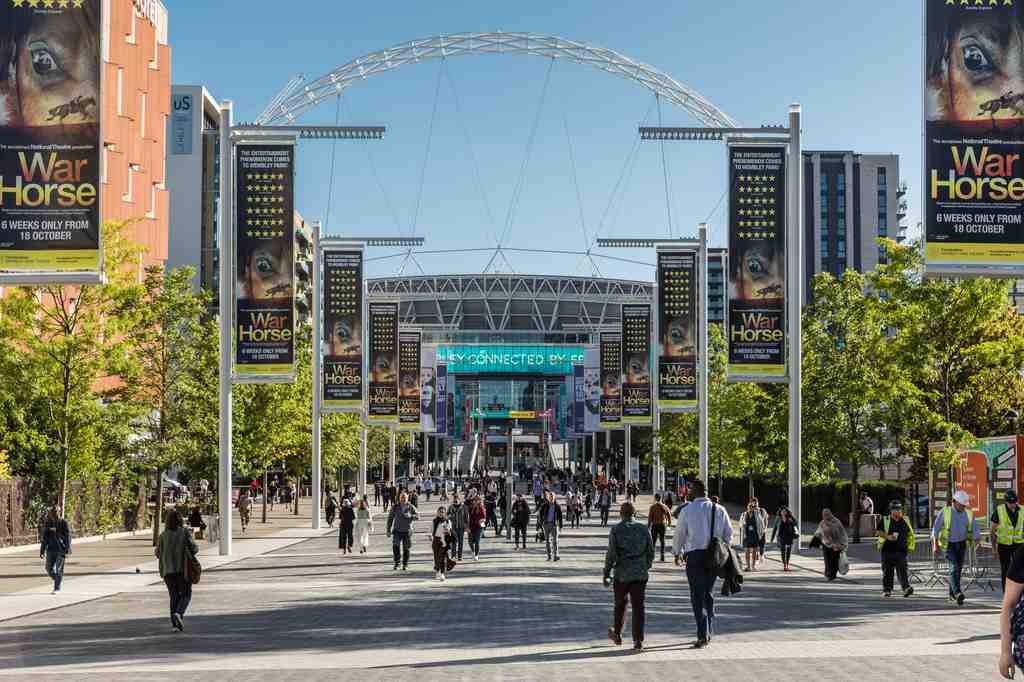
You can spot Wembley Park right in front of you-a broad, bustling avenue lined with banners and trees, stretching up towards the legendary Wembley Stadium arch overhead, creating a grand pathway you simply can’t miss.
Now, as you stand in the heart of Wembley Park, let’s take you on a whirlwind journey-no passport required, but having comfortable shoes definitely helps! Imagine for a moment, the late 1700s: the air is crisp, there’s a gentle hush, and instead of today’s modern buzz, there are rolling fields stretching as far as the eye can see. This area was once a luxurious country estate, transformed by the famous landscape designer Humphry Repton, who apparently liked to call every patch of trees he worked on a “park”-which is handy, since that’s where Wembley Park gets its name. He designed it as a dreamy, tree-lined escape, so much so that he claimed it was “as quiet at seven miles from London as it could be at seventy.”
But Wembley Park’s story isn’t all peace and greenery-cue the drama! Fast-forward to the late 1800s when the railway rolled in, and along came Sir Edward Watkin with a seriously tall ambition. He wanted to build Britain’s answer to the Eiffel Tower right here. Picture the scene: band music wafting on the breeze, cricket balls cracking, tea being served in elegant pagodas, crowds bustling around merry-go-rounds and a huge, partly-built iron tower reaching for the sky. Watkin’s Tower, as he called it, didn’t quite live up to its French rival, though. It opened to much fanfare, but by 1902, the tower-now known as “Watkin’s Folly”-was declared unsafe, shut down, and eventually blown apart. All that’s left now? A great story, and some holes in the ground!
But Wembley Park was determined to keep the spark alive. Even without the mighty tower, pleasure gardens and sports swept through the area, from rowing and athletics to ice skating on the frozen lake in winter. You could have run into film crews-by the early 1900s, the park included a film studio, and eventually, studios here welcomed stars from the Beatles to big TV productions.
Now, brace yourself as the roaring 1920s arrive! Wembley Park was picked as the site for the British Empire Exhibition, and suddenly, this leafy suburb transformed into a global showcase. Wembley Stadium, then called the Empire Stadium, was built here, and the world came running-literally-for sports, pavilions, restaurants (including one that would lead to London’s famous Veeraswamy Indian restaurant), and even a working replica of a coal mine. The whole area buzzed with the hum of excitement and the clang of builders-don’t worry, the steak and kidney pies were probably less thrilling.
From there, Wembley Park didn’t just become a famous address; it became the face of West London, drawing people to work, play, and live. Large houses sprouted up in “Metroland,” the new suburbs that made commuting to the city trendy-and made Wembley a household name. After all, who wouldn’t want to swap smoggy city air for weekends at Wembley Park, complete with golf, cinemas, and, eventually, some of London’s best concerts?
And the adventure didn’t end there. Wembley Park’s venues played a starring role in the 1948 Olympics-the so-called “Austerity Games,” where athletes got extra rations and medals weren’t quite as shiny as usual. There were celebrations, sports records, and the air must’ve been absolutely electric on those early summer evenings.
As the decades rolled on, Wembley Park just kept changing with the times. The Empire Pool, now the SSE Arena, turned from an Olympic pool to an ice rink, and then into a music hotspot hosting everyone from Bowie to Madonna. Wembley Stadium itself became hallowed turf for football, speedway, religious gatherings, and one of the most legendary concerts of all time-Live Aid in 1985.
And today? Look around: there’s gleaming new architecture, the gentle rustle of leaves lining the walkways, banners fluttering, shops, restaurants, and that world-famous stadium beckoning at the end. There’s still a pulse of excitement running through Wembley Park, reminding us that whether it’s cricket or concerts, future plans or histories past, this place has always been about bringing people together for a good time-or at the very least, some truly memorable stories.
Ready to delve deeper into the redevelopment, geography or the notable places? Join me in the chat section for an enriching discussion.


