
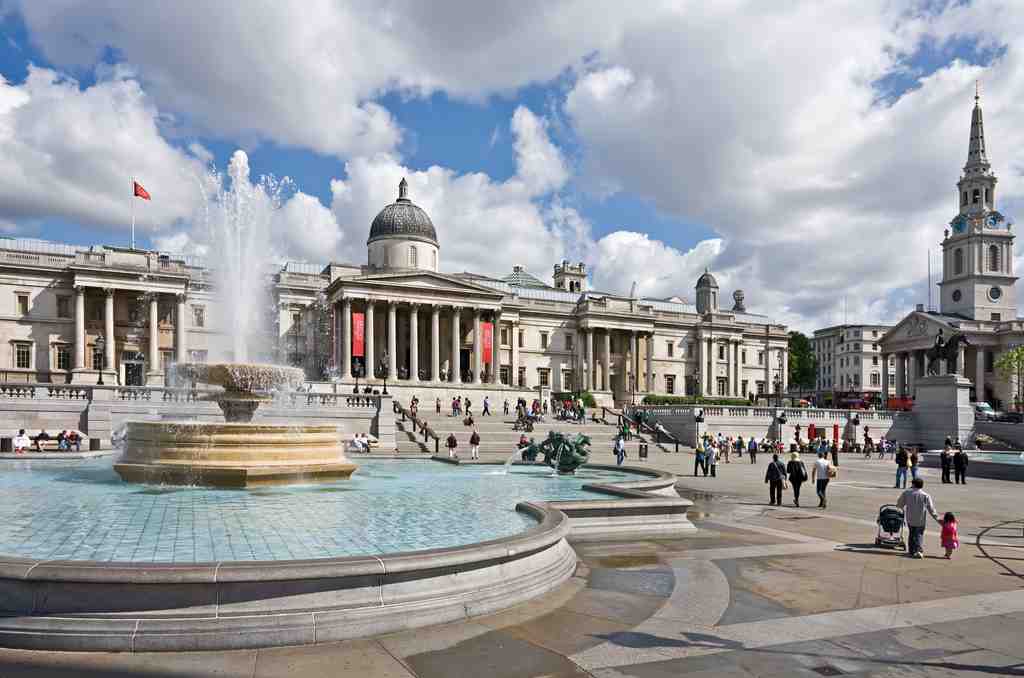
You can spot Trafalgar Square by looking for the great, open space with its magnificent fountains in the foreground, the tall Nelson’s Column guarded by four bronze lions in the center, and the grand pillared facade of the National Gallery stretching along the north side.
Alright, let’s jump into the centre of London’s stage-Trafalgar Square! Take a good look around: you’re standing on a site that’s been buzzing with people for centuries. This square, sparkling with fountains and overlooked by the National Gallery’s stately columns, commemorates a naval victory so dramatic it sounds like it was written for the movies-the Battle of Trafalgar in 1805, when Admiral Nelson gave Napoleon’s fleet quite a British surprise off the coast of Spain. The square gets its name from that iconic win, though you’re not likely to find any waves around here-unless you count a sea of tourists and the occasional street performer.
Legend has it, back in the 1200s, this area was home to the King’s Mews-not “mews” as in cute kitten sounds, but the royal stables, where hawks and then horses kicked up a fuss. It wasn’t until King George IV rode his horses off to Buckingham Palace that John Nash, an architect with a vision, was told to clear some space for a grand new square. Mind you, Nash didn’t quite live to see it open. Things sort of slogged along until Charles Barry, another architect, ramped up construction in the 1840s. Finally, in 1844, this plaza swung its gates open and Trafalgar Square was born, just in time for those first Londoners to test out its legendary reputation for public gatherings.
Now, at the very heart of the square stands Nelson’s Column-a whopping 169 feet high! Perched atop is Admiral Nelson himself, keeping an eye out for enemy ships (or maybe just watching the crowd below). The four massive lions at his feet were added later; the sculptor, Sir Edwin Landseer, was so keen to study a real lion that he borrowed a dead one from the zoo, but took so long that the poor beast started to fall apart… so if the paws look more like moggies than mighty lions, now you know why.
This square isn’t just about statues, though. Over the years, it’s seen everything from royal parades to political protests that made the ground shake. In the Victorian era, the square’s most notorious residents were actually pigeons-so many that their droppings did almost as much damage as an invading army! The city finally had to call in falcons and bylaws to shoo them away. And if you visit near Christmas, keep an eye out for the towering tree, a yearly gift from Norway as thanks for Britain’s help during World War II-just try not to stand too close when they turn on the lights, it’s a sparkly spectacle!
Fast forward to the present and you’ll notice something called the “fourth plinth” in the square; it was left empty for years and is now a playground for modern artists. You never quite know what’ll appear up there-a giant blue rooster, a swirl of ice cream, or something just as surprising. Contemporary art in the heart of historic London-now that’s something Admiral Nelson never saw coming.
Look in every direction and you’ll spot even more pieces of history. The National Gallery stands to the north, home to centuries of art. To the east, St Martin-in-the-Fields church-where, if you listen carefully, you might hear a choir or two-and Canada House and South Africa House are always waving their flags. The old Charing Cross marker stands nearby, the point from which distances to London are measured. Think of it: right now, you’re standing at the center of old and new London.
You might just catch the sound of water splashing from the fountains-a clever addition to keep crowds cool and riotous gatherings down (because nothing ruins a good protest like a soggy sock). If the city seems particularly lively, that’s because Trafalgar Square has always been a magnet: film premieres, sports celebrations, New Year’s festivities, and marches for every cause imaginable-it’s all happened under Nelson’s watchful gaze.
So as you turn in a slow circle, imagine the echo of speeches, music, laughter, even the flapping of pigeons past-as if every stone is storing stories of Londoners through the ages. That’s Trafalgar Square for you: a meeting place, a memory box, and possibly the only spot in the city where four lions, an admiral, and a giant Christmas tree can share the same stage for the world to see.
Intrigued by the name, geography or the statues and monuments? Make your way to the chat section and I'll be happy to provide further details.


