
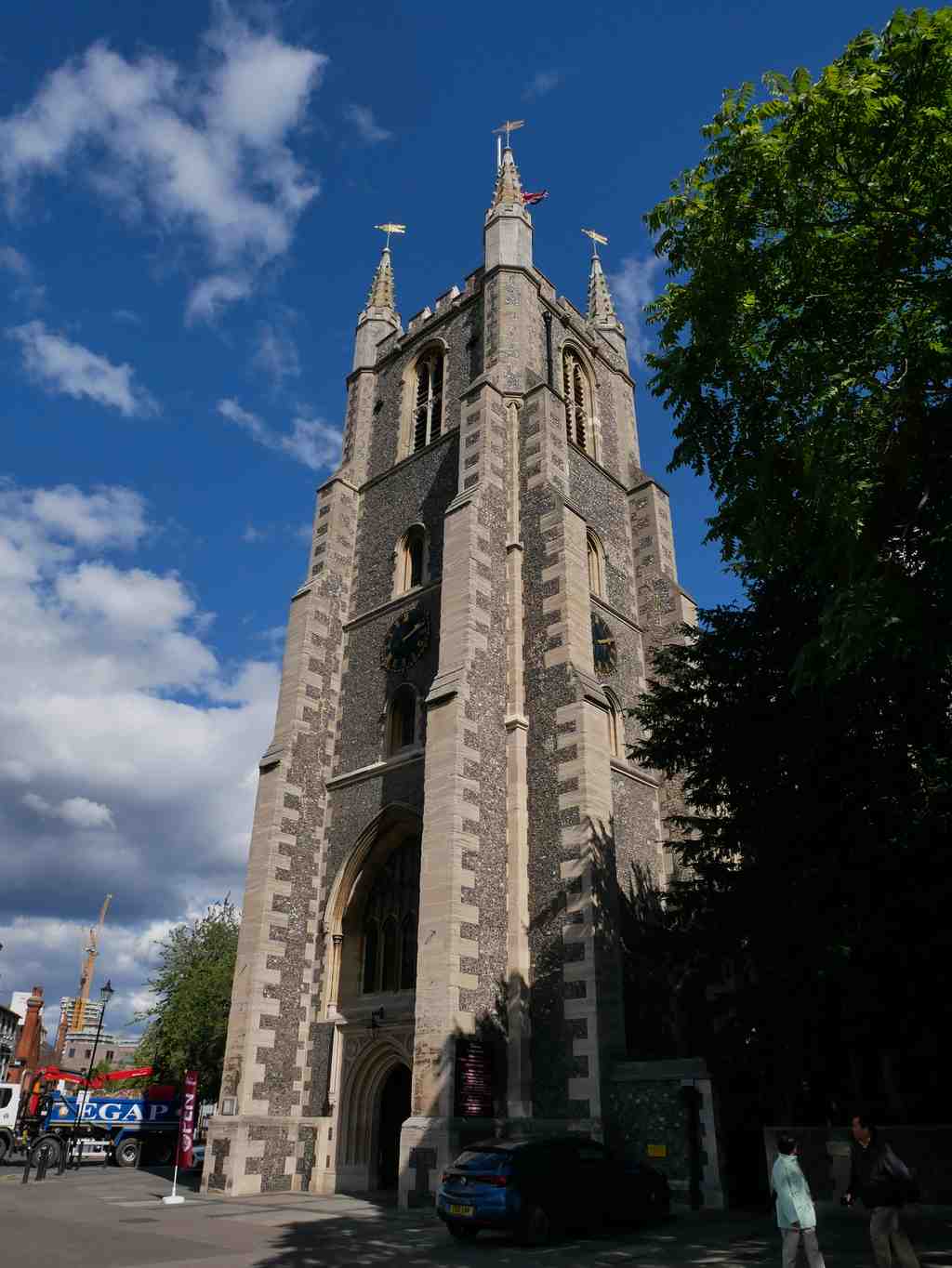
To spot Croydon Minster, just look ahead for a tall stone tower with four pointy spires on top, grey flint walls with pale stone corners, and a big arched entrance-it's hard to miss against the blue sky.
Alright! Welcome, my fellow explorer, to Croydon Minster-the grandest church in Croydon’s skyline, and truly one of Britain's great survivors. You’re standing in front of a building whose towering presence isn’t just about height, but about a thousand years of fascinating history, royal drama, utter disaster, and, of course, a dash of British humour. Don’t just gaze upwards in awe-let me take you on a time-travel tour through the tales hidden in these old stones.
Imagine the scene over a thousand years ago, when this land was just a patchwork of Saxon villages and dense, misty forests. Croydon Minster started life in the middle Saxon period, as a “minster”-a place where clergy lived together and looked after the spiritual needs of the growing local population. In fact, it was once so important that medieval kings made special mention of it. Picture King Coenwulf of Mercia, issuing charters and running councils right where we’re standing now, with priests bustling around in rough woven robes, probably more concerned with the weather than with Wi-Fi signals.
The earliest priest we know by name is Elfsies-now there’s a name you don’t hear every day-who turns up in a will from around 960. By the time of the Domesday Book in 1086-England’s first great survey-the church was already an old local fixture. And by the 14th century, a charitable fishmonger named John de Croydon left money to “the church of S. John de Croydon”, telling us it was dedicated to St John the Baptist, just like today.
Imagine generations of Croydon families bustling into the shadowy, echoing medieval church, decorated in the beautiful “Perpendicular” style-the pointed arches and tall windows you see echoing in today’s structure. Crest-shields on the walls still bear the colourful arms of archbishops who poured their wealth and hopes into its construction.
But here’s where Croydon Minster’s history heats up-almost literally! Fast forward to the Victorian era: after some restoration work in the mid-1800s, the church was set ablaze on a frosty January evening in 1867. They think it was a rather enthusiastic set of Gurney stoves that overheated and set the flues-and then, the whole building-on fire. By morning, Croydon’s cherished church was a shell, blackened and gutted. The town was in shock… but like any good British community, they muddled through. Services carried on in a temporary “iron church”-yes, really, basically a huge old shed holding 700 people, just down the road on Scarbrook.
Now, if you take a deep breath here, you might almost catch a whiff of soot and steam from those frantic rebuilding years! The great Victorian architect George Gilbert Scott swooped in, drawing up plans that would rise from the ashes. In just under three years, from 1867 to 1869, masons and carpenters worked furiously, weaving in what survived of the old-especially this proud west tower and the elegant south porch-while making it bigger, brighter, and even more majestic. On January 5th, 1870, exactly three years after the terrible fire, the new church was reconsecrated, packed with townsfolk who must have felt hope burning in their chests.
Throughout it all, Croydon Minster has been more than just a church. Six Archbishops of Canterbury are buried here, sleeping quietly under your very feet-Edmund Grindal, John Whitgift, Gilbert Sheldon, William Wake, John Potter, and Thomas Herring-each one a big deal in church history. It's practically the Westminster Abbey of Croydon!
Today, Croydon Minster is not only the heart of local worship, but also Whitgift School’s chapel and is linked to the Minster Schools. The church’s musical tradition is alive and well, roaring forth from a powerful four-manual pipe organ dating all the way back to 1869-so if you hear a thunderous sound, don’t panic, it’s not another fire, just the organist flexing their musical muscles! Speaking of noise, those 12 ringing bells up above? Cast in 1936, they rang out for the coronation of King George VI and Queen Elizabeth, and their peals have marked everything from royal events to local celebrations ever since.
Don’t forget to peek round the south side, too-you’ll find St John’s Memorial Garden. Once a cemetery, now a tranquil space of remembrance and reflection. Croydon Minster has weathered fires, forgotten centuries, and all the ups and downs of local life, standing tall, full of secrets, laughter, music, and a sprinkle of holy mischief. Quite a spot for a selfie, if you ask me!
If you're curious about the organ, bells or the st john’s memorial garden, the chat section below is the perfect place to seek clarification.


