
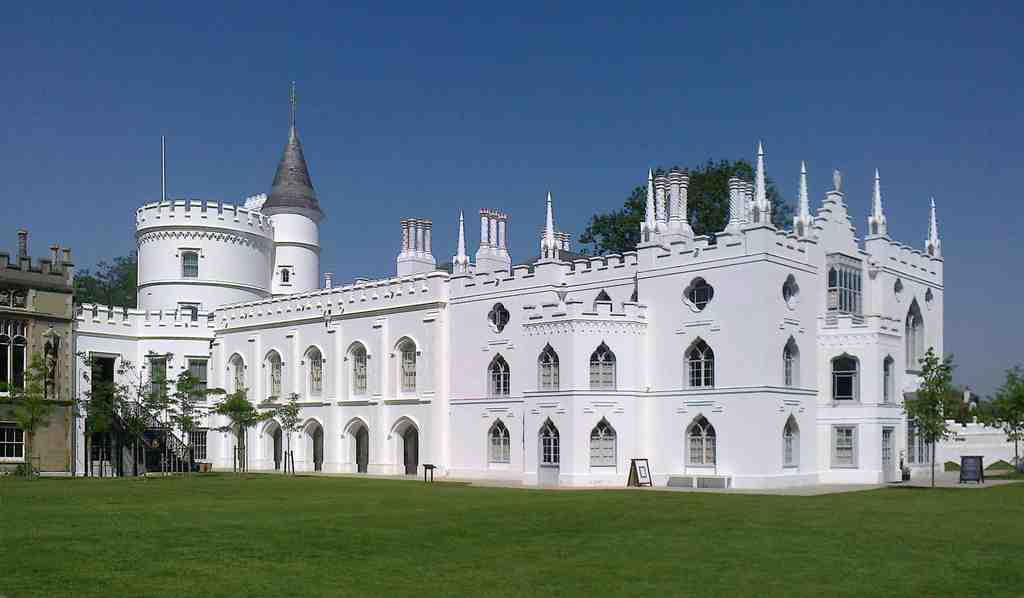
Look ahead for a gleaming, bright-white castle-like building with fairy-tale turrets, pointy battlements, and tall chimneys rising above a lush green lawn-there’s no mistaking Strawberry Hill House!
Alright, time for grand finales! Welcome to the magical Strawberry Hill House, a place that looks like it leapt right out of a fever dream of knights, poets, and oversized birthday cakes. Built by Horace Walpole in the mid-1700s, this Gothic Revival villa is a masterpiece of quirky invention-a real-life Gothic castle before they were cool. Imagine, the year is 1749, and Walpole, fresh from inheriting a tidy fortune, is told by friends and family that he really ought to build himself an impressive country house. What he leases, though, is nothing but a humble cottage with a less-than-glamorous name: “Chopped Straw Hall.” I suppose “Chopped Straw Hall” doesn’t quite have the same ring, does it? With a twinkle in his eye, Walpole renames his estate after an old local title he finds: Strawberry Hill. Now that’s tastier!
Walpole wasn’t alone on his architectural adventure. He formed a “Committee of Taste” -sounds serious, but really, it was Walpole and two creative friends dreaming up wild designs. Together, they set about transforming the place into a Gothic fantasy land. They borrowed turret plans from old castles and inspiration from the mighty cathedrals of Westminster and Canterbury-though, let’s be honest, some elements were freewheeling Gothic, and others were Walpole’s personal inventions. He wanted “gloomth” inside, with grand shadows and mysterious corners to set off his collections, and a “riant” (cheerful) sunlit garden outside. Talk about mood lighting!
As you stand here, imagine the scent of newly cut grass and the sight of the villa’s bright walls almost glowing against the English sky. Construction went on in stages, and Walpole delighted in adding ever more elaborate details-towers, battlements, shell-like benches, secretive passageways, even fireplaces designed by the famous Robert Adam, and arched windows inspired by Westminster Abbey. The finished product was irregular, extravagant, and nothing like any other house before it. When Walpole’s creative partner Richard Bentley stomped off after a disagreement (creative differences-very dramatic!), Walpole’s vision marched on, each year bringing more flights of fancy.
But the exterior is just the start. Inside, Strawberry Hill once played host to Walpole’s legendary collection of antiquities and oddities-think ancient armor, a creepy clock said to have belonged to the ill-fated Anne Boleyn, and even a cardinal’s hat from the days of Henry VIII. Each room was designed as a setting for these treasures, turning the house into something halfway between a fairy tale and a haunted museum-Walpole even claimed his house inspired his famous Gothic novel, “The Castle of Otranto.” Fancy that!
Visitors flocked here from near and far, from royalty to curious locals. It turned into such a sensation that Walpole joked Strawberry Hill had become an inn and he couldn’t enjoy breakfast without a crowd at the door. He found it hilarious-and sometimes exhausting. In the garden, intricate shell benches captured the imagination, specially designed to startle and charm. Even the garden was a revolution-unruly and natural, rejecting the fussy lines of European gardens for winding paths, carefully placed groves, and surprise views. For Walpole, a garden should be a place of joy, not just brooding mystery-though there was plenty of both at Strawberry Hill!
After Walpole, the house changed hands and fortunes. Some owners brought it to ruin-there was a mammoth 24-day auction where its treasures were sold off like in a dramatic costume-drama. Others, like the determined Frances Waldegrave, poured love and money back in, restoring chic details and throwing dazzling parties for the cream of Victorian society. In modern times, the place has survived dereliction, restoration, and even a starring role on TV, finally reopening in 2010 after a dazzling £9 million makeover. The public can now wander its wild gardens, admire the restored rooms, and, if they have a good imagination, maybe sense the swoosh of Walpole’s silk cloak echoing through the halls.
So, as you stand before this twinkling white castle, remember: Strawberry Hill is the original Gothic party house, a place where every brick was set with a wink and a dream. It’s proof that a spot of whimsy, a dash of drama, and a wild sense of history can create something truly magical-just one more reason Twickenham has a storybook ending.
Intrigued by the under horace walpole, later owners or the 21st century? Explore further by joining me in the chat section below.


