
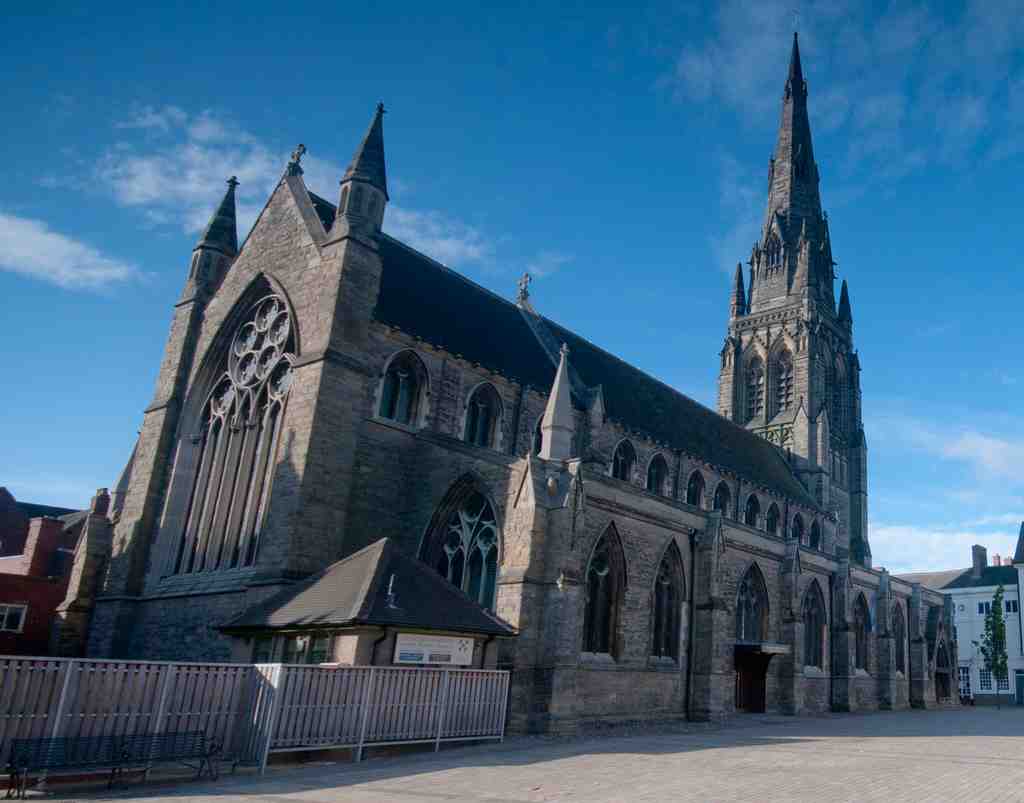
To spot St Mary’s Church, just look across the market square for the grand stone building with soaring pointed arches and a tall spire that seems to stretch straight up into the sky.
Welcome to St Mary’s Church-where history isn’t just set in stone, it’s practically bursting through it! Imagine standing here centuries ago, with the bustling market all around you, the fading scent of bread, livestock, fresh produce-I know, it probably smelled a bit different back then! St Mary’s has been the beating heart of Lichfield’s market square longer than most of the pigeons have had feathers. People believe a church has stood proudly on this spot since 1150, back when Lichfield was just finding its feet-and its bishops were laying out the town, building churches, and probably hunting for the best pie in the square.
The first church was likely built of timber and whatever sturdy bits they could find. But life was unpredictable; in 1291, flames swept through the town, devouring homes, market stalls, and even this very church. Out of the ashes, a new St Mary’s rose in the 14th century-a medieval beauty with aisles, grand arches, a west tower, and, oh yes, a dramatic spire. That spire, however, turned out to be a little... accident-prone. It crashed down not once, but three times! Folk in Lichfield probably got used to glancing up nervously when it was windy-just in case gravity decided to win another round.
This wasn't just any old church. By the late 1300s, St Mary’s became the church of Lichfield’s most important guild-the Guild of St Mary and St John the Baptist. This wasn’t just about praying; the guild pretty much ran the show in town, organizing fairs, running charities, and making sure nobody cheated at dice (or at least, not too obviously). Here in the north side lies the resting place of Anthony Dyott and his family. The Dyotts were Lichfield’s local VIPs-owners of Freeford Manor, and if you peek into the north chapel, you’ll find it still dedicated to them.
By the 1700s, structural headaches meant the medieval church was torn down. In its place, between 1716 and 1721, came a brand-new design-neoclassical, elegant, and paid for by enthusiastic townsfolk passing round the collection plate. Even the young Samuel Johnson (who later became a rather famous wordsmith) grew up in a house across the square, probably watching the masons through the window as he tried not to get caught skipping chores. Oddly enough, the church ended up with a Victorian Gothic tower at one end and a neoclassical nave at the other-a real architectural mash-up, you might say, like putting jam on your fish and chips.
When the Victorians caught the rebuilding bug in the 1800s, the church body was replaced again, now in glorious Derbyshire sandstone, complete with those dramatic arches and the spire you see before you. This was serious Gothic revival, designed by James Fowler-though we can’t say for sure if he pinched any ideas from earlier sketches. The inside was brightened with colourful decorations by Charles Bateman, making it a riot of Victorian style inside and out.
Now, don’t let all this grandeur fool you-by the 20th century, the crowds dwindled, the city centre quietened, and St Mary’s church risked joining history’s long list of ‘Gone But Not Forgotten’. But Lichfield folk are nothing if not determined. In the 1980s, the church was transformed into a vibrant community space: the ground floor became home to Lichfield Library (which now houses more than 200,000 books!) and the top floor morphed into The Hub-a lively spot with a speciality coffee shop, art gallery, exhibitions, and a space buzzing with music, performances, laughter, and maybe the odd library shush.
And the bathing in history doesn’t stop there! The church register safely holds the baptism record of none other than Samuel Johnson himself, while the Dyott Chapel is still used for worship. Above you, sturdy walls and a spire that’s braved centuries of storms-and the occasional collapse-hold stories of faithful villagers, grand guilds, and now, readers, coffee-lovers, and art fans too. St Mary’s has always adapted, always welcomed everyone, truly a beating heart in the centre of Lichfield.
So take a look up at those arches, imagine the chimes of the 18th-century bell, and feel proud to be standing in a place that’s survived fire, falling spires, and the march of time-yet still feels every bit alive with the spirit of the city! Now, anyone fancy a ghost story?


