
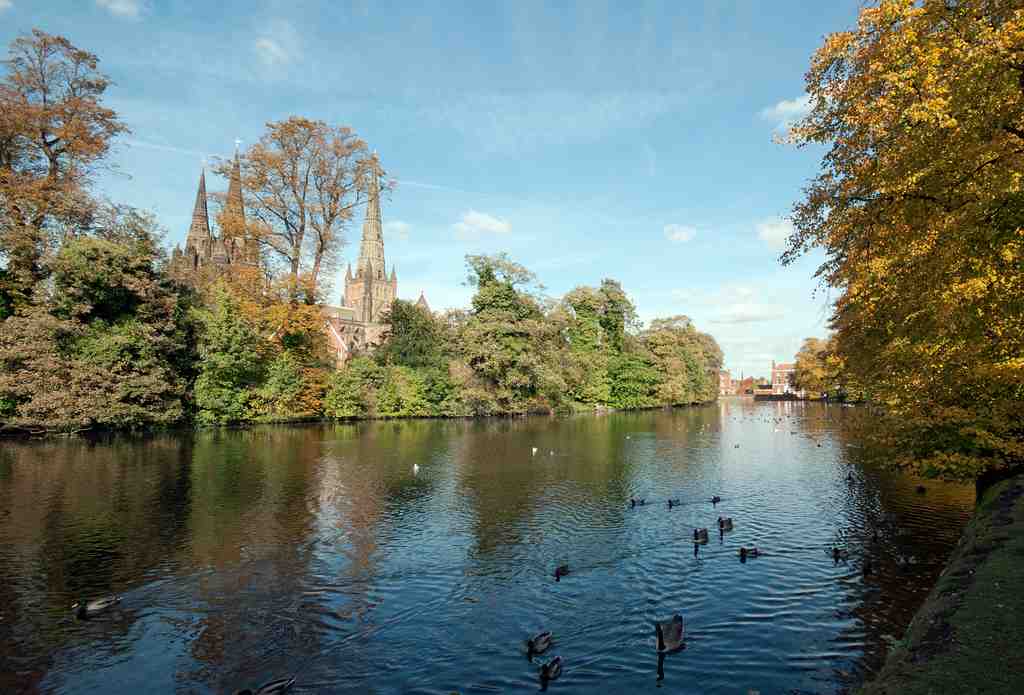
Right ahead of you, you’ll spot Minster Pool stretching out like a calm mirror between the cathedral’s spires and the leafy trees lining its banks-just look for the glistening water between Bird Street and Dam Street, with the dramatic cathedral rising over the north side.
Now, take a moment to let your eyes wander over the rippling surface of Minster Pool. Ducks paddle by like local celebrities, occasionally sidling up for a portrait opportunity. But today, you’re not just seeing a pretty pond-you’re standing by a survivor with nearly a thousand years of history behind every gentle wave.
The story of Minster Pool begins back in the wild, boggy landscapes of the 11th century, when this spot wasn’t so much the centerpiece of Lichfield as it was a marshy inconvenience. Locals must have had quite the time trying to keep their shoes clean. But necessity breeds invention-or, at least, it convinces people to build dams. To power a hard-working mill on Dam Street, folks dammed the eastern end of what was then just a soggy stream, and in doing so, created the broad, shining Minster Pool you see today.
Before long, this was much more than just a mill pond; it became a key part of Lichfield’s defenses. Imagine the cathedral rising behind sturdy stone walls, its reflection caught in the still water, as centuries ago invaders circled the Close during the Civil War sieges. The pool became a moat, making the fortified cathedral a challenge for any would-be attackers. If you listen closely, you might almost hear the echoes of distant clanking armor and the shouts of defenders rallying at the walls.
But that’s not even the end of Minster Pool’s talents! Over time, Lichfield’s brooks-Leamonsley and Trunkfield-gathered in this gentle valley, funneling from the west through Beacon Park and the Museum Gardens, until they finally slipped beneath Bird Street to enter Minster Pool’s waiting arms. It’s as if the city’s very veins run into this pool, drawing life and movement from the surrounding hills.
See that broad avenue on the south side? That’s not just a path-it’s the legacy of poet Anna Seward, who, in the late 1700s, convinced the city to transform this area from a muddy, smelly hazard (yes, it doubled as a sewer!) into a landscaped walk for townsfolk and travelers. Just imagine Georgian ladies strolling here in their long skirts, fanning themselves with one hand and pinching their noses with the other, until Anna brought forth her inspiration: “Let’s make this beautiful!” So, the pool was sculpted into a sweeping serpentine curve, and "New Walk" became a highlight of the town, rather than something you tried to avoid on windy days.
Now you might be thinking, “Okay Andy, but I don’t see a mill or a drawbridge!” You’re right! The original Castle mill, once grinding grain, malt, oil, rye, and wheat, was finally demolished in 1856 after so many transformations, it probably forgot what it was supposed to do anymore. By then, the pool was up for more changes too. There was even a not-so-popular plan to fill it in for public gardens, but Lichfield folk, fiercely loyal to their pool, protested so fiercely the proposal quickly sank-unlike the pool itself!
In the Victorian age, the streets were continually improved. Bishop Langton, way back in 1310, had split an even larger pool into two by building a causeway-one side became Bishop’s Fish Pool, the other, this Minster Pool. He even fortified the north bank with strong walls and added a hefty drawbridge on the south end, right by Dam Street. Knights and bishops alike must have clopped across the stone bridge, casting lingering glances at the water below.
When Lichfield’s main road needed something sturdier, Joseph Potter came along in 1816 and built the bridge you see today: three stone arches, iron railings, and a couple of stylish lamp pylons, letting coaches roll straight into town instead of trundling all the way round Stowe Pool.
Time, mud, and the odd cannonball left by the Civil War (yes, those were found when they dredged the pool in 1855!) have layered history thick here. Even today, those waters carry a hundred stories. And if you walk along the northern Garden of Remembrance or pause by the memorials along Minster Walk, you’ll feel how this pool gathers not only brooks, but the city’s memory-dedicated to those lost in wars and loved by picnickers, poets, and passersby.
In 2011, Minster Pool got the VIP treatment: dredged, fortified, and gifted with fresh benches and up-lighters that make those linden trees glow at night. So, whether you’re here for the history, the ducks, or just a moment’s peace beside the water, you’re not just looking at a pool-you’re gazing into the very heart of Lichfield. And you didn’t even have to bring a boat or a medieval army to enjoy it!


