
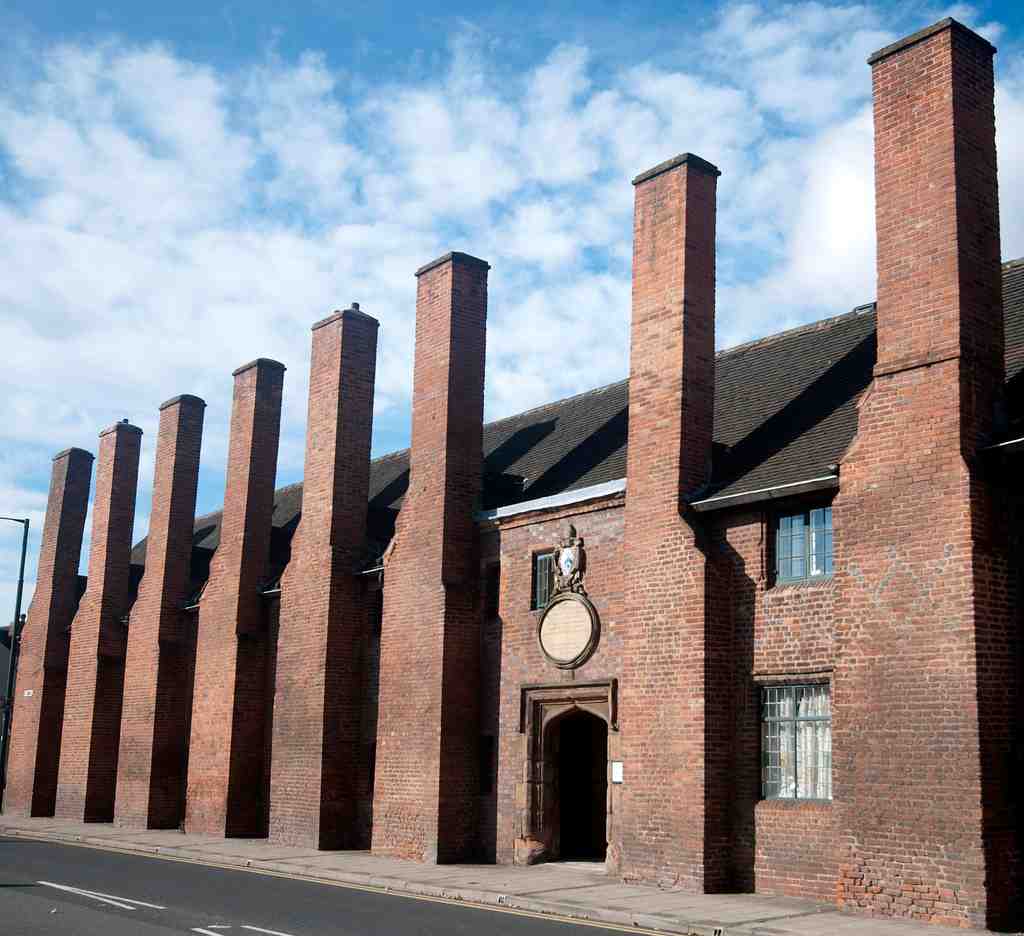
To spot the Hospital of St John Baptist without the Barrs, just look for a long row of tall, red-brick chimneys standing smartly along St John’s Street-there’s nothing else quite like it!
Now, take a deep breath and imagine yourself back in medieval Lichfield, right outside the southern city gates, as dusk settles and the giant wooden doors clang shut for the night. In 1129, Bishop Roger de Clinton was really making things happen: he fortified the Cathedral Close, designed an all-new town, dug a mighty defensive ditch, and wrapped the city in tall stone walls. Lichfield quickly became a hotspot for pilgrims, drawn by the new cathedral that guarded the precious remains of St Chad. But here’s the twist-if you rolled up to the gates after 8 or 9 pm, tough luck! You’d have to wait until the gates opened at 7 am-unless, that is, you found shelter at St John’s, just outside the walls.
This was no ordinary hospital-at this time, “hospital” meant a place of hospitality, for tired pilgrims and travelers who’d missed curfew. Bishop de Clinton ordered a priory to be built right here in 1135, and filled it with Augustinian Canons who promised to offer food and beds to anyone turned away by the city’s curfew. If you close your eyes, you might feel the wind tugging at your cloak and the crunch of gravel under the shoes of countless weary pilgrims, grateful for a warm fire and some bread. The chapel-still standing close by-hosted the evening prayers of holy men and travelers alike, a little oasis buzzing with whispered Latin and gentle candlelight.
For three whole centuries, this place was the beating heart of comfort for Lichfield’s after-dark arrivals. Imagine the sounds-laughter, foreign accents, snores, prayers all mixing together. But as the centuries turned, the city walls became less of a barrier-the gates eventually fell into disuse and stayed open. So what to do with a shelter for stranded travelers when nobody’s stranded anymore?
Enter Bishop William Smyth, a practical man with a soft spot for the city’s elderly. In 1495, he refounded St John’s as an almshouse for “thirteen honest poor men” who’d had a rough break in old age. Not only did each gentleman get his own cozy room and fireplace (hence those magnificent chimneys you see in front), but they received seven pence a week too. I bet even then, it wasn’t quite enough for a night out, but a fella could dream!
The building’s brick front today, with those eight curious Tudor chimneys, marks an advance from the simple shared halls-each resident, for the first time, had warmth and privacy. The plaque above the entrance and the style of the buildings on either side tell stories from different centuries. The Masters Hall to your left was rebuilt again in 1720, its doorway and tablet reflecting the tidy taste of Georgian Lichfield.
The adjacent chapel, at one point, nearly collapsed from neglect-almost like a sad chapter in an old library book. It was lovingly restored in the 19th century. Some walls were raised, new Gothic arcade arches were added, and the south wall enjoyed a set of sturdy buttresses. The stained glass, especially the “Christ in Majesty” window installed in 1984, bathes the chapel in colored light on sunny days. Imagine sunlight glowing through those windows, painting rainbows for prayers to float on.
And the story marches on. In 1929, rooms were refitted to face a tranquil central quadrangle, with the hospital gradually opening its doors to married couples in the swing of the 1960s. Modern comforts arrived-gas heating, real bathrooms-finally putting those drafty medieval chills to rest. If you could peek inside today, you’d find a sculpture of ‘Noah and the Dove’ standing quietly in the courtyard, a gentle reminder that new beginnings were always possible here.
And, if you ever wondered what happened to St John’s close to the Cathedral-you’ll find its newer cousin there, repurposed from the old Theological College, serving as a peaceful haven for the retired, right in the heart of Lichfield’s history.
So next time you see those eight tall chimneys, imagine the generations of travelers, lonely gents, devoted canons, and hopeful couples who found a home here. If walls could talk, these might just clear their throats and recite an epic saga-minus the snoring, of course.


