
Directly in front of you, you’ll spot the Franciscan Friary site as a tranquil garden space, with stone slabs laid out in the grass showing the outline of ancient walls-just look for the classical-style portico marking the entrance near the library’s southwest corner.
Now, take a deep breath and imagine that you’re standing at the gateway to another world-one where monks in grey habits once hurried through sandstone arches, laughter from the cloisters echoed against high stone walls, and the scent of woodsmoke drifted in the crisp Lichfield air. It all began way back in 1237, when a group of Franciscan Friars, known locally as the Grey Friars for their simple robes, arrived in town with a mission: live simply, help the sick and poor, and build a place to call home. The Bishop of Lichfield was so taken with these fellows that he gave them land, and King Henry III even threw in some oak trees-sounds like a royal housewarming gift, doesn’t it?
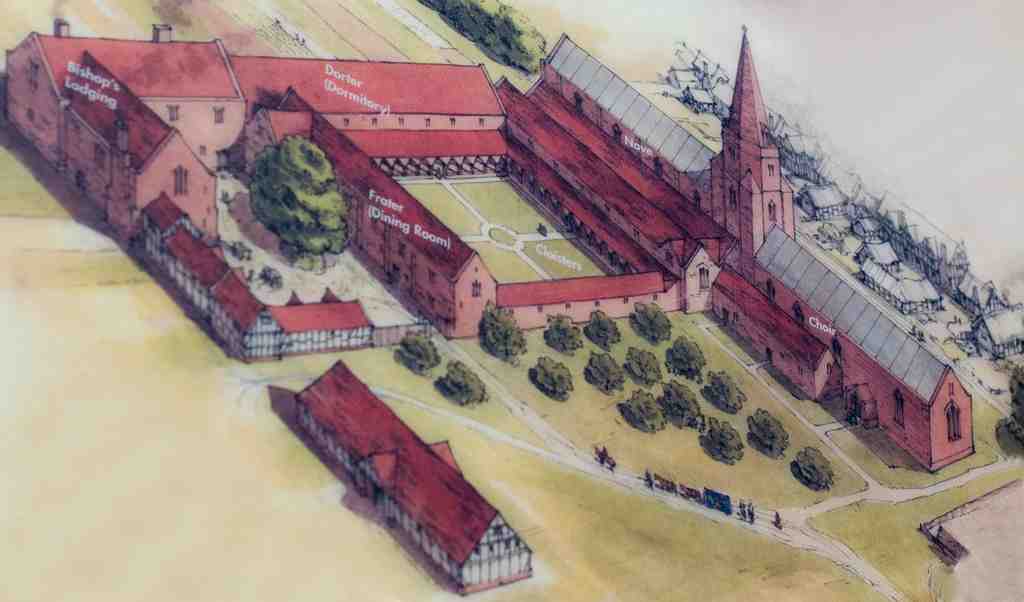
You might imagine the friars working together, hammering beams and stacking sandstone blocks, while the city buzzed around them. Their efforts blossomed into a huge estate-there was a sprawling church, a peaceful cloister at its heart, a quiet dormitory for sleeping, and a lively refectory where the friars gathered to eat. The townsfolk adored the friars, showering them with support. In fact, in 1241, even the Sheriff helped keep them warm by providing clothes-now that’s what you call local government in action!
But every good story has its twists. In 1291, with their friary almost complete, disaster struck-a fire raged through, turning their growing dream into ashes. The city’s response was swift and generous, and by 1301 the friary was rebuilt and back in action. Imagine the relief; the monks could once more walk the tranquil cloister, draw fresh spring water from the famous Crucifix Conduit, and look after the poor with renewed vigor. Life here wasn’t all solemn prayers; the friars’ simple way of life caught the mothers’ hearts and the city’s affection-they were the medieval good guys with a knack for gathering support.
As the centuries passed, the timber buildings transformed into sturdy sandstone halls, and the church grew to epic proportions. Just picture it: the nave alone was 110 feet long-big enough for half of Lichfield to squeeze inside for a sermon! Yet, all this generosity led to a bit of an ironic twist: the Franciscan Friary, which aimed for poverty, gradually gained wealth. If only they could see the humor in their accidentally fat purse-more wealth than they ever intended.
Fast forward to the days of Henry VIII, our famously unpredictable king. By the 1530s, he was running out of cash and had his eye on all that shiny church property. Thanks to Thomas Cromwell, the king’s loyal minister (and legendary party pooper), monasteries and friaries were shut down all across England. In 1538, after more than three centuries, the Franciscan Friary here was dissolved. Its church, cloister, and most buildings were demolished, torn down stone by stone. Only a couple of buildings survived-the Dormitory and the Bishop’s Lodging, which stubbornly stood their ground at the corner of the estate.
If you listen closely, you might almost hear the echoing footsteps of owners that came after, as the surviving buildings became a cozy home for families for hundreds of years. The land changed hands, was remodeled and re-invented, until the 20th century, when Sir Richard Ashmole Cooper gave the plot to the city to lay out a new road-very handy for those traffic jams on Bird Street!
Much was lost but not all. When the church site was threatened by new construction in the 1930s, archaeologists swooped in and uncovered the ruins, mapping out the ancient walls so you can now wander among them. The area became a Scheduled Ancient Monument, securing its place as a quiet slice of history for you to visit-slabs and stones laid out like a medieval treasure map beneath your feet.
So take a look around-the site may feel peaceful now, but you’re standing on a spot pulsing with centuries of bustling life, noble generosity, fire and disaster, royal politics, and quiet persistence. The echoes of the friars linger in the gardens, and their legacy lives on every time the word “Friary” pops up on a Lichfield sign. You could say these monks, who set out for poverty, left behind a wealth of history-and that, perhaps, is the best kind of treasure.


