
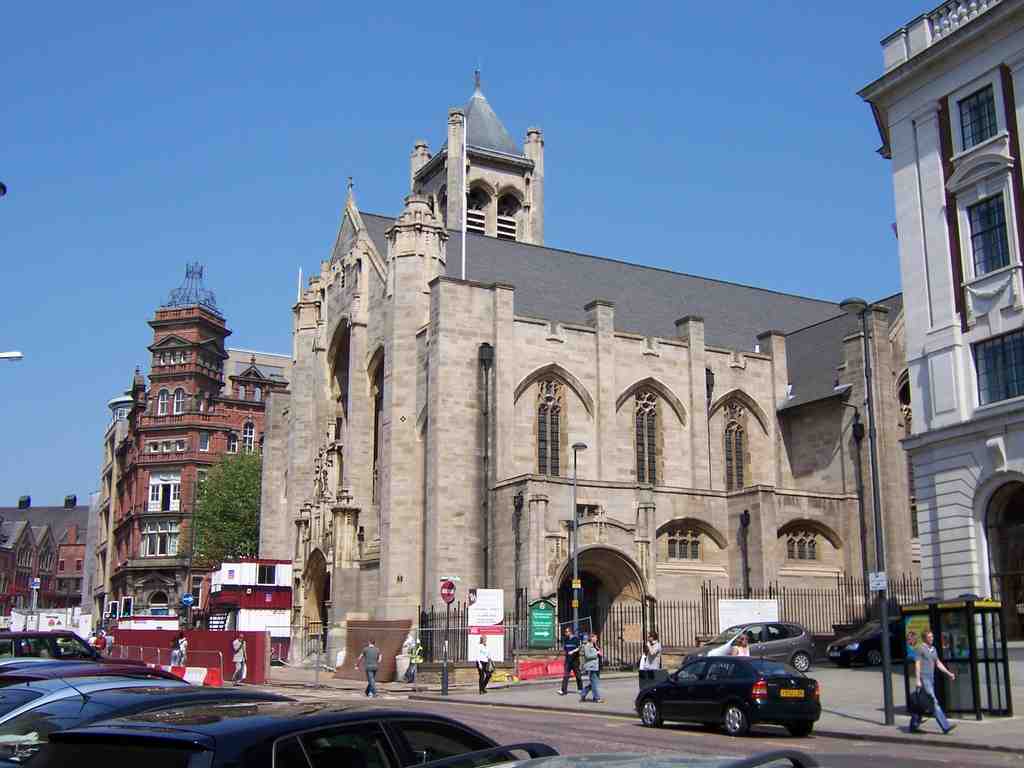
If you look to your left, rising proudly above the street, you’ll spot the creamy stone walls and tall gothic arches of Leeds Cathedral, topped by a squat tower fluttering the flag of Vatican City-a bit like a medieval castle parked in the middle of the city centre.
Now, as you stand in front of this impressive building, let me whisk you back through the centuries. Imagine Leeds, centuries ago, bustling with a different kind of energy. The air is thick with the smell of coal smoke, and the bells of distant churches echo through narrow cobbled streets. But for local Catholics, there’s something missing-no great cathedral to call their own. Their story begins in secrecy and struggle, all the way back in 1786, when Lady Lane Chapel appeared like a beacon-Leeds’ very first legal Catholic place of worship since the reformation. Imagine creeping through shadowy lanes to attend mass, always watchful, always aware.
Fast forward to 1838: Leeds is growing, and with it, the Catholic community. They build St Anne’s Church on the corner of The Headrow and Cookridge Street, finally giving the city an open and substantial place for worship. By 1878, when the Diocese of Leeds was formed, this church was promoted to full cathedral status-a proper “upgrade”, you might say! But no sooner had people started getting comfortable than, boom, disaster struck. In 1899, the buzzing city authorities decided The Headrow needed a makeover, aiming for something grand, Paris-style. The poor cathedral was caught right in the way-imagine someone deciding to build a new motorway through your favourite restaurant! Its fate was sealed; demolition followed, and its stones made way for a glittering new boulevard. They say you can find some pieces of that lost cathedral far from here, reused in a hotel on the Scarborough coast, like secrets hidden in plain sight.
But the Catholic community wasn’t giving up. After scratching their heads and exploring every possible new location, they finally accepted a spot handed to them by the city council-not far from the old one, right where you’re standing now. So, in 1901, construction began again. Local architect John Henry Eastwood, with a name that sounds like he could have played a cowboy sheriff, designed the new building in the Arts and Crafts Gothic Revival style. The challenge? He had barely any space to play with. There are no sweeping wings or sprawling lawns to this cathedral-no, it’s compact but mighty! And as you look up at that beautiful west front, you’ll see a tall gable clinging between sturdy buttresses capped with those elegant turrets, and, if you squint, an ornate crucifix carving watching over the city’s busy bustle.
The inside is dramatic, too- vaulting, stone pillars, and rows of pews invite you to imagine the light filtering through stained glass, while centuries-old relics from English Catholic martyrs rest under the altar, quietly reminding visitors of days when faith had to be guarded like treasure. If your ears are lucky, you might hear the mighty 1904 organ, with its seven divisions and 55 ranks, restored and ready for an encore after more than a century. Or perhaps a gentle Gregorian chant floating from the portable chamber organ, still played daily, as if the music has its own keys to the cathedral.
And here’s a twist: while most big English cities have a grand Church of England cathedral, Leeds is a rebel-it leaves that to Ripon, Wakefield, and Bradford. Instead, this cathedral, along with the Church of the Holy Rosary up in Chapeltown, looks after the faithful of Leeds, generous and unfazed by boundary lines.
As you stand here, in the heart of modern Leeds, between the whirl of cars, the aroma of coffee shops, and the calls of street vendors, take a moment to imagine that hidden layer of history beneath your feet. This building is far more than stone and glass-it’s a survivor, carrying traces of lost chapels, noisy demolitions, hidden relics, tireless architects, secret stories, and the laughter and tears of generations. It’s proof that even when the city is determined to bulldoze your history, a little determination-and perhaps a helping hand from above-can keep a community’s spirit shining tall. And really, isn’t that something worth seeing?




