
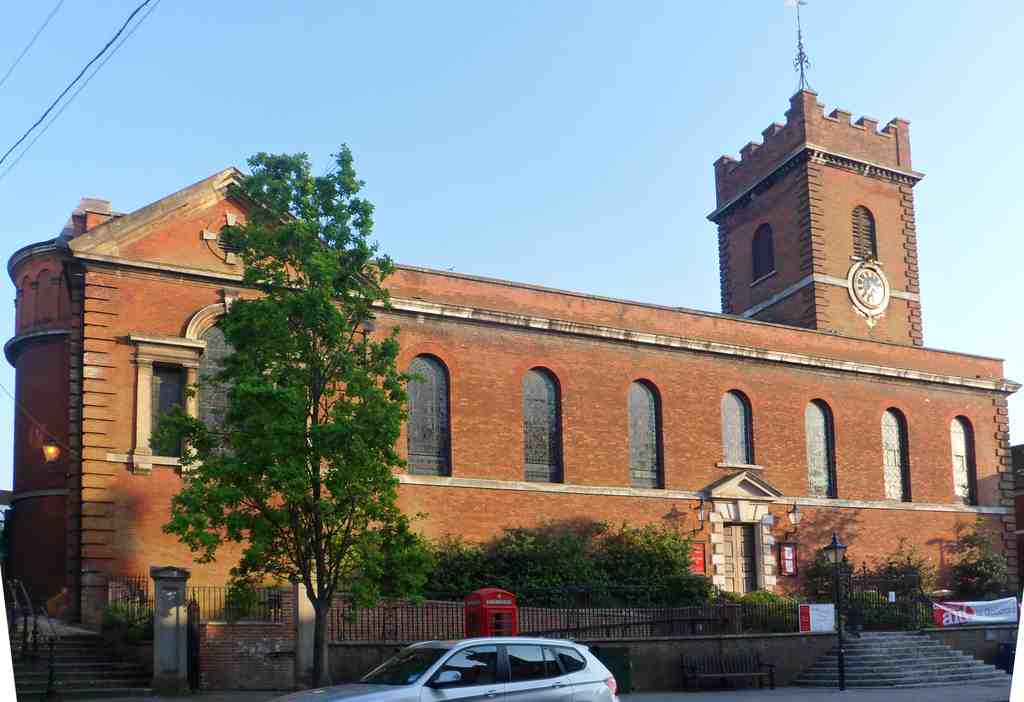
To spot Holy Trinity Church in front of you, look for a massive, red-brick building with tall arched windows and a square clock tower rising above the street, just at the crest of Guildford’s High Street.
Now, take a moment to stand and let this view soak in-this grand church has stood through centuries of drama, faith, and a bit of architectural mayhem! Holy Trinity’s story stretches back to the age of knights, kings, and the occasional clumsy construction. The original church on this spot was medieval, possibly dating all the way back to Norman times-imagine local villagers tromping through mud and rain to a stone church, with the Weston family’s mysterious and chequerboard-patterned chapel standing guard on the south side.
Let’s step into the 16th century for a moment-a time of tapestries, flickering candles, and secrets behind every corner. Richard Weston, from nearby Sutton Place, wanted to make sure he’d get a prime spot for his eternal rest. He had his own chapel built, where he planned to nap forever-well, in theory. The Weston Chapel became his family’s special corner, even during the storms of the Reformation, when being Catholic was almost as risky as storing fireworks near the altar. The family clung to their faith, dodging suspicious officials and giving up public office, but holding tight to their chequerboard-walled treasure. Inside, you’ll still find their monuments, including a chest tomb with a ruffled lady atop-Anne Pickering, whose first husband, Sir Francis Weston, was executed for getting a little too close to Anne Boleyn. If you think your family reunions are awkward, imagine trying to explain that relationship at the pearly gates!
But hold on-on a thundery April day in 1740, disaster struck. The steeple came tumbling down, smashing most of the old medieval church. Townsfolk probably gasped and pointed from the High Street, wondering if Guildford’s bells would ever ring again. They salvaged what they could, including the Weston Chapel and a few iron railings, but most of what you see now was built in the early 1760s-a handsomely solid, red-brick marvel designed by James Horne. This was the Georgian era, so imagine the church bustling with silk skirts, powdered wigs, and not a single mobile phone in sight.
Inside, things get even more spectacular. The church boasts one of the largest unsupported ceilings in southern England, so if you ever have the urge to try your luck with a frisbee indoors, well, you’d have plenty of space! The interior bursts with vivid frescos-look out for the dramatic Crucifixion, surrounded by saints, kings, and prophets, all presided over by a gloriously painted Ascended Lord in Heaven.
Holy Trinity isn’t just about beautiful art and historic chapels. It’s also home to eight bells-four of which have been ringing since 1769, joined by others cast in 1912. For nearly forty years, this church acted as Guildford’s pro-cathedral, filling in until the grand new cathedral was finally finished in 1961-talk about being the understudy who saves the show!
And because Guildford loves a good tradition, Holy Trinity remains its civic church. It’s here that the mayor is installed, and every year, townsfolk gather for the Act of Remembrance. If you wander inside, you’ll find the tomb of George Abbot-the guy who founded Abbot’s Hospital just across the street-and even a pulpit designed so the preacher could gaze disapprovingly at everyone in the balcony. Don’t worry, it’s been shortened since then, so you’re safe from stern Victorian glances!
So, as you stand here listening, imagine the centuries of footsteps-pilgrims, priests, mayors, mourners, and maybe even the odd nervous choirboy-echoing through these brick walls. Holy Trinity Church isn’t just a building; it’s a living piece of Guildford’s soul, with a past as dramatic as any theatre. And remember, if a steeple ever falls again, just shout, “Not again!” and duck.




