
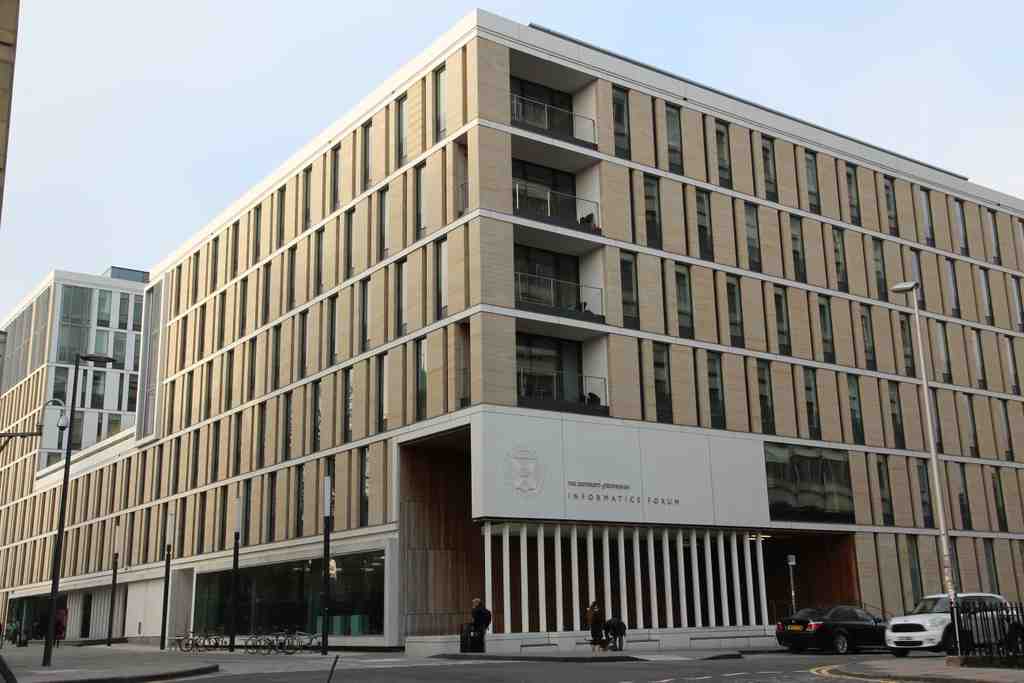
To spot the School of Informatics, just look for a large, modern building that stands out with its tall glass windows and neat, vertical lines on the pale stone walls-the main entrance says “INFORMATICS FORUM” above white pillars, sitting right on the corner as the street curves.
Now, welcome to the beating heart of digital discovery at the University of Edinburgh! Imagine the air buzzing with quiet genius, the windows glowing late into the night as minds shape the future of artificial intelligence. But it wasn’t always quite so shiny. Picture Edinburgh in the late 1990s: floppy disks, brick-sized mobile phones, students swapping ideas in cramped departments scattered around the old city. In 1998, the university decided to roll all that pent-up brainpower into one brilliant new whole-merging the Department of Artificial Intelligence, the Centre for Cognitive Science, the Department of Computer Science, plus some legendary institutes like the famous Artificial Intelligence Applications Institute. With a spark, the School of Informatics was born, like a digital phoenix rising from a sea of paperwork!
You might think that’s a lot of academics crammed together, but the magic here is how all those disciplines-from computational linguistics to systems biology-actually started working in harmony. It’s a bit like assembling the Avengers, but instead of superheroes, you’ve got wizards of code, masters of machine learning, and warriors of logic!
Strolling past these walls, you’re treading alongside history-makers and pioneers. Malcolm Atkinson, Alan Bundy, Rod Burstall-names whispered with awe in university corridors. Geoffrey Hinton, one of the legendary “Godfathers of AI,” studied right here before dreamt up the neural networks that let your phone recognize your selfies. Nigel Shadbolt, now a giant in the world of open data, walked these halls too.
Of course, every great tale needs a twist. In 2002, disaster struck: a devastating fire swept through Cowgate, destroying many buildings-including the beloved AI library and much of the informatics home. It could have been a knockout blow, but the story didn’t end there. By January 2003, the community had rallied, and the school set up shop in Appleton Tower. If these walls could talk, they’d tell stories not just of discovery, but of resilience-nobody here lets a little thing like a fire keep them from cracking the mysteries of the universe!
There’s a world of secret labs tucked inside these walls. One investigates how to make computers think and adapt like brains; another explores how humans and robots can understand each other-from text to speech to give-and-take conversation. Across the corridor, another group is shaping the architecture of future computers, dreaming up machines even faster and smarter than today’s.
Here’s the punchline: according to some of the most respected global rankings, this school is at the very top. Number one in the UK, number one for natural language processing-beating Cambridge, Oxford, and the world! So when you walk past all those students and researchers, you might just brush shoulders with someone inventing tomorrow. Or at least someone who can finally explain what the cloud really is!
Alright, onward, digital explorer! Time to see what’s next on Edinburgh’s epic story circuit.




