
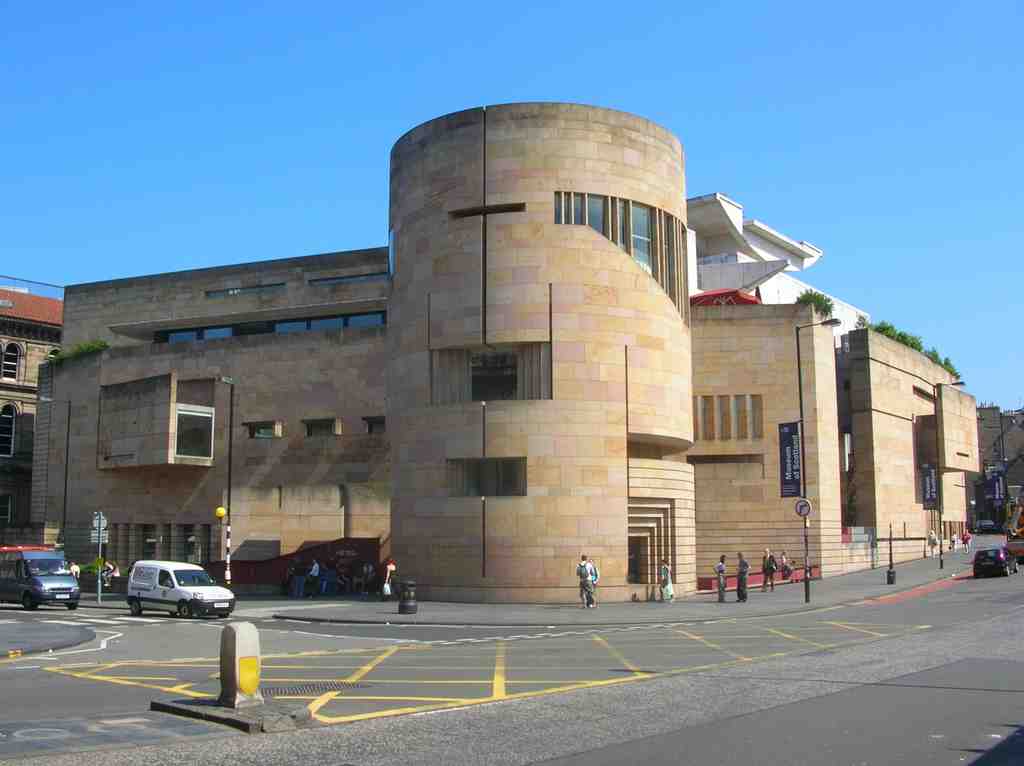
In front of you stands the National Museum of Scotland-just look for the bold, round tower of golden sandstone, its modern, geometric shapes and large windows gleaming under the Edinburgh sky, right at the corner of Chambers Street.
You’re standing at the crossroads of stories from every corner of Scottish history-and the world! The National Museum of Scotland wears two faces side-by-side: the striking modern sandstone tower before you, all sharp lines and round towers, and tucked beside it, the grand Victorian palace that looks like it was built to house adventures and mysteries rather than just artifacts.
Let’s set the scene. It’s 1861, Queen Victoria’s reign is in full swing. Edinburgh is bustling and Prince Albert himself comes to lay the foundation stone of what will soon become the city’s greatest curiosity cabinet. Sadly, it’s Albert’s last public act before his sudden death, so this place has a touch of royal drama built right into its bones!
Step inside-at least in your imagination-and you’ll find yourself in a soaring glass-and-iron hall that looks straight out of a Victorian fantasy novel. You’ll hear the echoes of early inventors, explorers, and some very curious schoolchildren (and more than one parent chasing after them). That grand gallery, stretching four stories high, glimmers with hundreds of suspended wonders-from flying machines to ancient stone carvings, and a clock that moves like a giant, ticking sculpture, the famous Millennium Clock. Can you hear its gears clanking and bells chiming as the hour strikes?
But every good museum needs a story of rivalry, discovery, and, well, the odd prank. This site’s story begins in the 1600s, when Robert Sibbald’s “Chamber of Rarities” wowed visitors-even Daniel Defoe claimed it couldn’t be matched anywhere else in Britain. Over time, the collection grew, split, changed hands, and once even served as Charles Darwin’s classroom, where he learned to stuff animals and studied Scottish minerals. Picture Darwin himself here, a curious young man poking at ancient bones while his professor paces nearby.
In the late 1800s, the museum became the Industrial Museum of Scotland, collecting weird and wonderful inventions from across the globe, even building a so-called “Bridge of Sighs” linking it with the university next door. In classic student fashion, this bridge once became the secret pathway to a hidden stash of party refreshments-until, of course, the grown-ups discovered it and the fun abruptly ended.
But the museum’s sense of humor endures! In 1975, they created the world’s sneakiest bird: the bare-fronted hoodwink, which was really a clever mash-up of various bird parts and a prank on gullible visitors. The bird, experts claimed, always flew away before anyone got a good look. That’s the sort of delight hidden in these walls.
But it’s not all fun and games. Here, you can spot the famous Dolly the sheep-no, not a woolly jumper, but the first-ever cloned mammal, forever frozen in time. There are Ancient Egyptian mummies, glamorous costumes from Sir Elton John, ancient Scottish beheading machines, and even stolen treasures being returned to their rightful homes like the Ni'isjoohl totem pole.
Every element of the building itself tells a story-those golden stones were chosen to speak to Scotland’s ancient geology, and the rooftop garden bursts with wild Scottish plants. This museum isn’t just for gazing at old, dusty relics; it’s a living, evolving curiosity cabinet, as full of surprises as a Scottish loch. And with millions visiting every year, you’re in very good company-even if, so far, nobody’s managed to beat the schoolchildren at spotting all 8,000 objects in the new galleries in one go.
So as you look up at this remarkable blend of old and new, imagine chambers filled with stories-where the past has a pulse, and no two visits are ever truly the same. Now, who’s ready to go find Dolly, the world’s most famous sheep?




