
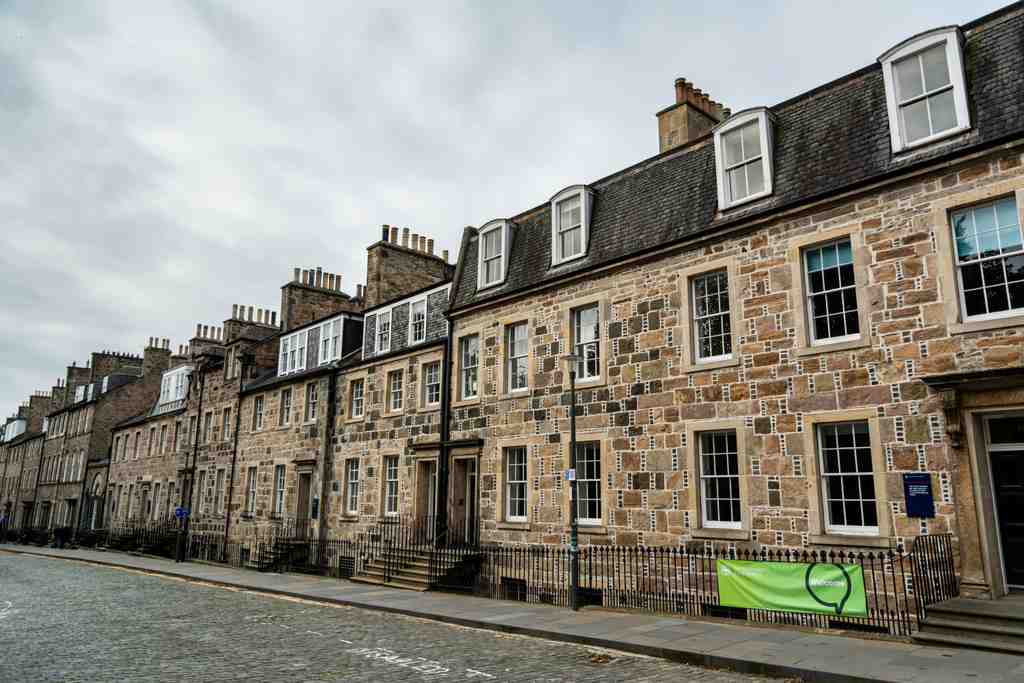
Look for a row of beautiful Georgian townhouses with symmetrical stonework, high chimneys, and tall windows all lined up along a cobbled street - you can’t miss their sandy color and classic elegance right in front of you.
Ah, you’ve arrived at George Square! Take a deep breath and let your imagination transport you back to 1766, when this very spot was a brand-new oasis for Edinburgh’s well-to-do. The Old Town was bursting at the seams, so George Square became an escape for those with a bit of gold in their pockets and dreams of more elbow room. Picture smartly dressed lawyers and nobles strolling across these stones, children skipping, horse-drawn carriages rattling by, and crisp Scottish air swirling around those chimneys up above.
At first, the square was a neat arrangement of dignified Georgian houses-modest by today’s standards, but the absolute envy of Edinburgh at the time! You’d need a snappy wig and a good reputation to move in. Sir Walter Scott once lived here, as did the indomitable Lord Braxfield-a judge so stern, people say he could out-frown a Scottish winter! Over at Number 23, a young Arthur Conan Doyle scribbled notes as he studied medicine, years before Sherlock Holmes ever put on his deerstalker hat.
But it wasn’t all tea and tranquility. In 1792, the square was the starting line for the fiery Dundas Riots. Angry crowds gathered right here, with the home of the Lord Advocate, Robert Dundas, their target. You can almost hear the rumble of voices echoing off the stone, the tension heavy in the summer night as the city’s heartbeat pulsed just out of sight.
Of course, change is the only constant, and George Square wears its story like a patchwork quilt. In the late 1800s, some of the houses on the east side weren’t just homes-they transformed into George Watson’s Ladies College, bustling with the laughter and chatter of bright-eyed students. By the 1960s, the world was changing fast, and so was the square. Out went the southern side’s graceful Georgian rows, in came the bold, new University of Edinburgh buildings-think Gordon Aikman Lecture Theatre and the imposing Appleton Tower. There were protests, tempers flared, and history buff groups like the Cockburn Association campaigned to save every last crumb of Georgian charm. The Dominican priory, stubborn as a Highland thistle, simply refused to sell their slice of the square to the university. If buildings could throw up a “Do Not Disturb” sign, that priory certainly did!
Today, George Square is the academic heart of Edinburgh. During the summer, it transforms in the most magical way-Edinburgh’s world-famous Fringe Festival turns the square into a buzzing hive of creativity and laughter. Pop-up bars and food stalls appear overnight. The scent of coffee, curry, and ambition hangs in the air, and actors dash past in wild costumes, ready to transform a classroom into a stage at a moment’s notice.
The central gardens, a patch of green mystery, still retain a hint of exclusivity-but, whisper it, you can usually wander in from the south, brushing past “Baillie lamps,” charming little lanterns that once lit up the homes of Edinburgh’s city councillors. There’s even a whimsical monument called “The Dreamer,” a tribute to Winifred Rushforth, perfect for anyone needing extra inspiration-perhaps for writing the next great detective novel.
So, as you stand here, feel the layers of time: judges and writers, rebels and students, even the ghosts of worried architects hoping their efforts would last. And if you’re lucky, you might catch a performer practicing their lines under the shade of those storied trees, keeping George Square’s lively, ever-changing story alive all over again.
Interested in knowing more about the georgian square, gardens or the famous residents




