
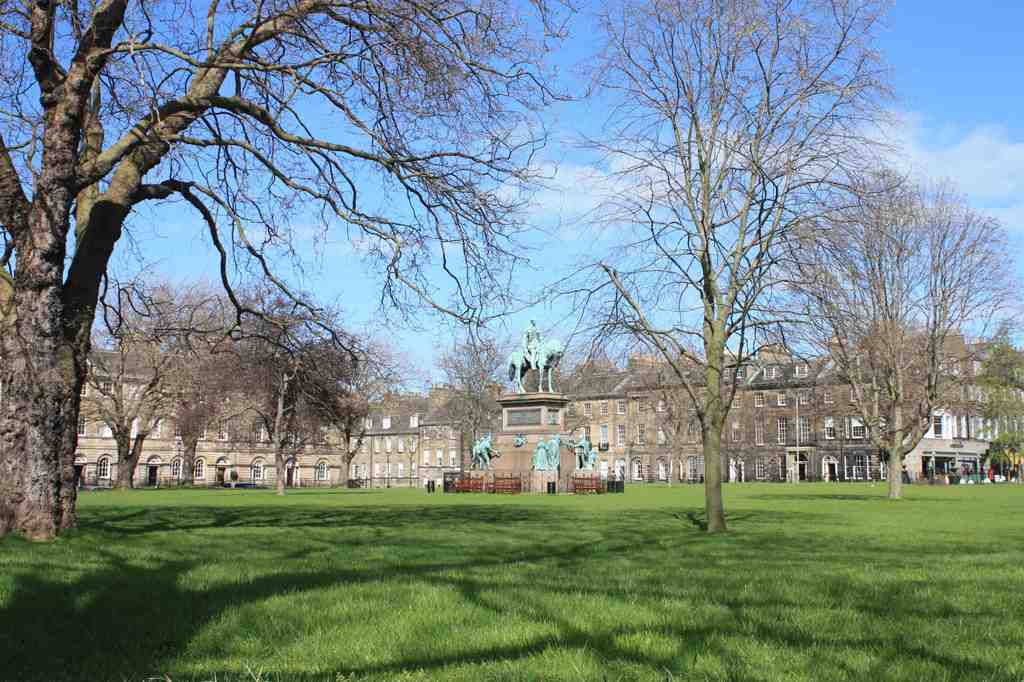
You’ll spot Charlotte Square straight ahead-a grand, leafy garden square framed by curved rows of honey-colored Georgian townhouses, with an imposing bronze statue of a man on horseback right in the center of the private lawns.
Alright, welcome to Charlotte Square-the crown jewel at the western tip of Edinburgh’s majestic New Town. Go ahead, take a deep breath and soak in the fresh scent of grass and old stone, and listen: if these elegant homes could talk, the stories they’d tell! Now, while it may look rather calm and dignified today, Charlotte Square’s history is a fair bit livelier, full of ambition, rivalries, royal honors, book festivals, and even a hint of wartime secrecy. Ready for the tale?
Imagine this: it’s the late 1700s, and the city’s designers were working on a grand plan for the New Town, where Edinburgh’s best and brightest would mix business, pleasure, and maybe the odd bit of gossip about the neighbors. This very square was meant to mirror the equally stately St Andrew Square over to the east, locking Edinburgh’s New Town in a gentle architectural embrace. The man behind the plan was James Craig, who first called this place St. George’s Square. But here comes our first little drama-there was already a George Square in the south. Talk about confusing your dinner invitations! So, in 1786, they renamed it in honor of King George III’s beloved wife and daughter: both named Charlotte. Good job, royal family, for cutting down on the monogramming costs.
But Charlotte Square took its sweet time becoming the showpiece you see. The north-west corner wasn’t completed until 1990 because of a boundary dispute so long-running, you’d think someone had hidden a treasure chest under one of the paving stones!
The design you see-with uniform stone facades, graceful windows, and neat railings-came mostly from Robert Adam, one of the greatest architects of his day. Adam poured his imagination into the plans, then promptly passed away just as work was beginning. You could say he really put his house in order before moving on.
These days, the heart of Charlotte Square is still the lush private garden-no public picnics, I’m afraid, unless you’re very charming or have a secret key. Originally, it was a perfect circle laid out by William Weir, but later, they squared it up for a grander effect, planting more trees and filling the lawns with the sound of birds and the occasional nervous squirrel. The focal point is Prince Albert’s statue, finished by Sir John Steell in the style of field marshals-because nothing says “eternal glory” like sitting on a horse forever. Around the base, you’ll see four figures, each bigger than the last, supposedly representing Science and Learning, Labour, the Army and Navy, and Nobility. The Queen herself popped by in 1876 to reveal the finished work-imagine the city’s excitement that day!
Look around the perimeter and you’ll notice each house is more distinguished than the last. Number 5 was home to the Marquess of Bute, who adored the square so much he eventually bequeathed his house to the National Trust for Scotland. His neighbor, Number 6, is today the official residence of the First Minister of Scotland-so if you smell a hint of policy and power, that’s where it’s brewing. Number 7, restored to its original Georgian splendor, offers you the chance-on another day-to step inside and see how Edinburgh’s elite used to live, complete with antique fireplaces and hush-hush parlors.
In warmer months, the gardens once transformed into a literary wonderland for the Edinburgh International Book Festival. Now relocated, but for many years this green haven played host to readers, writers, and rain-soaked publishers.
Of course, Charlotte Square hasn’t escaped history’s less glamorous moments: during World War II, a vast air-raid shelter lay hidden beneath your feet, and the original garden railings were melted down for the war effort-talk about giving up your garden view for victory!
It’s a square of secrets, style, and stories, a place where the well-heeled and the wildly imaginative have always felt at home. Keep your eyes peeled-a true Edinburgh legend could be living behind any one of those magnificent doors.


