
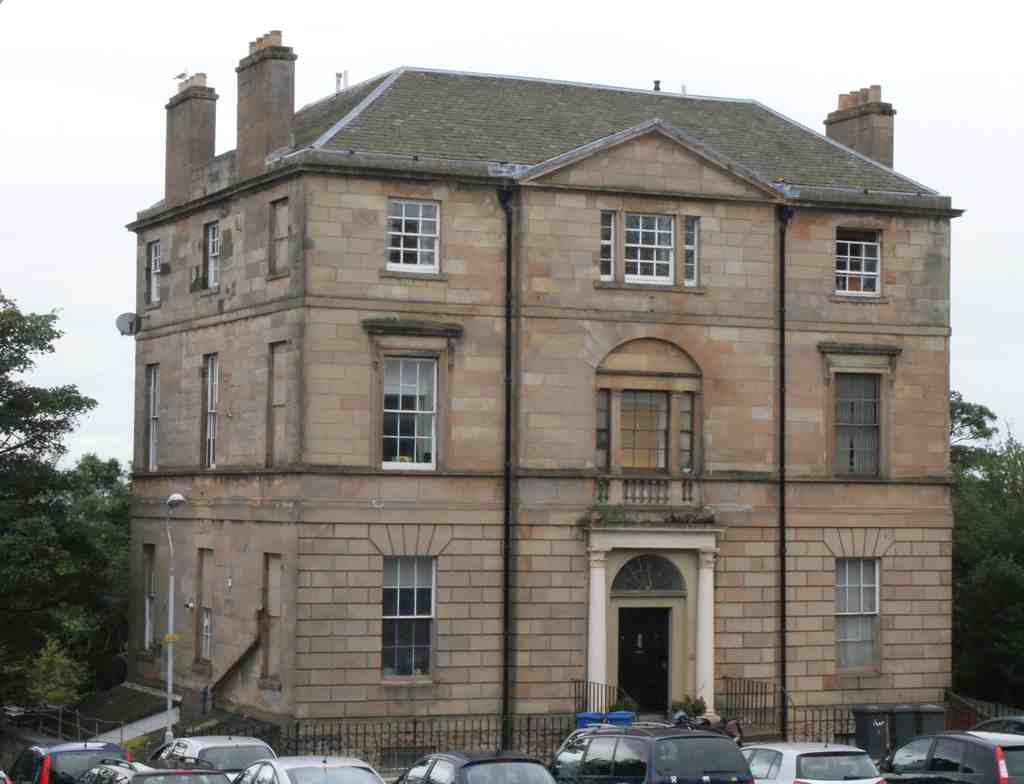
Alright, you should be able to spot Viewfield House right in front of you. You’ll notice it’s a stately, square, three-storey Palladian villa made of sandstone and ashlar blocks. The building stands out with its central bay featuring a shallowly projecting pediment. The ground floor has a rusticated exterior, and there's a heavy entablature supported by white columns flanking the front door.
Welcome to Viewfield House, a grand building with quite the history! Built around 1808 for James Blackwood, the Provost of Dunfermline, this house has seen a few changes over the years. It's a category B listed building, with three storeys topped off by a pitched grey slate roof.
The architecture is something to marvel at. The central bay creates a focal point with a shallow pediment and beautiful Palladian windows on the first floor. It's built with smooth sandstone ashlar, which gives it an elegant, timeless look. The ground floor's rusticated exterior adds some textured charm, and the basement is rock-faced for that robust feel.
To get to the front door, you ascend a set of steps flanked by white columns. Above the door is a semicircular fanlight, adding some extra flair. Architectural buffs might appreciate that the doorcase is modeled after The Tower of the Winds in Athens.
Inside, you'd be greeted by a decorative entrance lobby with plasterwork in Adam style, including roundels, fan vaulting, and an oval ceiling. Towards the back, there’s a dogleg staircase with a cast iron balustrade and an octagonal lantern.
The house had substantial grounds surrounded by trees in the 19th century, making it quite the scenic spot. Over the years, it has been home to various notable figures, including the family of John Finlay, a wealthy merchant from Calcutta.
In 1915, the house was bought by the Carnegie Trust and became home to the Carnegie Trust's Craft School from 1920, where students learned various crafts from furniture making to embroidery. After serving a stint with the WRNS during WWII, the house returned to the Trust but eventually closed in 1963. It continued to be used for craft classes until 1980 and was split into flats in 1982.
So, while you admire the architecture, just imagine the hustle and bustle of its vibrant history!


