
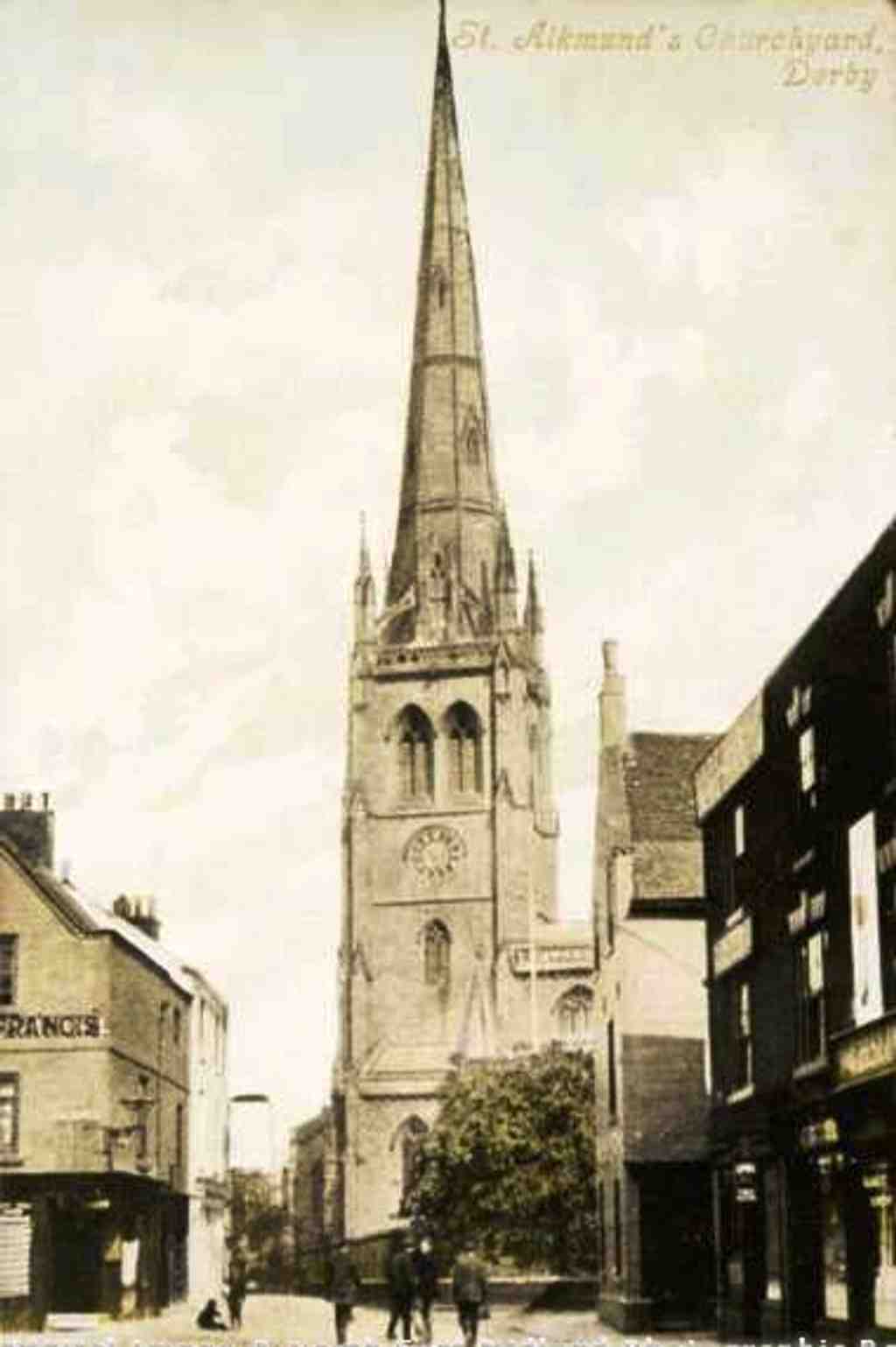
To spot the old St Alkmund's Church, look straight ahead for a tall, striking Gothic spire rising high above a row of townhouses, its stonework echoing with the stories of centuries past.
Welcome to the spot where St Alkmund’s Church once touched the sky! Picture it: a massive ashlar stone church in the middle of Derby’s only Georgian square, with a spire that shot up over 200 feet-practically poking through the clouds. In the 19th century, if you stood here, you’d be surrounded by elegant townhouses and the gentle buzz of shopkeepers and locals, all with the looming shadow of that famous steeple keeping watch over the square. Imagine the rhythmic clop of horse hooves and the laughter of children racing past a gabled sweet shop on the corner.
But let’s step back even further in time. St Alkmund’s wasn’t just any church-this ground has been holy since the 9th century, with churches dedicated to Saint Alkmund popping up one after another like a game of spiritual whack-a-mole. During excavations, they even found a huge stone sarcophagus and a 13-foot cross carved with birds and animals. Makes you wonder what secrets the earth is still hiding under your feet, right?
Fast forward to 1846. The latest version of St Alkmund’s Church was a true Victorian marvel. Designed by Henry Isaac Stevens for the princely sum of £7,700 (nearly as much as a small castle, if you ask me), its tall, elegant pillars and swooping stone arches turned heads and stole hearts. The aisle and nave were wide, light poured in from stained glass, and the flying buttresses propped up the steeple with the confidence of a Victorian lady holding her oversized bonnets.
Oh, and about that steeple-it was the talk of Derby! Its 216-foot spire stood directly in the line of sight of St Mary’s Catholic Church. Let’s just say, the Anglicans were not feeling very ecumenical, and the locals nicknamed St Alkmund’s “The Church of the Holy Spite.” When it comes to church rivalries, Derby really knew how to reach new heights-literally!
Inside, music lovers were treated to pipe organ performances; they had a legendary run of organists and even hosted the world-famous French organist Alexandre Guilmant for a grand recital in 1889. You could almost feel the notes vibrating up through the stone arches!
Life here wasn’t just about worship, of course. Picture the Lamb Inn on the square, its own brewery sending rich, yeasty smells drifting in the breeze. Shoppers darted past the medieval storefronts or picked up treats at Derby’s oldest sweet shop-imagine, the hum of conversation mixing with the chime of the church clock.
But every great story has its twist. By the 1950s, the beloved spire was hiding a dirty secret: the woodwork inside had started rotting and the stone was crumbling. It got so bad that they had to cut off the top 20 feet and cap the rest while workers clanged and called from scaffolds high in the air. Sadly, plans to restore the full spire never came to be, and the church lost some of its Gothic decoration, as if the old building was sighing with exhaustion after centuries of standing tall.
And then-progress, wrapped in concrete and tarmac. In the 1960s, Derby’s council swung the wrecking ball to make way for a shiny new road. Locals protested, but the old church was demolished in 1968, with its graveyard, secrets, and all, making way for St Alkmund’s Way. When the dust settled, archaeologists uncovered the ancient sarcophagus and that wild stone cross, now sitting just a short walk away, safe in the museum. All that’s left of St Alkmund’s here is a small plaque, reminding Derby of what once soared above this spot.
So as you stand here, with the noise of modern traffic swirling around, imagine instead the ringing of bells, the aroma of fresh bread and hops, and the echoes of Derby’s strangest steeple battle. History has a funny way of sticking around, doesn’t it? Give the ground a tap with your foot-you never know, maybe St Alkmund’s spirit is still hanging about, keeping an eye on Derby’s busiest road!




