
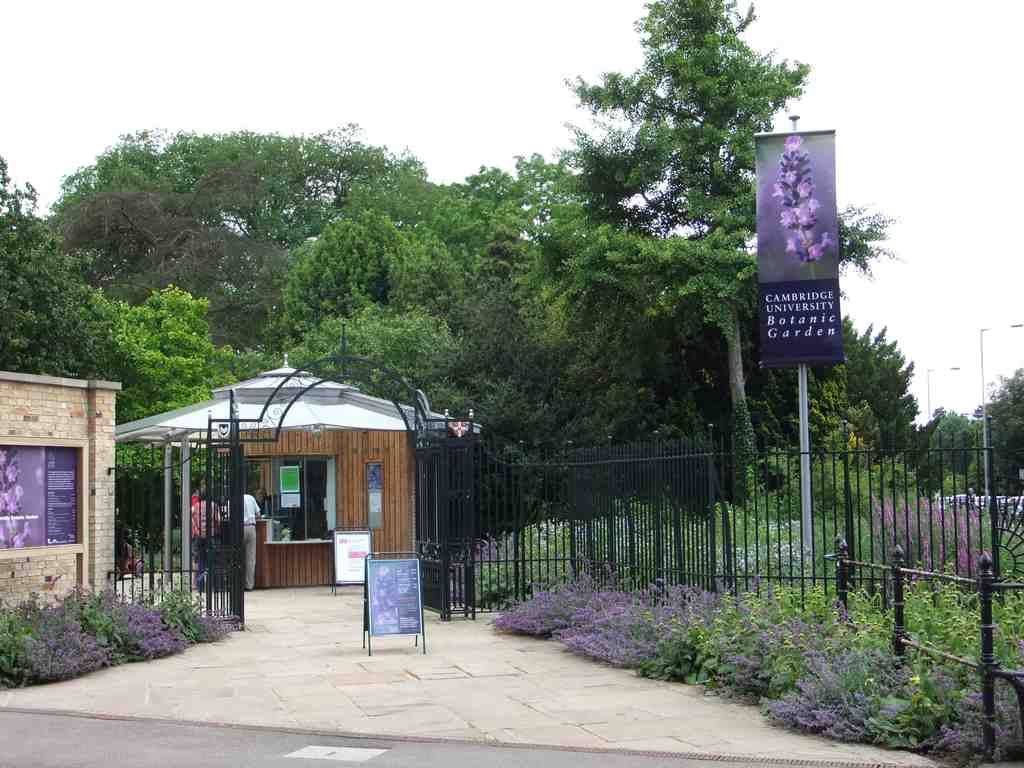
To spot the Cambridge University Botanic Garden, look ahead for a large wrought iron entrance gate set beside a small wooden ticket booth, surrounded by lush greenery and a banner with a purple flower marking the garden’s boundary.
Welcome to the Cambridge University Botanic Garden! Right here, on the edge of Trumpington Road, you’re at the gateway to a living laboratory, bursting with the scent of 8,000 plants from around the globe. Imagine stepping through these gates and being greeted by a chorus of leafy rustling and birdsong, where every plant has traveled-from tropical mountains and Arctic tundras-to grow side by side in this peaceful corner of Cambridge.
But it wasn’t always this magnificent! Picture Cambridge in the 18th century: scientific curiosity running wild, but not a proper garden in sight. After a few false starts, a clever chap named Dr. Richard Walker, Vice-Master of Trinity College, snapped up a chunk of land for £1,600-about the cost of a decent second-hand car today! Back then, the garden was squeezed into just five acres in the noisy town center, filled with curious students and the clink of glass from the first greenhouses.
This early physic garden, inspired by London’s famed Chelsea Physic Garden, was a place to study the medicinal powers of plants-imagine undergraduates earnestly sniffing herbs, hoping to cure headaches or learn a bit of botany before heading off to treat patients. For a while, things bloomed beautifully under Professor Thomas Martyn’s care, but when he left, the weeds nearly won!
Enter John Stevens Henslow-a man with muddy boots and even muddier ideas about science. Henslow, who would later become Charles Darwin’s teacher, knew the cramped town plot just wouldn’t do. He dreamed big: a huge, flat expanse where botany could blossom. In 1831, the university bought this very site-forty acres just waiting to be transformed. By 1846, the first tree was planted, and Henslow and his team wrestled with the heavy earth, carving lakes and raising mounds, designing beds in careful botanical sequence so each shrub and fern had its perfect home.
Don’t be fooled by today’s peaceful setting; the early days were a gardening adventure full of muddy drama! Funds were tight, so only half the land was planted-while the rest was rented out as allotments. But little by little, the garden grew: a lake emerged from a stubborn gravel pit, glasshouses shot up to shelter tropical wonders, and even one of the country’s first rock gardens took shape. Some of the rarest trees you’ll find in Britain started their lives here and, if you listen, you might hear them whisper stories of plant-hunters and scientific breakthroughs over the centuries.
Through two world wars, this garden became a hotbed for scientific experiments that would change biology forever. Pioneers like William Bateson and Edith Rebecca Saunders worked here, unlocking the secrets of plant genetics in the crisp morning air. Later, researchers like Frederick Blackman and George Edward Briggs explored how plants breathe and grow, using these grounds as their green laboratory.
Let’s fast-forward to recent times-on 25 July 2019, this tranquil spot rocketed into the headlines. On a day when even the cacti wilted, the garden made UK weather history by blazing to a record-shattering 38.7°C-oh, what a sizzle! Flowers drooped, staff squinted into the sun, and the ancient trees whispered, “We’ve never been this hot!” The record stood proud until 2022, when a fiery blast in Lincolnshire snatched the crown, but the garden hit its own new high at 39.9°C. You might say: it’s a hot spot for science… and for sunbathing plants.
Look out for Cory Lodge, built in the 1920s as the director’s home, and let your nose follow the fragrance of Indian bean trees and rare Ginkgo biloba trained along the walls. In recent years, the Sainsbury Laboratory has taken root-a gleaming center where cutting-edge plant science and computer wizardry combine to solve nature’s greatest mysteries. And for a touch of gravity-until 2022, you could visit a real descendant of Isaac Newton’s famous apple tree, right here, before Storm Eunice blew it down.
So take a deep breath, step through those iron gates, and wander where Darwin once dreamed. Who knows what secret you’ll discover among the petals and leaves? Welcome to Cambridge’s most extraordinary garden!




