
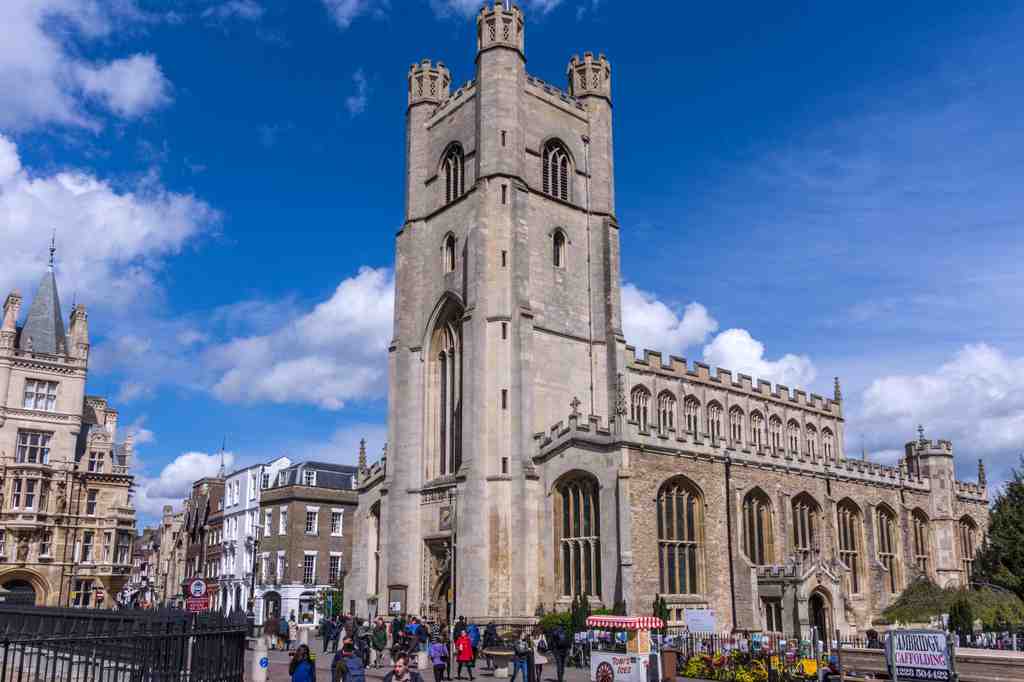
Look for the tall stone tower ahead of you, topped with little turrets and big arched windows, rising grandly above the street on your right - with golden stonework that stands out beautifully against the sky.
Alright, step a little closer and take in the sight! This grand church before you is St Mary the Great-though locals in a hurry call it just “GSM.” Now, imagine yourself in medieval Cambridge, the kind of place where students would grumble about having to walk no farther than three miles from this exact church. That rule still applies today, so if any students look nervous, maybe they're measuring the distance with every step!
This church has been the beating heart of Cambridge for centuries. Its story goes all the way back to at least 1205, when records show King John appointed a chaplain named Thomas de Chimeleye here. Some say the stones beneath your feet might even date back to 1010! But the original church was caught up in the chaos of 1290, when a fire swept through the building and left only ashes and sorrow behind. The fire unleashed a storm of rumors and injustice, leading to a turbulent chapter in Cambridge’s history, before the church was finally rebuilt and renamed St Mary the Great.
Through the Middle Ages, GSM was so much more than a place for Sunday sermons. University charters, royal proclamations, and dueling debates echoed between these stone walls, with crowds that likely spilled out onto the street. If you close your eyes and listen, you might almost hear the rustle of parchment and the clatter of boots as townsfolk burst in during the Peasants’ Revolt in 1381, grabbing and burning the university’s precious documents. Imagine the tension in the air that day!
But GSM had a special place at the heart of Cambridge University. University officers, by ancient rule, must live within a 20-mile radius, while undergrads get just three. (No pressure, students!) For centuries, this church hosted compulsory “University Sermons,” where sleepy scholars tried their best not to nod off. But with the grand new Senate House opening just across the street in 1730, the rowdiest debates moved out, and the church got a bit quieter… at least for a while.
As you look up at the church’s soaring tower, built finally in 1608, try to imagine builders painstakingly arranging each stone-financed by not one, but two English kings: Richard III and Henry VII. Their investment certainly paid off; the church now holds the title of Grade I listed building, making it one of the crown jewels of Cambridge architecture. The design is called Late Perpendicular, and you’ll notice all those elegant, tall windows and crisp stonework, practically asking for a choral anthem to ring out through the arches.
Speaking of ringing out, GSM has some of the oldest continuous bell-ringing traditions in the world! Step closer and you might hear the bells clanging in the tower. The special “Cambridge Quarters” chimes you hear echoing through the city even inspired those of Big Ben in London-so if the sound feels familiar, you’re not imagining it!
Now, venture inside (use your imagination-we’re on the street, after all), and you’d spot not one, but two mighty organs. The University Organ, up in the west gallery, has pipes with a history longer than some countries-first built in 1698 and lovingly restored over centuries. The sound it makes? Let’s just say, if ghosts ever haunt Cambridge, you’d find them swaying to those powerful organ notes.
Speaking of drama, this church has seen its share of intense moments-ever heard of Erasmus? He preached here! And Martin Bucer, a reformer whose remains were burned outside by order of Queen Mary I, but later brought back into the church by Elizabeth I and honored with a special memorial.
Today, GSM is a hub for all kinds of folk and continues its rich traditions with a warm, inclusive spirit-singing, celebrating, and marking the greatest moments in Cambridge life, from the funeral of physicist Stephen Hawking to the noisy bell ringers every Sunday.
So as you stand beneath the watchful tower of Great St Mary’s, remember you’re at the crossroads of kings and scholars, revolutions and hymns, ancient bells and modern minds-a place where Cambridge’s story has been written in stone, sound, and some very determined footsteps. Ready for the next chapter of our tour?
Curious about the architecture and features, list of vicars or the burials and funerals? Don't hesitate to reach out in the chat section for additional details.


