
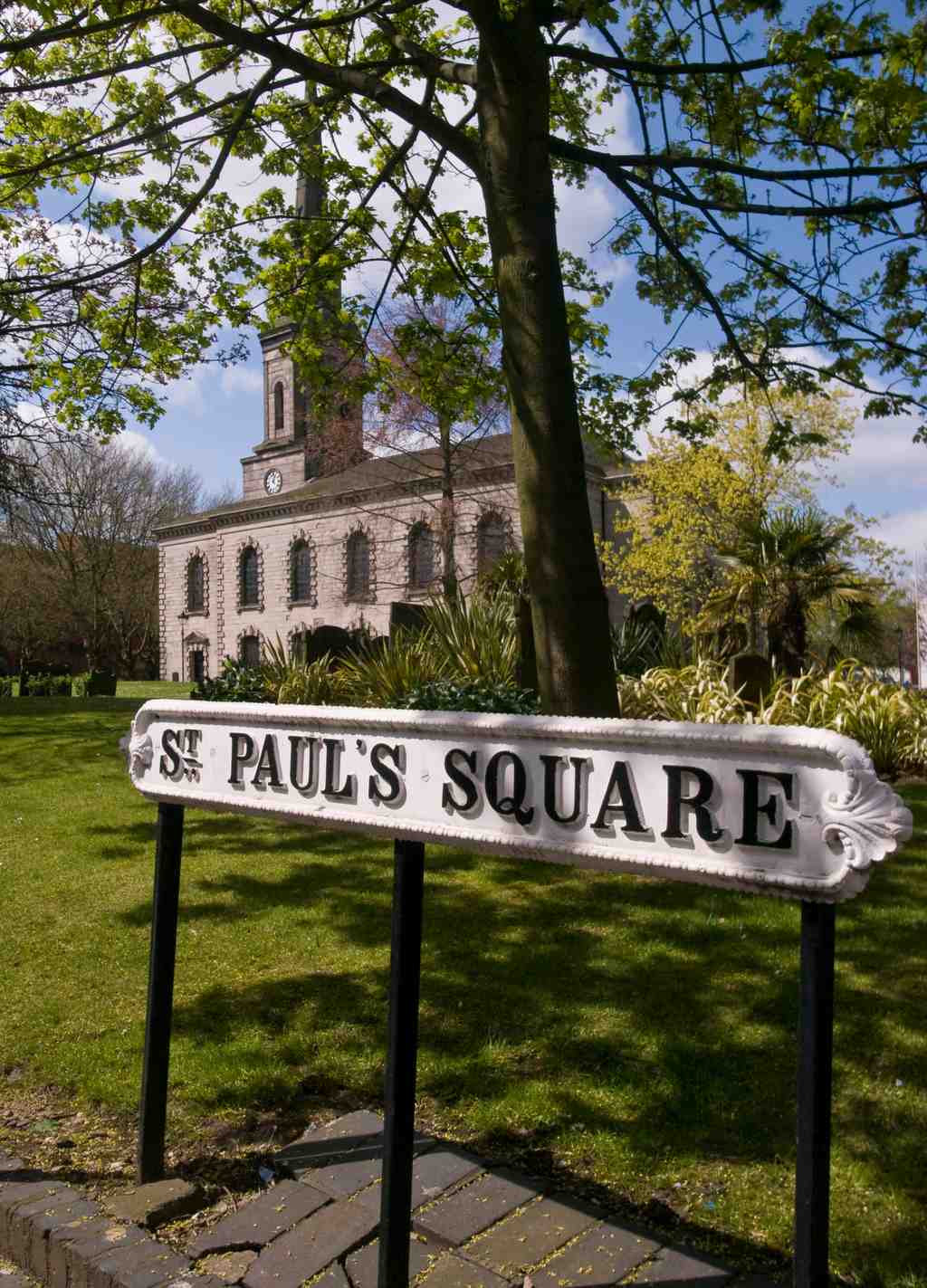
Ahead of you is a calm Georgian square framed by red-brick terraces and centered on a pale stone church with a slender spire rising above its rectangular body.
This is St Paul’s Square, the last surviving Georgian square in Birmingham, and it lets the Jewellery Quarter exhale for a moment. In the early seventeen seventies, the Colmore family’s Newhall estate laid out this district on a tidy grid. That Georgian framework shaped everything: straight streets created order, and plots nearest the church sold more easily and fetched higher rents. So this place was never just handsome. It was planned status... with a landlord’s eye for profit.
At the center stands St Paul’s Church. Roger Eykyn of Wolverhampton started it in seventeen seventy-seven on land Charles Colmore gave from the estate, and the church opened in seventeen seventy-nine as a chapel of ease, which simply means an extra church built to serve people too far from the main parish church, St Martin in the Bull Ring. It is the only survivor of Birmingham’s eighteenth-century churches. That gives the whole square a rare, slightly defiant grace.
The church itself is plainspoken and elegant, a rectangular design modeled on St Martin-in-the-Fields in London. The spire came later, in eighteen twenty-three, when Francis Goodwin added that upward flourish. If you glance at the image on your screen, you can see how the surrounding houses complete the composition: brick fronts, measured windows, and that carefully rationed Georgian elegance.
Inside, the church holds a small masterpiece most people outside never suspect. Its east window from seventeen ninety-one shows the Conversion of St Paul. Benjamin West designed it, and Francis Eginton made it here in Birmingham. Eginton helped revive enamel-painted stained glass in the city, so even this church window quietly advertises local craft skill. And the congregation had clout: Matthew Boulton and James Watt owned pews here, because pews could be bought and sold like property. Even worship had a seating market.
By the late nineteenth century, workshops and factories pressed hard against the square, and some elegant fronts were chopped about for industrial use. Ask a local who knows the area well, and they will often point to the nineteen seventies as the real rescue. That was the turning point, when restoration began to reclaim the square’s Georgian character after industry had nearly smothered it.
That rescue is still unfinished. Leaking parapet gutters, the drainage channels hidden behind the top of the walls, have damaged plaster and stone inside the church, and campaigners recently sought about six hundred and sixty thousand pounds for urgent roof repairs.
One small Birmingham squabble lingers here too: the road signs dropped the apostrophe, and not everyone took that calmly. You can spot the evidence on the app.
From here, ordered streets give way to organized creativity. Just off the square, the Royal Birmingham Society of Artists shows how Birmingham relied on trained eyes and practiced hands as much as elegant planning.


