
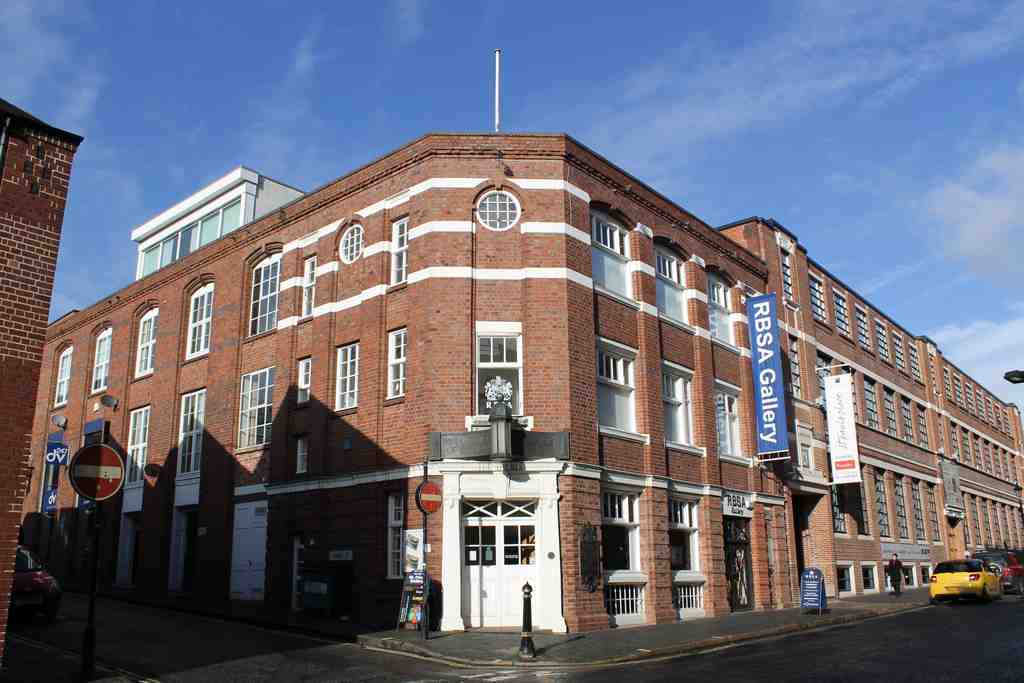
Look for the red-brick, warehouse-style front with tall rectangular windows and a pair of bronze plaques fixed to the facade.
This is the Royal Birmingham Society of Artists... the city’s reminder that creativity here was never just a decorative extra. Birmingham trained it, organized it, argued about it, and gave it a proper institution. The story starts in eighteen oh nine, when Samuel Lines, Moses Haughton, Vincent Barber, and Charles Barber opened a life drawing academy in Peck Lane. That meant artists and designers learned by studying the human figure, line, proportion, and form... exactly the sort of disciplined seeing that would feed not only painting, but the city’s wider making culture as well.
By eighteen fourteen, that circle had grown into the Birmingham Academy of Arts. In eighteen twenty-one, the Birmingham Society of Artists took shape, and by eighteen sixty-eight it had a royal charter and the name you see today. In other words, this was Birmingham saying that art belonged in the machinery of civic life, not tucked away as a luxury.
One of the main ambitions from the start was education. The Society kept alive the teaching mission begun by Lines, and that eventually helped lead to the Birmingham School of Art in the eighteen forties. So when people talk about the Jewellery Quarter as a place of skilled hands, remember that hands need eyes... and eyes need training.
Locals tend to enjoy this next bit because it sounds almost absurdly grand. In eighteen thirty, the Society’s New Street gallery opened not with a modest handshake, but with Princess Victoria herself, still a child, escorted by the Duke of Wellington. For a supposedly provincial art society, that is a fairly confident way to enter the room.
And this was no minor club. In the later Victorian period, it became influential in the Pre-Raphaelite world, with its rich detail and moral seriousness, and in the Arts and Crafts movement, which championed skilled handmade work over dreary mass production. Presidents included Edward Burne-Jones, William Morris, John Everett Millais, and Lord Leighton... serious names, not polite filler.
The building in front of you marks a later chapter. Financial pressure and commercial redevelopment gradually pushed the Society out of its old New Street home, and in two thousand it moved here, into this converted warehouse near St Paul’s Square. Charles, Prince of Wales, opened the gallery on the twelfth of April that year. Then, in twenty seventeen, a legacy from painter Kate Fryer helped fund a full refurbishment, so a member’s devotion quite literally reshaped the place.
Now, take a second to notice those bronze plaques on the outside. They date from nineteen nineteen and are the earliest known Birmingham works by William Bloye, who later became the Society’s president and Professor of Sculpture. Nice little clue, that... the future leader announcing himself quietly on the wall.
Inside and behind the scenes, the Society keeps an archive of catalogues, minute books from the eighteen twenties, letters, records, the whole paper trail of ambition. Annual exhibitions have run since eighteen twenty-seven, missing only the years nineteen forty, nineteen forty-one, and twenty twenty. Even artists, it turns out, respect a stubborn tradition.
From here, the story shifts neatly. Art taught people what to imagine in metal, stone, and design... and at the next stop, the Assay Office will show you how Birmingham decided what that crafted beauty was officially worth. If you plan to come back, the gallery usually opens Tuesday through Saturday, from ten thirty to five.


