
Look for black iron gates and railings held between tall stone piers, forming a formal entrance to a broad cemetery beyond.
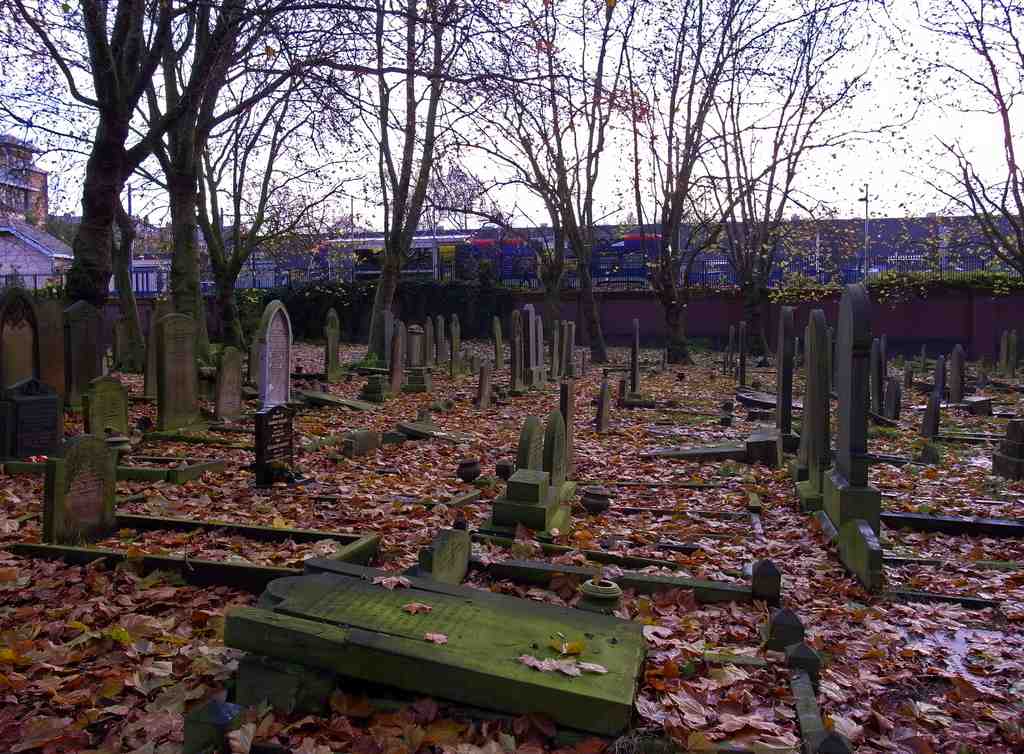
This is Key Hill Cemetery, opened on the twenty-third of May, eighteen thirty-six, and first known as Birmingham General Cemetery. It mattered because it gave Birmingham something new: a burial ground outside a churchyard, and one that welcomed nonconformists - Protestants outside the Church of England - in a city full of independent minds and equally independent opinions. In plain English, this was where a great many Brummies who helped build modern Birmingham could claim their place in death, even if they never quite fit the official mold in life.
Local architect Charles Edge laid it out, and he gave it these imposing gates and piers too, now restored and listed for their historic value. He also designed a Greek Doric chapel here - Greek Doric means the plain, sturdy classical style with simple columns - but that chapel has gone. That absence tells its own story. Cemeteries preserve memory, yes, but they also show you what cities let slip.
By nineteen fifteen, one writer felt confident enough to call Key Hill the Westminster Abbey of the Midlands. That sounds grand, but frankly he had a case. This ground holds politicians, reformers, manufacturers, journalists, scholars, and artists: Joseph Chamberlain and his family, George Dawson of the Civic Gospel, Harriet and Robert Martineau, pen maker Joseph Gillott, Alfred Bird of egg-free custard fame - proof that civic immortality can arrive by sermon, speech, or pudding.
Some graves carry whole dramas. Marie Bethell Beauclerc taught herself shorthand at twelve and became England’s first female shorthand newspaper reporter in eighteen sixty-three. Constance Naden, poet, philosopher, scientist, and artist, became famous in her lifetime, then much later drew supporters who helped rescue her memorial. Even here, reputation needed maintenance.
John Skirrow Wright’s funeral in eighteen eighty drew such enormous crowds that more than three hundred police had to control the procession. George Dawson’s followers raised a handsome monument decades after his death, refusing to let his influence fade quietly. And William Murphy’s memorial turns a grave into an argument, declaring that an attack in Whitehaven in eighteen seventy-one led to his death eleven months later - religious conflict carved into stone for strangers to read.
This place also carries Birmingham’s changing shape. Six rows of graves disappeared for the Metro. The old mortuary chapel vanished. If you like, check the before-and-after image in the app; it shows how Key Hill endured as the city around it changed almost beyond recognition.
What survives survives partly because local people fought for it. The Friends of Key Hill Cemetery formed in two thousand and four, later joining forces with Warstone Lane, and their work has literally uncovered the lost - including the buried grave of Robert Thomas, Jane Ward Earp, and their children.
So this is not just a cemetery. It is a stone archive of who made Birmingham: dissenters and industrialists, women who broke rules, men who filled streets, families who left glass, ink, sermons, science, and public argument behind them. Leave here with that in mind... the city’s glitter never came from ornament alone. It came from systems, labor, belief, and the stubborn human wish to be remembered with dignity.
And if you want to return, Key Hill is open all day, every day.


