
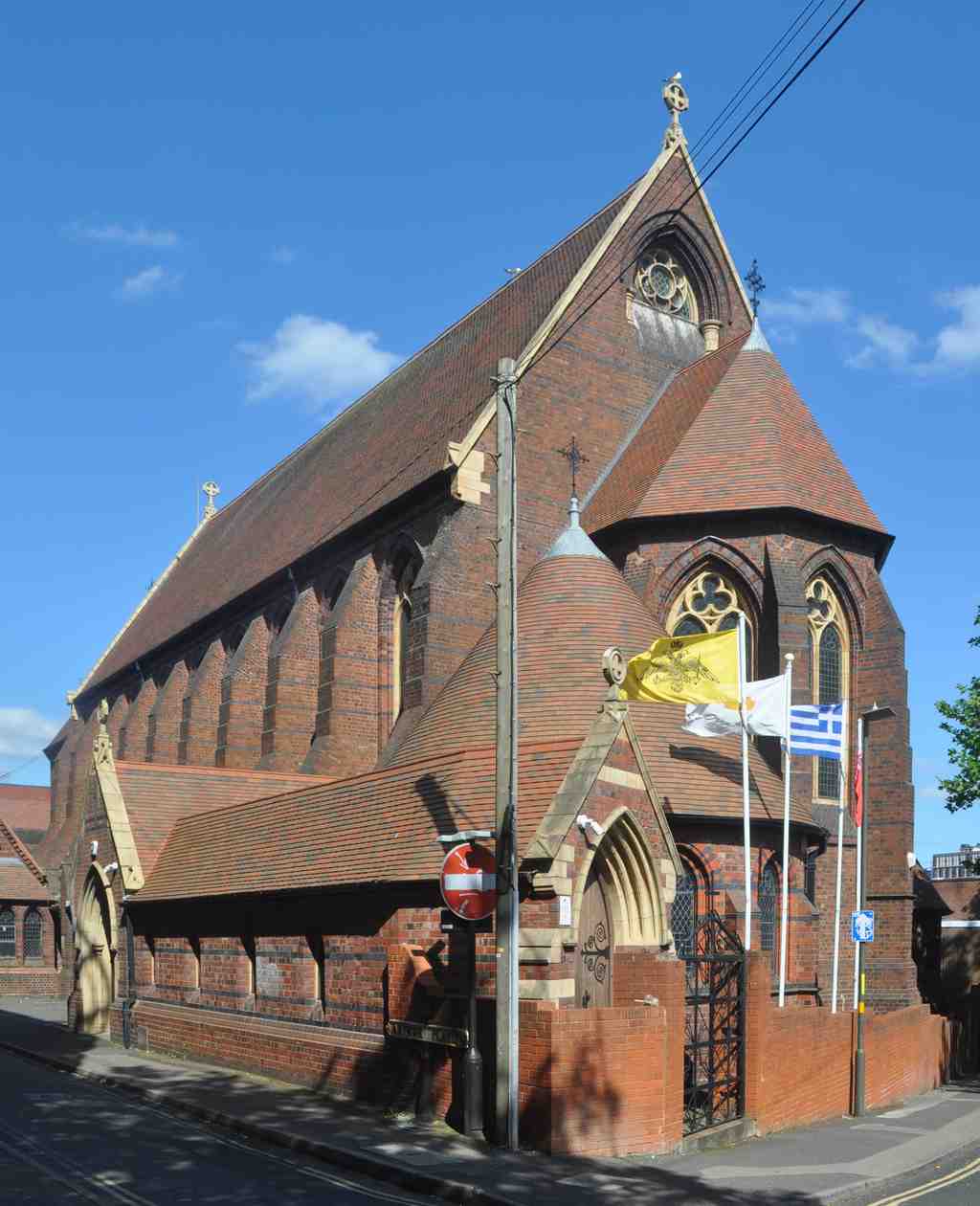
Look for the red-brick church with pointed Gothic windows, a broad rectangular body, and a deep arch framing the entrance.
Standing here, you can feel Birmingham change key a little. Not every important building in this part of town deals in display. Some deal in belonging. This cathedral began life in eighteen seventy-three as a Catholic Apostolic church, and J. A. Chatwin, one of Birmingham’s busiest church architects, gave it a solid Gothic Revival shape in the Early English style: a wide central hall for worship, called the nave, with strong buttresses and a serious amount of brick. Birmingham does love a building that looks ready to outlast an argument.
What gives this place its real power, though, is what happened after the Second World War. As Greek Cypriots came to Britain looking for work and a better life, Birmingham’s Greek Orthodox Community began to grow. By nineteen forty-seven, there were enough Orthodox worshippers here that the Archbishop of Thyateira sent a priest once a month to lead the liturgy in a church hall on Pershore Road. On other Sundays, families travelled to London or Manchester just to pray in their own tradition. That tells you something: faith, language, and community were worth the train fare.
By nineteen fifty-one, they held weekly Orthodox services at Saint James in Edgbaston, after the Anglican service ended. Then a small group got organized properly. Andreas Constantinou, whose cafe became a gathering place, worked with John Efstathiades, a former village church warden from Cyprus who was already in his seventies, along with George Sergiou, Christos Christophorides, George Apeches, Michael Angelides, Michael Epifaniou, and others. They raised money for the essentials of Orthodox worship: icons, a Holy Bible, and an iconostasis, the screen covered with sacred images that separates the altar from the main body of the church.
Their persistence paid off. In nineteen fifty-eight, this church became Birmingham’s first Greek Orthodox church, dedicated to the Dormition of the Mother of God and Saint Andrew, and Father Nicodemos Anagnostou began regular liturgies here as its first permanent priest.
If you glance at the photo in the app, you can see how that older Victorian shell still shapes the place today. But locals know the real story is not only inside the sanctuary. This cathedral also houses the Apostolos Andreas Greek School. It began the same year as the church, first in a Greek coffee shop in Lozells, then in borrowed rooms, then finally in its own building beside the church in two thousand and two. So this is not just somewhere people come to worship. It is where children learn Greek poems, prayers, songs, dances, history, and the language of grandparents. That is how a migrant community turns borrowed architecture into home.
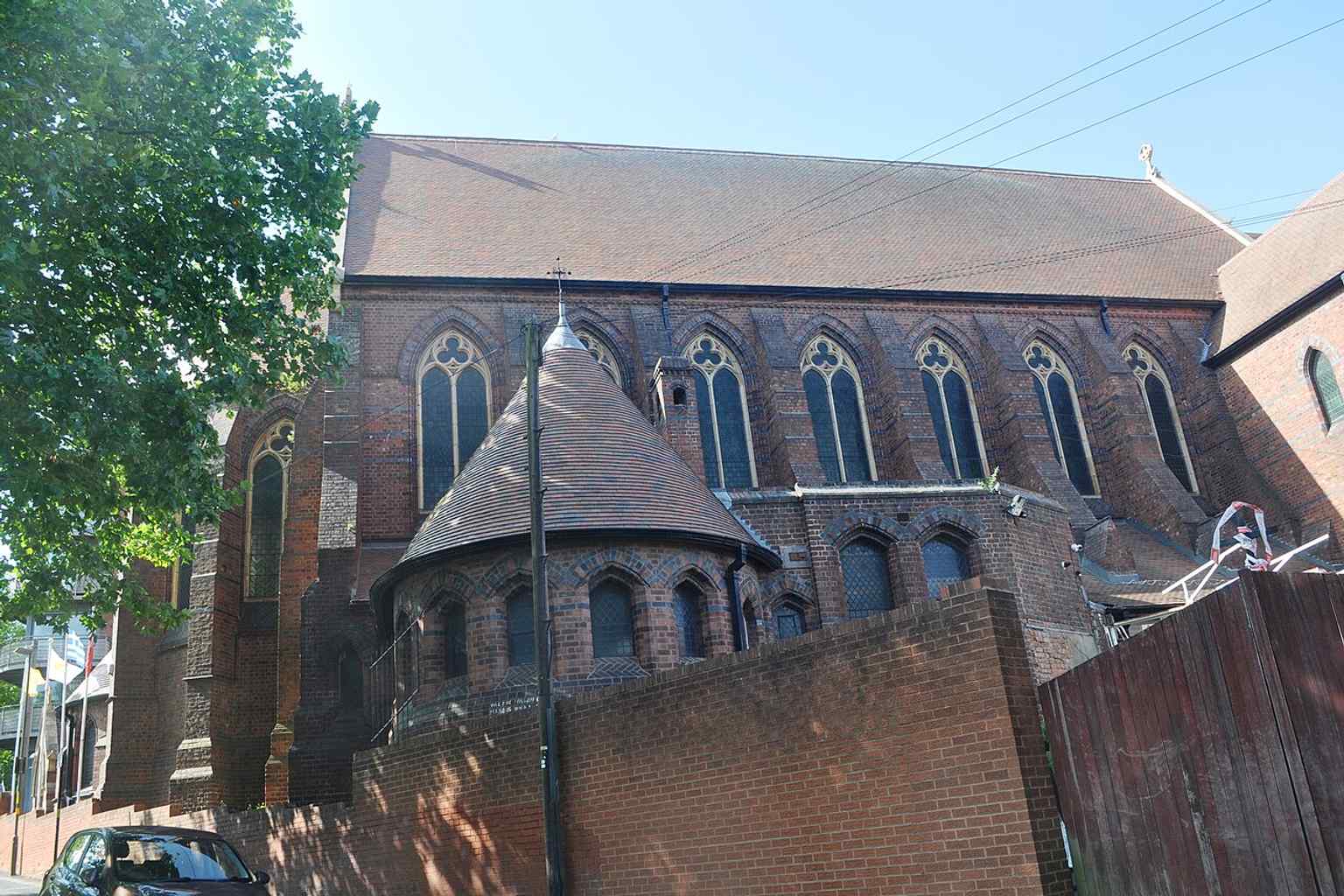
In nineteen eighty, when Bishop Irinaios of Patara Birmingham took his place here, the church became a cathedral, the seat of a bishop. Later, one of the school’s great teachers, Christophoros Cartoudis, received his British Empire Medal here in two thousand and fourteen, surrounded by the community he had served for decades... a fitting choice, really. Awards are nicer when the people who taught you to read can see them.
From here, the story turns back toward the Quarter’s working bones, where buildings show you exactly how craft and trade were organized. Argent Centre is about a four-minute walk from here. If you want to catch this cathedral open, it generally welcomes visitors on Sunday mornings from half past nine to one.


%20(August%202024)%20(1).jpg)