
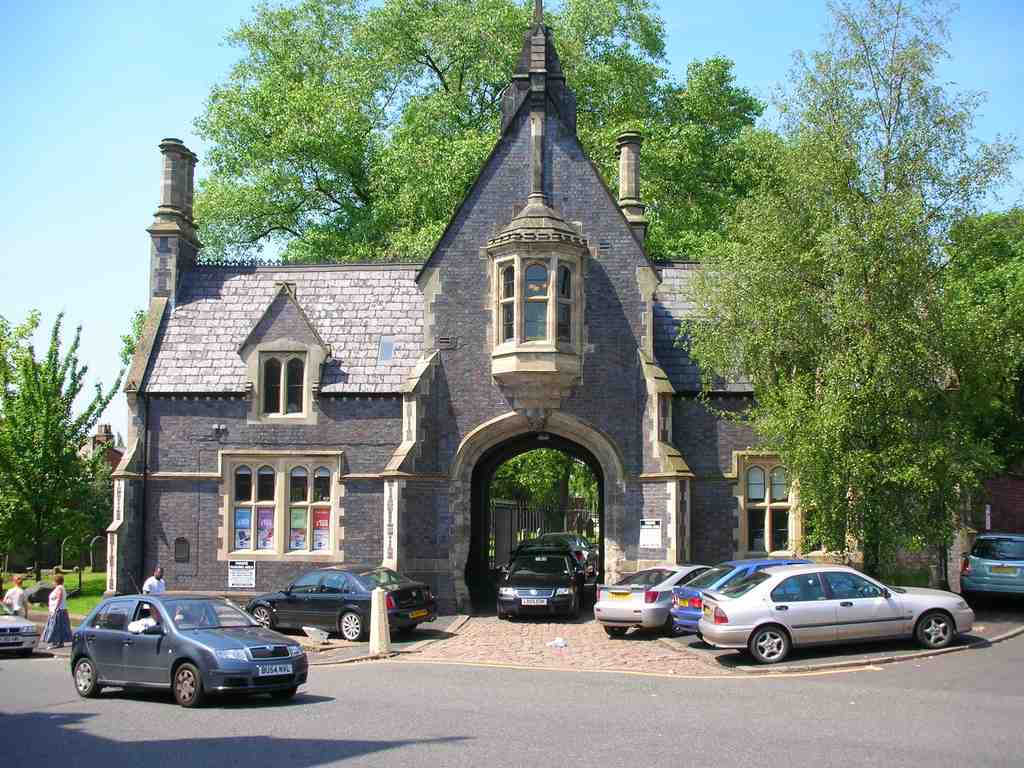
Look for the blue-brick gate lodge, the stepped stone catacombs cut into the slope, and the dark arched openings that give Warstone Lane Cemetery its unmistakable face.
This is memory in stone... an archive of the Jewellery Quarter where industry, grief, war, and careful rescue all ended up sharing the same ground. Warstone Lane opened in eighteen forty-seven as the Church of England cemetery, while nearby Key Hill served the nonconformists, meaning people outside the established church. Even in death, Birmingham kept its filing system tidy.
Locals will point out something most visitors miss: those catacombs were not simply a grand Victorian flourish. Builders cut them into the side of an old sandpit or quarry, turning an awkward industrial scar into burial space. Practical, slightly eerie, and very Birmingham. If you check the image on your screen, you can see those tiers clearly, stacked into the slope like a stone ledger.
The catacombs also caused trouble. Coffins stored there but not buried in earth were considered a health risk, and they helped prompt rules requiring such coffins to be sealed with lead or pitch. So even the law here grew out of pressure, seepage, and the city trying to manage what it had already built.
The cemetery’s chapel began with a foundation stone laid on the sixth of April, eighteen forty-seven. The Blitz later damaged St Michaels and All Saints chapel beyond repair, and workers demolished it in nineteen fifty-four. War reshaped this place in other ways too. After German bombing wrecked St Thomas’s Church at Bath Row in December nineteen forty, the city eventually cleared its gravestones and reinterred the dead here. A burial ground became a refuge for other disturbed burial grounds... grim, but oddly compassionate.
If you glance at the first image, the blue-brick gate lodge survives from eighteen forty-seven to eighteen forty-eight, designed by J. R. Hamilton and J. M. Medland, and it still stands as one of the cemetery’s original Victorian markers. The whole site is now Grade II listed for its historic importance.
Some stories here cling hard. John Baskerville, the great printer and famous atheist, did not arrive until eighteen ninety-seven after a long and rather undignified posthumous shuffle across the city. Edward Warrulan, a young Aboriginal Australian brought to England in the colonial world’s cold machinery, died in Birmingham at about nineteen and lies here in an unmarked public grave. Fifty-one Commonwealth servicemen from the First World War and thirteen from the Second are also buried here; where headstones vanished, a screen wall memorial gathers the names in one place.
Since two thousand and four, the Friends of Key Hill and Warstone Lane Cemeteries have helped restore graves and care for plots that neglect nearly erased. And now, fittingly, we leave the stillness of the catacombs for another afterlife of the city: routes and tunnels carrying people onward. Head next to Jewellery Quarter station, about three minutes away. If you plan to return, the cemetery usually opens from half past eight, closing at four on weekdays and half past six on weekends.


