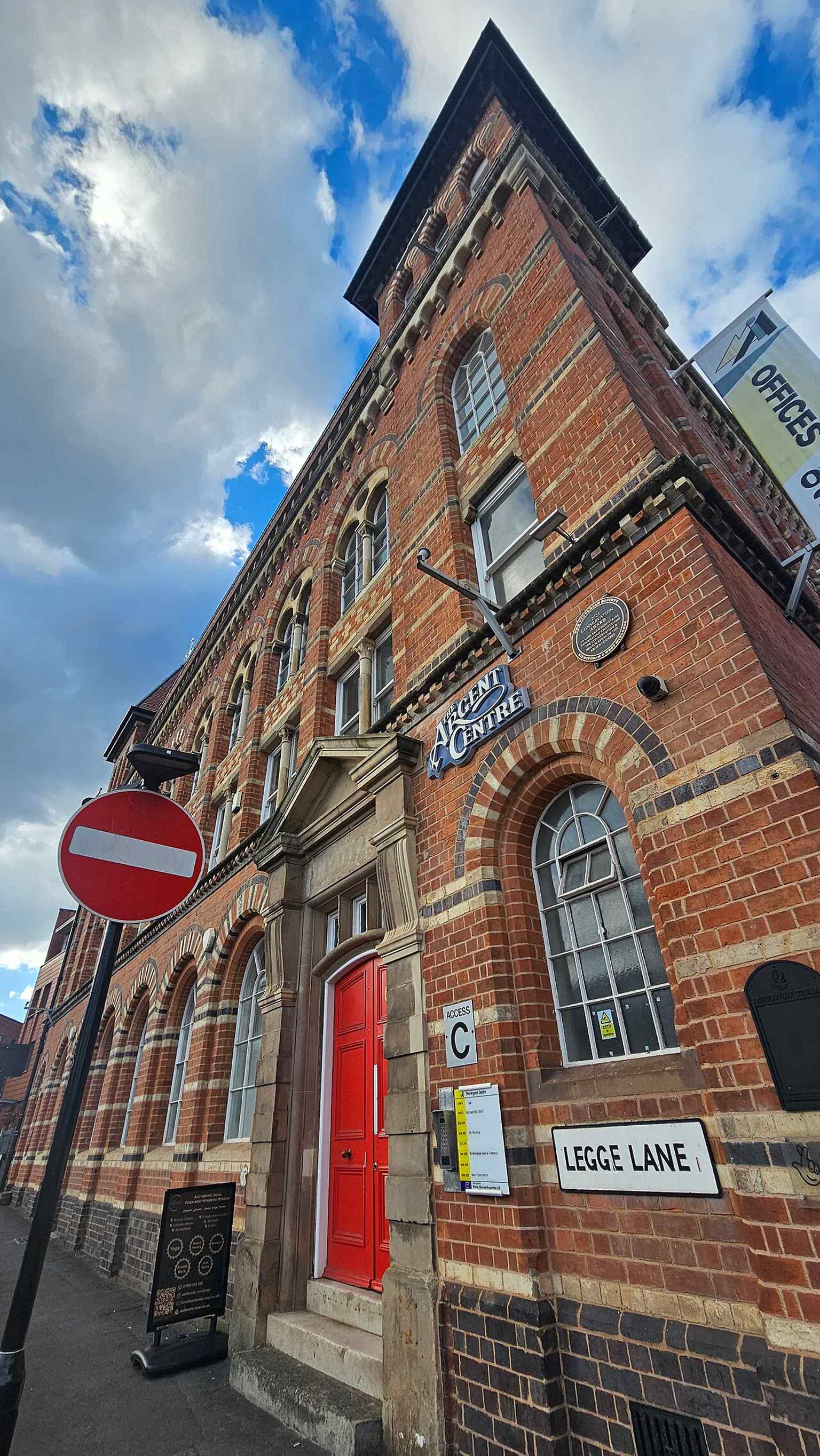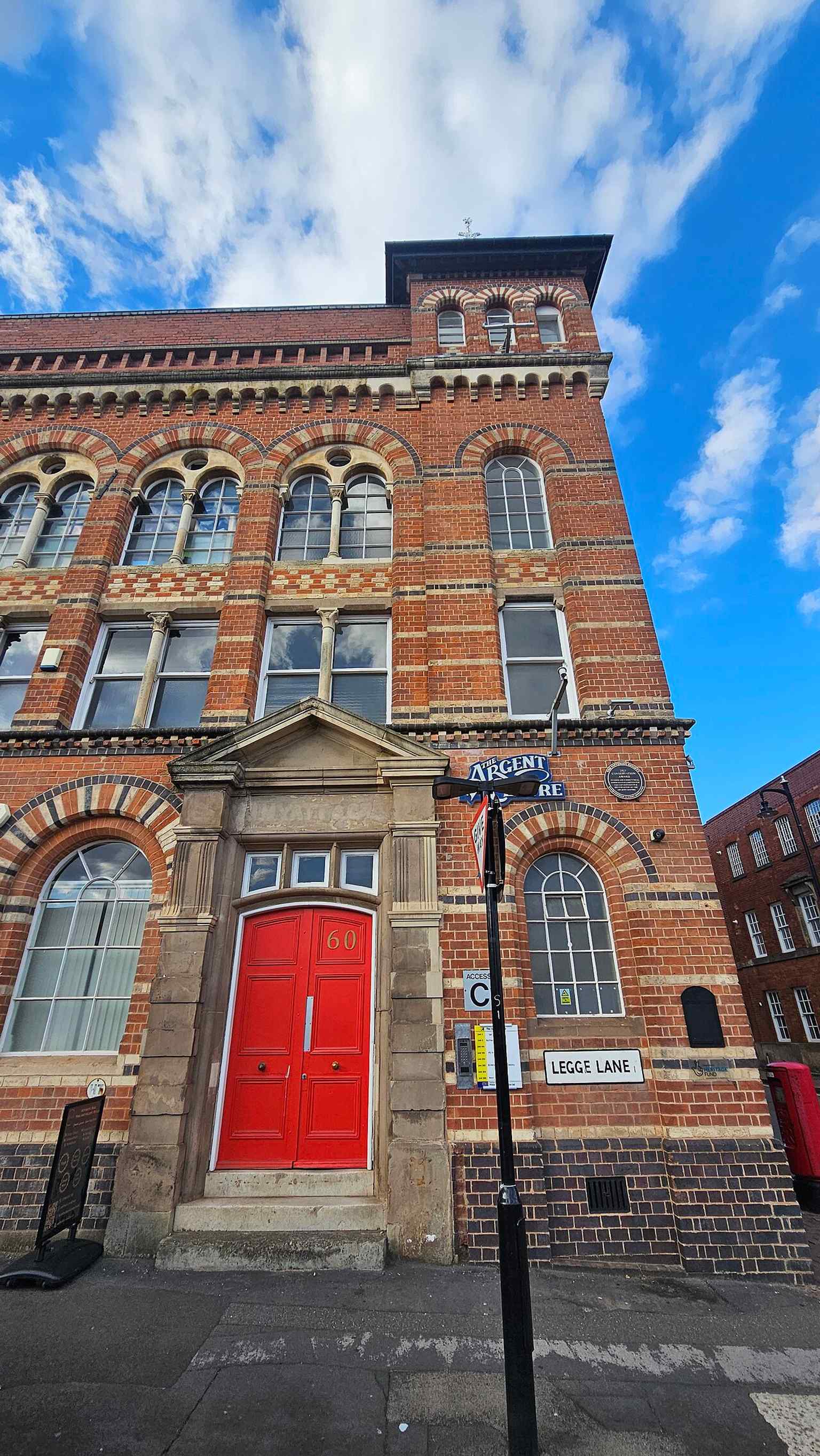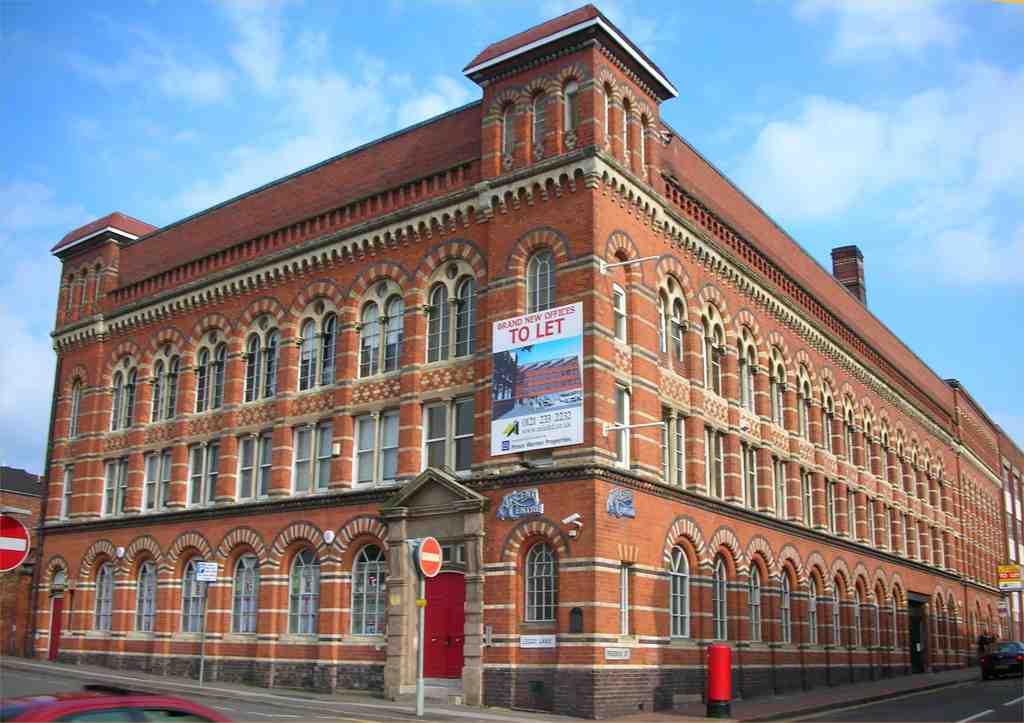
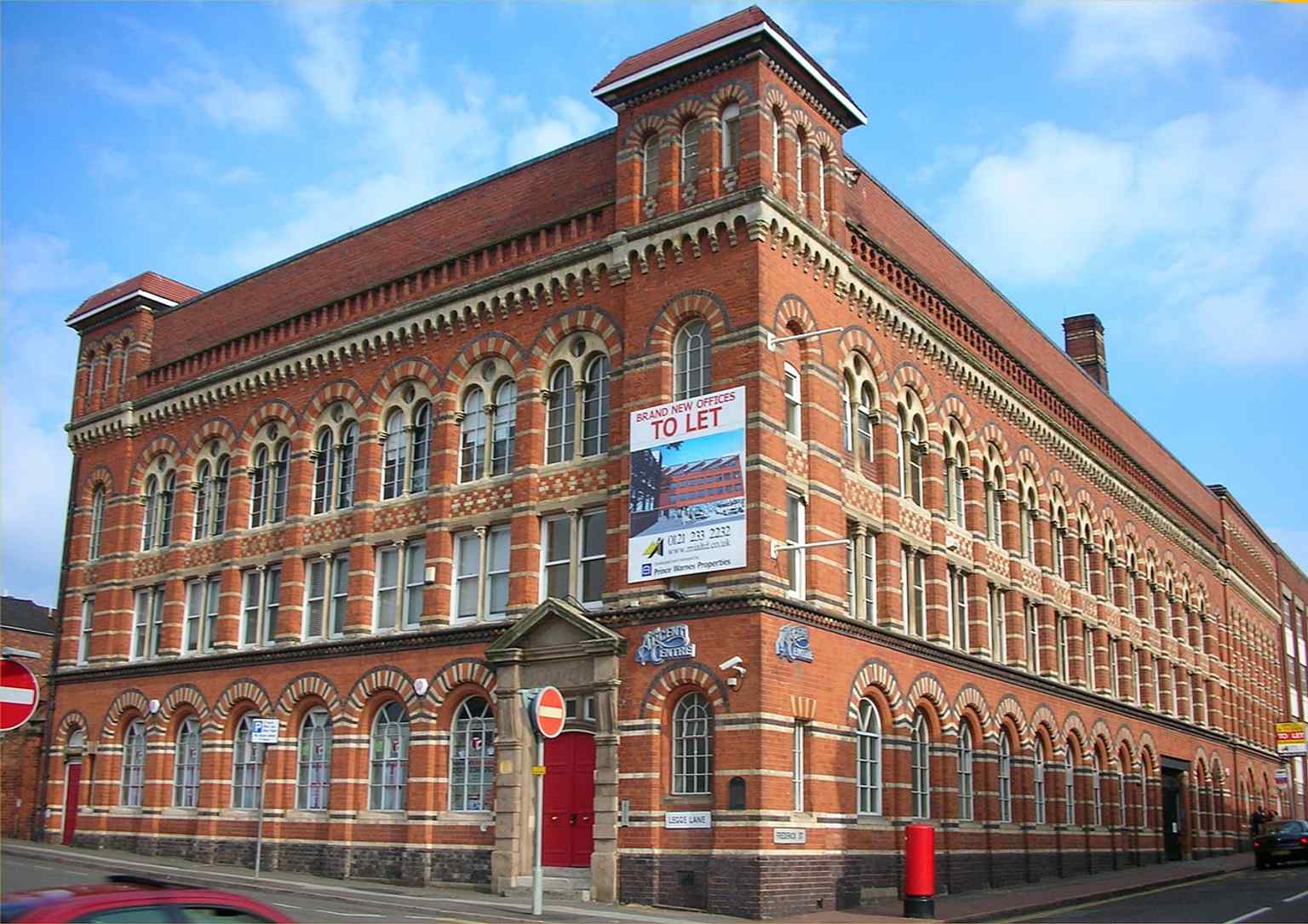
On your right, the Argent Centre is a hefty red-and-cream brick block with corner turrets, tall arched windows, and little pyramidal roofs that give the whole place a faintly theatrical skyline.
This is the Argent Centre, a Grade II* listed building on the corner of Frederick Street and Legge Road. Architect Jay Gee Bland designed it in eighteen sixty-three for W. E. Wiley, a manufacturer of gold pens, and the place first carried the name Albert Works, possibly because it faced a Victoria Works across the way. Birmingham could be practical even in its royal references.
This building is a neat lesson in factory logic. It looks like one vast industrial lump, but the real trick is hidden in the plan: long, narrow, multi-storey workshops, only sixteen feet wide, wrapped around an open courtyard. That layout let daylight hit workbenches from two sides, which mattered when your business depended on precision, repetition, and eyes that hadn’t yet met electric task lighting. Even the flat roofs had a purpose. The designers meant them to take extra storeys later if business kept growing.
And grow it did. Wiley spent five thousand pounds on the factory, roughly half a million pounds in today’s money, employed about two hundred and fifty people here, and turned out gold pens, propelling pencils, withdrawing pencils, and other finely made small goods until the firm merged with other pen makers in eighteen seventy-six. The site itself had once held a pair of semi-detached houses, which tells you something about this district: domestic space didn’t so much disappear as get swallowed by industry, one plot at a time.
Take a moment and look at the scale of the frontage... then imagine the reality inside. Not one cavernous hall, but slim vertical workshops packed around a central void. That’s the bit most people miss, and once you know it, the whole building reads differently.
The structure was clever too. The floors used hollow bricks tied together with wrought iron, improving fire resistance and helping reduce insurance costs. Very Birmingham: elegant engineering with an eye on the bills. If you glance at the image on your screen, the older exterior view helps the multicolored brickwork stand out, and you can see how the design borrows a little swagger from Renaissance Florence.
Then the building takes a delightful left turn. One wing housed Turkish baths, heated by recycled steam from the factory engines feeding dry warm air into the baths. Visitors didn’t just bathe, either. They played chess, fenced, and knocked billiard balls around. A pen factory with leisure facilities sounds oddly modern, until you remember Victorians loved efficiency almost as much as they loved improving other people.
The courtyard later caught a bomb during the Birmingham Blitz, and bent window frames lingered into the mid-nineteen eighties. In two thousand and twenty to two thousand and twenty-one, restorers brought back the missing pyramidal roofs on the corner turrets using old engravings and surviving tile fragments, right down to new stainless-steel finials.
After pen-making, scientific suppliers Griffin and George and Gallenkamp moved in, then offices followed in nineteen ninety-three. Today the building offers flexible workspace for small firms, and the Pen Museum inside keeps the original trade in the story.
From here, we leave workshop architecture and follow Birmingham’s obsession with exact making into an even more far-reaching product: money itself. The Birmingham Mint is about an eight-minute walk away.