
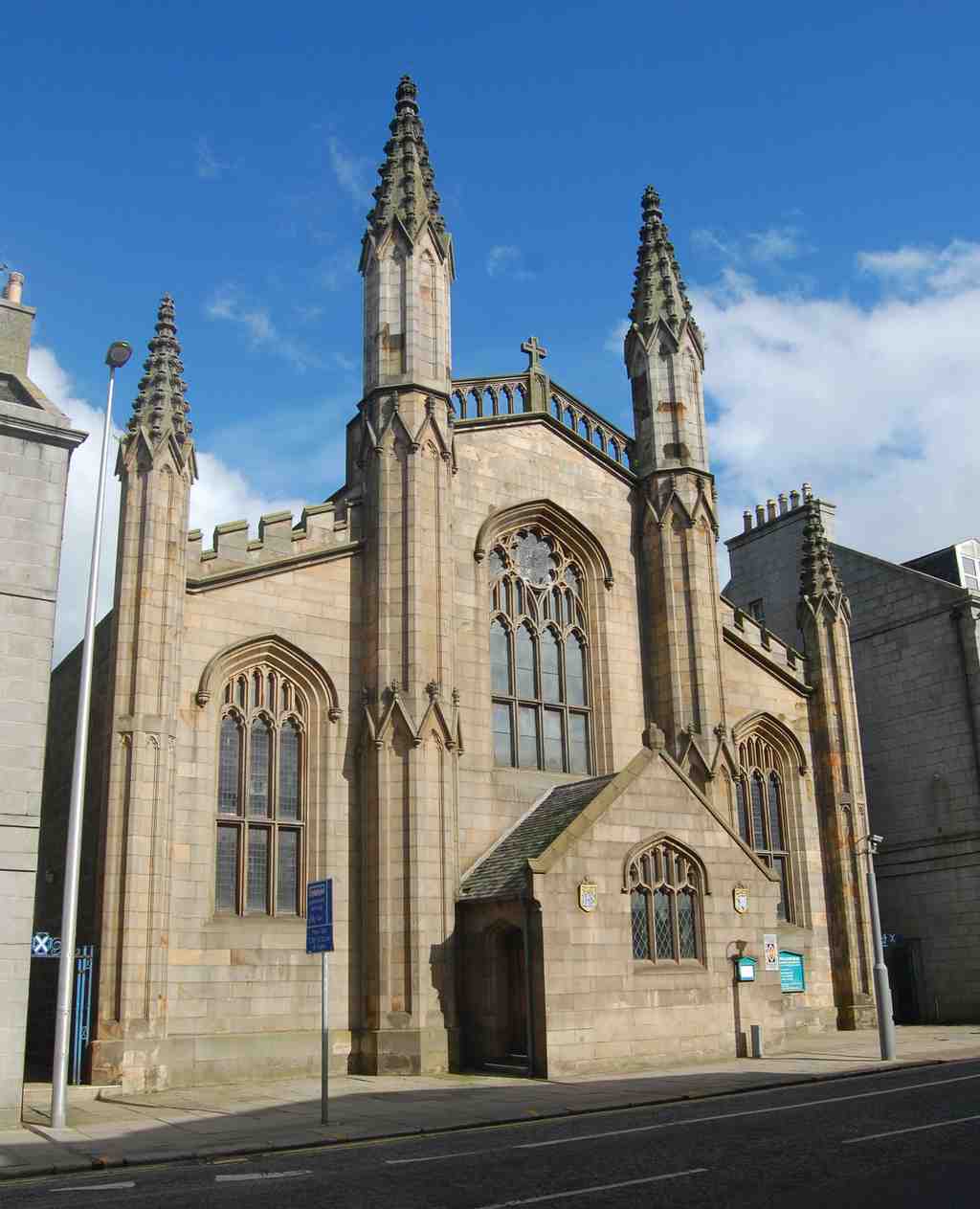
On your right, look for the pale stone church with tall, spiky corner pinnacles and three big pointed-arch windows stacked across the front.
This is St Andrew’s Cathedral, the Episcopal cathedral for Aberdeen and Orkney... and it’s got the kind of backstory that starts with politics and ends with architecture trying to keep a straight face. The Scottish Episcopal Church found itself in a rough spot after 1688, when King James VII was pushed out. Episcopalians were suspected of still backing him, and new laws basically told them: hand over your churches, and while you’re at it, don’t build new ones. Oh-and keep gatherings small. Nothing says “religious settlement” like making prayer meetings feel like a suspicious book club.
So for a long time, the congregation existed in a kind of semi-shadow. The first clear record we have is from 1716, when a priest named Andrew Jaffrey served the group-but where they actually met is anyone’s guess. Then in 1776, Bishop John Skinner got practical: he built a house in Long Acre and used an upstairs room as a chapel. Imagine climbing the stairs to worship, trying not to creak the floorboards too loud. After restrictions eased in 1792, they finally put up Saint Andrew’s Chapel next door, and worshipped there for about 25 years.
By 1817, confidence-and stone-had returned. The building you’re looking at opened that year, designed by Archibald Simpson in a perpendicular Gothic style: crisp vertical lines, pointed arches, and all the “reach for the heavens” energy you could want on a windy Aberdeen day. Most of it is local granite-Aberdeen’s signature stuff-but the front facing the street is sandstone, chosen because it was cheaper. Simpson wasn’t thrilled. Architects rarely are when budgets start talking.
The cathedral kept evolving: a chancel was added in 1880 by George Edmund Street, and a porch came in 1911 by Robert Lorimer. Then in the 1930s, renovations took a transatlantic turn-because Aberdeen played a quiet but vital role in American church history. In 1784, Samuel Seabury became the first bishop of what would become the Episcopal Church in the United States, consecrated here in Aberdeen-well, not here exactly, but in that earlier “upper room” chapel setup. Plans were made for a grand expansion funded by the American church... then the Wall Street crash hit, and the big dream shrank to something more realistic. Still, decorator Ninian Comper made sure it looked glorious: a vaulted ceiling with panels showing the coats of arms of the then 48 U.S. states alongside local families, plus a gold-painted canopy in the chancel that catches the light like it’s got something to prove.
And here’s a detail worth keeping in your pocket: in 1938, the U.S. ambassador Joseph Kennedy opened an extension-accompanied by his 21-year-old son, John. Yes, that Kennedy. History has a funny way of slipping through side doors.
Even recently, this place has had cliffhanger moments. Financial strain and building issues forced a temporary closure in 2020, right in the pandemic mess, but it reopened for worship in December 2021-still gathering on Sundays and Thursdays, still doing what it’s been doing for centuries: adapting.
When you’re set, Aberdeen’s Mercat Cross is a 2-minute walk heading south.




