
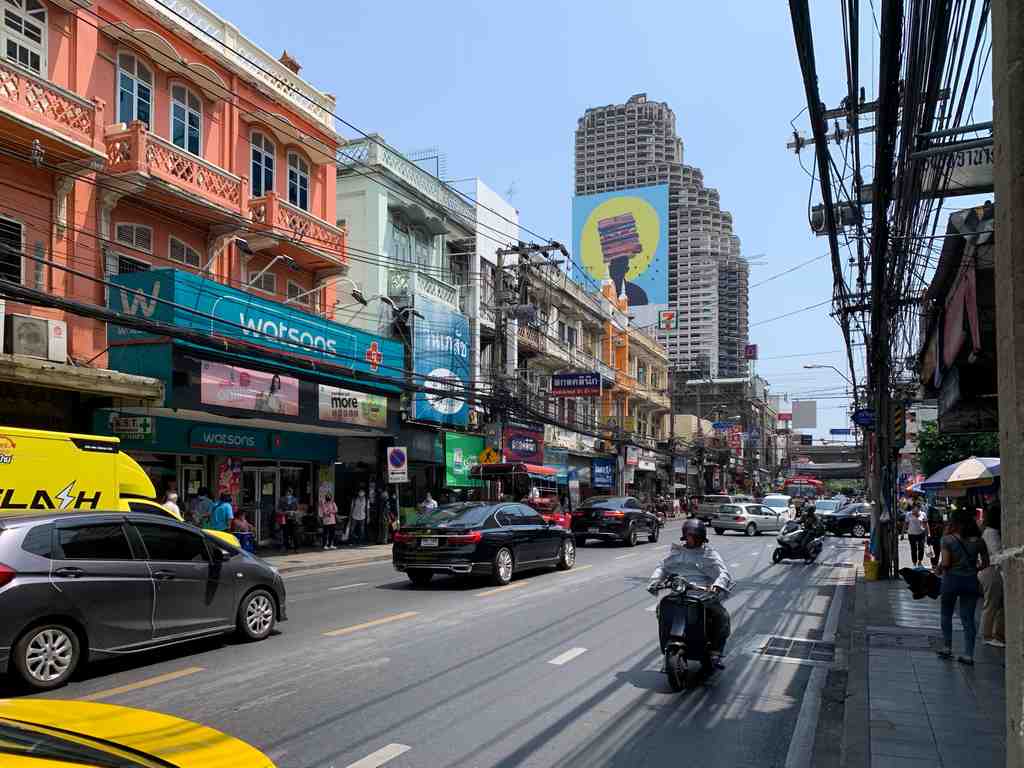
Look straight ahead for a lively street lined with colorful old shophouses, buzzing with cars and motorcycles, and framed by an eye-catching mural on a tall building in the distance-that’s Charoen Krung Road!
Alright, take a nice deep breath-do you smell the roasted chestnuts, the tang of exhaust, and maybe a hint of old paper from a used book shop? You’re standing at the edge of time on Charoen Krung Road, where Bangkok’s history and energy come together in one long, vibrant ribbon. Right now, you’re on what was once called the “New Road,” though after 160 years, it’s a bit like calling grandma’s sweater “the latest fashion.” Back in the early 1860s, the city was a watery maze-think more Venice, less gridlock. People zipped around by boat, and the streets were muddy, grassy lanes best navigated by jungle creatures or anyone with very waterproof shoes.
But then came the Europeans! Diplomatic consuls and traders with lovely carriages, fine hats, and an amazing ability to get sick from all the humidity and lack of fresh air. Imagine a line of foreigners, fanning themselves and coughing, petitioning King Mongkut-yes, just picture King Mongkut, the very same king you might know from 'The King and I'! The petition read something like, “Dear King, we love your city, but we’re all catching colds because there’s nowhere to ride our carriages!” The king, thoughtful and ever-modernizing, looked around at his muddy, tangled city streets and realized: maybe it was time to swap water taxis for the sweet sound of horseshoes clopping on pavement.
Charoen Krung was built with wide ambition, beautifully straight, and at first, people looked at it like, “Wow, this street is enormous-who’s going to walk all the way across?” For a time, only one side was really used. Locals called it "Thanon Mai”-New Road-until the king gave it the much grander name Charoen Krung, meaning “prosperous city.” Suddenly, this was the place to be seen, the lifeline stretching away from the old walled city, sweeping through Chinatown, cruising past consulates, theaters, and more noodle shops than anyone could count.
Feel the buzz of the present? That’s nothing compared to the excitement back when Bangkok opened its very first tram here in 1888-originally pulled by horses until the rails went electric. Generations of city dwellers would cling to the sides during the rush hour, bells dinging, ever so slightly behind schedule. The tram finally rattled its last journey in 1963, but a piece of one still waits for you at the far end of this road, resting in retirement like an old actor who refuses to leave the stage.
As you look around, the past peeks through-ornate colonial balconies, Chinese shophouses, and the ever-present jungle of overhead power cables, like lines on the city’s palm, telling its fortune. In the glory days of the 19th and early 20th centuries, this was the main artery of town, the spine along which embassies clustered and stories pulsed. Fancy a French connection? Soi Charoen Krung 36, nicknamed Rue de Brest, commemorates diplomatic ties with France. Portugal? Their embassy still hums with old tales nearby. The road bends and twists, linking a mosaic of cultures: mosques, cathedrals, markets, renowned hotels, mosques and eccentric local shops selling everything from herbal medicine to fortune-telling birds.
By the later 1900s, though, the real estate buzz swept elsewhere. Charoen Krung watched as Bangkok’s glitzy shopping centers grew up to the north and east, leaving its southern stretches to nap a bit as other districts grabbed the limelight. Some shops boarded up, but others held on stubbornly, giving this area a feeling of slightly faded grandeur-like an old movie star, still stylish, even if a bit outshone by flashier new arrivals.
Then, the city changed gears again! The underground Blue Line MRT rumbled in beneath your feet, opening shiny new stations, and suddenly, Charoen Krung had a taste of the future-a “Creative District” sprang up, with quirky cafes and art spaces alongside temples and steamed bun vendors. Of course, that brings new worries: will the vintage soul of this place get squeezed out by the rush of modernity? There’s a little mystery in the air: what will Charoen Krung look like in ten years? Twenty?
Today, all of that history is right here under your feet, threading together the old and the new, the grand and the ordinary. Hop onto Charoen Krung, and you’re not just walking a street; you’re time traveling through Bangkok’s growing pains, diplomatic dramas, and dreams of prosperity-one noodle shop, tram bell, and sidewalk tattoo artist at a time. Keep your eyes open, and you just might see the past waving to you from the next shopfront!




