
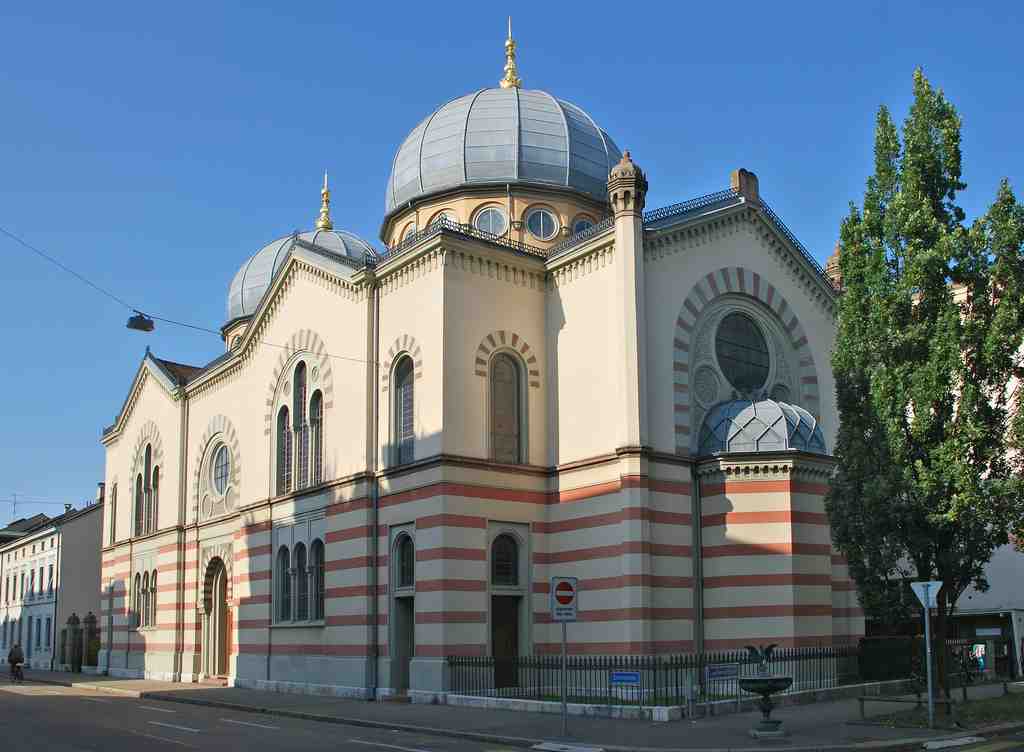
On your right is the Great Synagogue, an impressive building easily spotted by its pale stucco exterior, two massive round domes, and striking horizontal red stripes. We just left the lively halls of the Music Academy a few minutes ago, but the stories echoing through this space carry a much deeper, more complex weight.
The Jewish community in Basel has a history of incredible resilience, born from unimaginable tragedy. The very first Jewish community here was wiped out in 1349 in a horrific pogrom, which is an organized massacre of a specific ethnic or religious group. A panicked mob blamed the city's Jewish residents for poisoning the wells to cause the Black Death plague. The truly terrifying part is that the plague had not even reached Basel yet. The mob forced the community into a wooden hut on an island in the Rhine River and burned them alive. It took an astonishing six hundred and seventy-five years, until 2024, for the city to hold an official memorial for this dark chapter.
But the community eventually returned, and in the 1860s, they built the synagogue you see today. Architecturally, it has a wonderfully dramatic past. It originally had just one dome. The second one was added in 1892, giving it that iconic twin-tower look. Inside, the sanctuary was initially painted in a breathtaking Moorish style, a design inspired by the vibrant geometric patterns of Islamic architecture in North Africa and Spain. But in 1947, someone decided this was too old-fashioned. They painted over all those glorious colors with a flat, dull gray. Thankfully, a massive restoration in the 1980s painstakingly stripped away the gray paint to reveal the brilliant original colors underneath.
This city also played a massive role on the world stage. In 1897, Theodor Herzl hosted the First Zionist Congress here in Basel. Zionism was the political movement aiming to establish a Jewish homeland. Why did Herzl choose Basel? It was a string of happy accidents. Munich was the first choice, but local rabbis blocked it. Zurich was rejected because Herzl feared Russian spies would watch the delegates. Basel won because it had a beautiful concert hall and, most importantly, a solid kosher restaurant. Curiously, the leaders of this very synagogue were initially skeptical of the Congress and mostly ignored it.
Their first full-time rabbi, Arthur Cohn, did attend, though. He made Herzl publicly promise that the future Jewish state would respect religious traditions. The Cohn family legacy is astounding. During World War Two, Arthur's son Marcus used his quiet local law office to secretly save hundreds of Jewish refugees from deportation. And Marcus's son, another Arthur Cohn, took a totally different path, moving to Hollywood and becoming the first and only producer to win six Academy Awards.
If you are interested in community services, the administrative offices here are open on weekday mornings and briefly on Wednesday afternoons, though they are closed on weekends.
This magnificent building stands as a testament to a people who have survived the darkest storms and continue to shine brightly. Reflect on this incredible resilience, and whenever you feel ready, let us move on to the next stop.


