
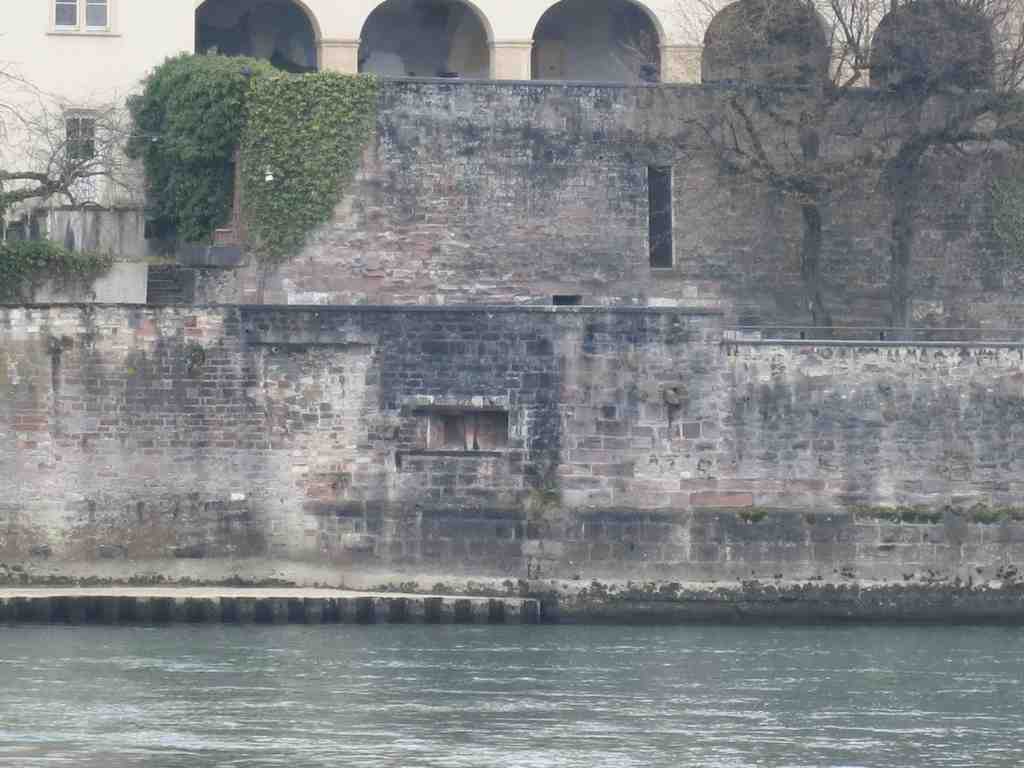
On your right, look closely at that imposing stone retaining wall right on the water, where you can spot a rectangular recessed bunker slit cut directly into the masonry beneath a terrace draped in dark ivy. Down here on the banks of the Rhine, we are standing face to face with a completely different kind of history. It is absolutely wild to think about what this wall represents.
That narrow opening in the rock is a World War Two infantry bunker, a physical relic of the Stadtkommando Basel, or the Basel City Command. Under the leadership of Colonel Hans De Bary, this special military unit was tasked with an incredibly daunting mission: defending this border city from a potential invasion.
Basel was in a highly precarious spot. Because it holds vital bridges over the river, it was a massive strategic prize. But here is the most intense part. Basel was actually situated ahead of the primary Swiss defense line. Military planners knew it was nearly impossible to hold the city indefinitely against a massive force. So, the grim strategy was to use Basel as a heavily fortified speed bump to delay the enemy. If an attack came, soldiers were ordered to fight house by house, street by street. Think about the sheer grit that would require.
In the lead up to the war, troops scrambled to build over five hundred barricades, anti-tank obstacles, and hidden positions across the city. They even rigged the very bridges crossing this river with explosives, fully prepared to blow them sky-high to halt an advancing army. Can you imagine the anxiety of living here? Walking over a bridge to get to work, knowing the pillars below were packed with dynamite?
The tension reached a boiling point in May of 1940. Swiss military intelligence intercepted reports of massive German troop movements just across the border, and the City Command triggered its absolute highest level of alarm. A wave of sheer panic swept through the streets. The train station was completely overrun, and up to thirty thousand people fled the city for the safety of the Swiss interior.
Though that specific attack never came, the reality of the war forced a strategic shift. By late June, the Swiss army withdrew the bulk of its forces into the Reduit, which was a massive system of heavily fortified mountain bunkers deep in the Alps. Because of this retreat, Basel was declared an open city, an international military term meaning the army officially abandoned defensive efforts there to save the civilian population and infrastructure from being completely annihilated by bombardment.
The water flows quietly past these stones, but these fortifications stand as silent witnesses to a time when twelve thousand troops guarded these banks, waiting for a war that was practically on their doorstep. If you are curious about the area's modern administrative offices, they operate Monday through Friday from eight in the morning to noon, and twelve thirty to five in the afternoon, but are closed on weekends. Look out over the water, and then let us walk those few short steps to the Middle Bridge.


