
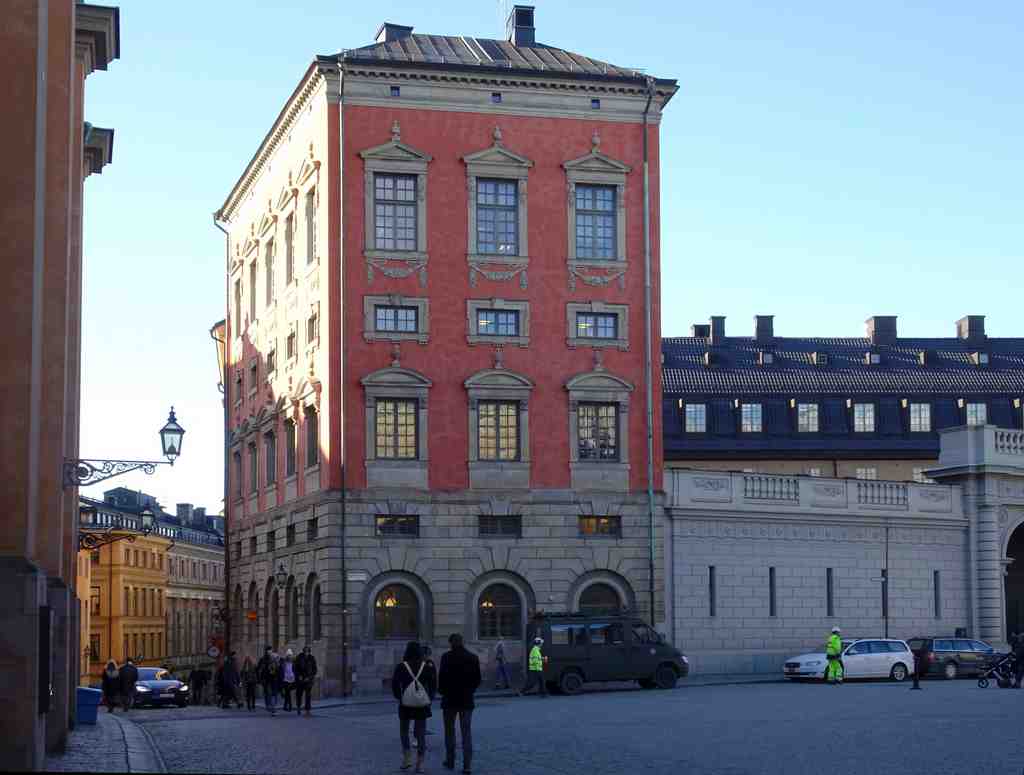
To spot Axis Oxenstierna's Palace, look for the tall, striking building with a reddish facade and distinctive stone trim just ahead, standing proudly at the end of the street and contrasting sharply with its lighter neighbors.
Now, take a moment to imagine Stockholm in the mid-1600s: the cobblestones crunch beneath the boots of old city guards as the city’s most ambitious people pass by. Rising before you, with its richly-colored walls, intricate sand-colored stonework around the windows, and towering five stories, stands Axis Oxenstierna’s Palace-a true masterpiece from the age when Sweden was shaping its empire.
Designed by Jean de la Vallée, this palace was meant to be just one grand wing of an even larger estate, rivaling any noble home in Europe. Its creator, Chancellor Axel Oxenstierna, wanted a residence that would signal his power right next to the royal Tre Kronor Castle. Imagine the excitement of the first stones being set in 1653, the air filled with the shouts of builders, the scrape of chisels shaping the rough sandstone-that same red hue you see before you.
But fate intervened: Oxenstierna died just a year after construction began, and his son followed only two years later. The family never moved in. Instead of a bustling noble household, the finished part of the palace stood quiet and unfinished-a monument to both ambition and loss.
Yet, this palace’s story was only beginning. In the late 1600s, the newly-formed Riksens ständers bank, which would one day become Riksbanken, filled its rooms with the world of finance. Just imagine inside, the clink of coins and murmur of important discussions echoing down corridors lined with 17th-century doors and ornate hinges.
Over the centuries, many Swedish government institutions would come and go, each leaving their trace on the palace. The building’s location, right by the royal castle, gave it an air of prestige and ensured the state always took good care of it-so much so that even today, most of the original details remain, from the window frames to the reddish walls. The palace stands as one of the best examples of early Roman Mannerism in Stockholm, its style deliberately imposing and full of clever tricks: for example, look at the windows facing Storkyrkobrinken. The land here isn’t straight, but the architect angled the windows and doorways slightly, fooling your eye and making the palace seem perfectly aligned, a visual illusion in stone.
The palace even got a facelift in 2013, bringing its colors back to their 1600s glory. And while it was always meant to be much bigger, there’s something magical about its preserved state-a building with five grand stories at a time when most houses only had two or three, with richly decorated stonework and an air of promise frozen in time.
So, as you stand in its shadow, imagine what might have been, and listen to the quiet heartbeat of Swedish history whispering from its ancient walls.
Interested in knowing more about the history, architecture or the façade renovation




